
Why Testing Method Matters
Body weight alone tells you how much you weigh - it does not tell you what you are made of. Two people with identical weights can have dramatically different ratios of muscle, fat, bone, and water. Body composition testing attempts to quantify those ratios so that health decisions can be grounded in something more meaningful than a single number.
No single method is perfect. Each involves trade-offs among accuracy, cost, accessibility, and practicality. Understanding what each test actually measures - and where it can mislead - helps you interpret results in proper context. See our guide to reading body composition results for help interpreting numbers once you have them.
| Gold-standard clinical method | DEXA (Dual-Energy X-Ray Absorptiometry) |
| Most accessible field method | Skinfold calipers or BIA scale |
| Key variable affecting BIA accuracy | Hydration status |
| Methods requiring lab or clinic access | DEXA, Bod Pod, hydrostatic weighing |
| Cardiometabolic risk proxy | Waist circumference and waist-to-hip ratio (Supported by extensive epidemiological literature) |
| Primary accuracy driver for calipers | Technician training and consistency |
Common Testing Methods at a Glance
Below is a reference-style breakdown of the most widely used body composition assessment methods, organized from lab-grade to field-based approaches.
DEXA (Dual-Energy X-Ray Absorptiometry)
DEXA uses two low-dose X-ray beams to distinguish bone mineral density, lean tissue, and fat mass. It is widely considered a clinical gold standard for body composition research. Results are highly reproducible and can identify regional fat distribution (e.g., visceral vs. subcutaneous). Requires specialized equipment, typically found in medical or research settings, and involves minimal radiation exposure comparable to a transatlantic flight.
Hydrostatic (Underwater) Weighing
Based on Archimedes' principle, this method estimates body density by comparing weight on land to weight submerged in water. Fat tissue is less dense than lean tissue, so the difference allows calculation of fat mass. Once the research benchmark, it has largely been supplanted by DEXA in clinical settings. Requires full submersion and controlled breath exhalation, which some individuals find uncomfortable.
Air Displacement Plethysmography (Bod Pod)
Similar in principle to hydrostatic weighing but uses air displacement rather than water. The subject sits inside a sealed chamber, and pressure changes calculate body volume and density. Results correlate well with DEXA and are more comfortable for most users. Equipment is expensive and not widely available outside university or sports performance labs.
Skinfold Calipers
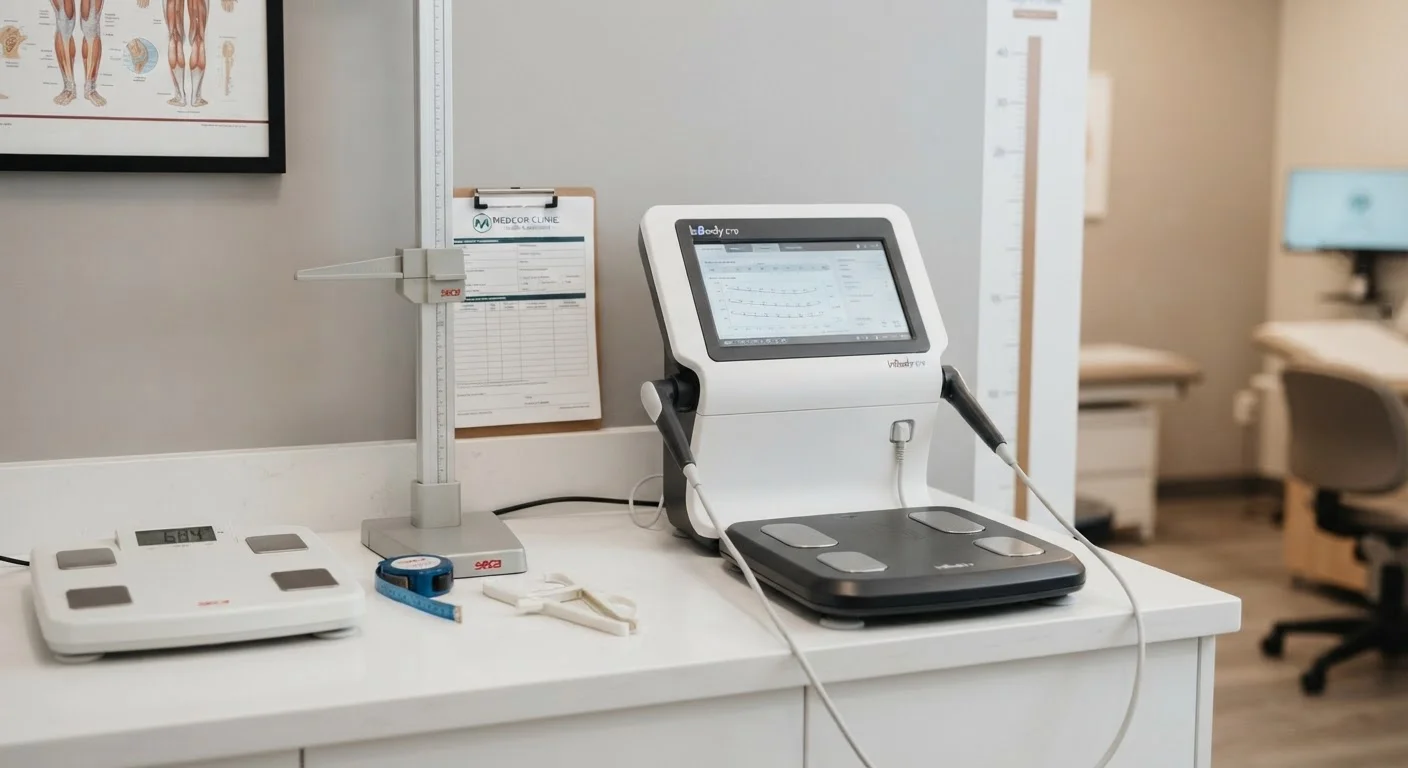
A trained technician pinches and measures subcutaneous fat at several standardized body sites. These measurements are entered into population-derived equations to estimate total body fat percentage. Accuracy depends heavily on technician skill and which equation is applied. Inexpensive and portable, making them common in fitness and athletic settings. Populations that differ significantly from the equation's reference group may see larger estimation errors.
Bioelectrical Impedance Analysis (BIA)
A low-level electrical current is passed through the body. Fat tissue resists the current more than lean tissue, and resistance measurements feed into equations estimating fat and lean mass. Consumer-grade BIA scales and hand-held devices vary considerably in accuracy. Clinical-grade multi-frequency BIA units perform better. Hydration status meaningfully affects readings - illness, recent exercise, or alcohol consumption can skew results.
Waist Circumference and Waist-to-Hip Ratio
Simple tape-measure assessments that serve as proxies for abdominal adiposity. While not direct body composition tests, these anthropometric measures have well-documented associations with cardiometabolic risk and are accessible without any equipment beyond a tape measure. For a deeper comparison of these metrics alongside BMI and body fat percentage, see what each metric actually measures.
Choosing the Right Method for Your Context
There is no universally superior method - the right choice depends on your goal, budget, and access. Research-grade accuracy calls for DEXA or Bod Pod, but for tracking trends over time in a non-clinical setting, consistent use of the same BIA device or caliper protocol can still reveal meaningful change. What matters most is consistency: comparing results across different methods or different conditions introduces noise that obscures real change.
Clinicians, coaches, and researchers may use different methods for different purposes. Always discuss interpretation with a qualified healthcare or fitness professional, particularly if results will inform medical or nutritional decisions.
This article is for general informational purposes only and does not constitute medical advice. Consult a qualified healthcare professional before making health decisions based on body composition data.