
Why Body Composition Metrics Matter Beyond the Scale
Weight alone tells you remarkably little about your health. Two people can weigh exactly the same and carry vastly different amounts of muscle, fat, and bone - with very different metabolic profiles to match. That's why clinicians, researchers, and fitness professionals rely on body composition metrics to go deeper. As explored in our body composition explainer, the ratio of fat to lean tissue is far more informative than a number on a scale.
The three most widely used metrics - Body Mass Index (BMI), body fat percentage, and waist-to-hip ratio (WHR) - each measure something meaningfully different. Understanding what each captures, and where it falls short, helps you interpret health information more accurately and have more informed conversations with your care team.
This article provides general health education only and is not a substitute for personalized medical advice. Always consult a qualified healthcare professional regarding your individual health status.
BMI: A Broad Screening Tool With Real Limitations
Body Mass Index is calculated by dividing weight in kilograms by height in meters squared (kg/m²). It was designed as a population-level statistical tool in the 19th century and was later adopted by public health systems as a proxy for body fatness. Standard adult categories - underweight, normal weight, overweight, and obese - are defined by fixed numerical thresholds.
BMI's main strengths are its simplicity and consistency: it requires no equipment beyond a scale and a tape measure, making it useful for large-scale screening and research. However, it has well-documented blind spots. BMI cannot distinguish between fat mass and muscle mass, so a muscular athlete may be classified as "overweight" while someone with low muscle and high fat may appear in the "normal" range - a phenomenon sometimes called normal-weight obesity. BMI also applies the same thresholds across all demographic groups, despite research suggesting that cardiometabolic risk patterns differ by age, sex, and ethnic background. For a plain-language breakdown of how BMI and related terms fit into broader weight health conversations, see our weight management terms guide.
| BMI | Body Fat Percentage | Waist-to-Hip Ratio | |
|---|---|---|---|
| What it measures | Weight relative to height | Proportion of mass that is fat | Fat distribution pattern |
| Equipment needed | Scale and height measurement | Varies: calipers to DEXA scanner | Flexible tape measure |
| Accuracy | Consistent but indirect | High (with advanced methods) | Moderate; technique-dependent |
| Detects visceral fat risk | No | Partially (with full-body methods) | Yes - primary strength |
| Distinguishes muscle from fat | No | Yes | No |
| Best use case | Population screening | Tracking composition changes | Metabolic risk assessment |
| Main limitation | Ignores tissue quality | Accuracy varies by method | Doesn't capture total fat volume |
Body Fat Percentage: More Direct, But Method-Dependent
Body fat percentage expresses what proportion of total body mass is fat tissue - including both essential fat (needed for hormonal and neurological function) and storage fat. Unlike BMI, it directly reflects body composition rather than inferring it from weight and height.
Measuring body fat percentage accurately, however, is more complex. Methods range from skinfold calipers and bioelectrical impedance analysis (BIA) - which are widely accessible but subject to hydration and operator error - to more precise techniques like DEXA scanning and hydrostatic (underwater) weighing. Our body composition testing methods guide covers these approaches in detail. For a head-to-head look at two of the most common clinical tools, see our DEXA vs. BIA comparison.
Body fat percentage is particularly useful for tracking changes over time - for example, monitoring whether a fitness program is shifting someone's composition toward more lean mass. It's also closely tied to lean body mass, which includes everything that isn't fat: muscle, bone, organs, and water.
Waist-to-Hip Ratio: A Window Into Metabolic Risk
Waist-to-hip ratio (WHR) is calculated by dividing waist circumference by hip circumference. It reflects where fat is distributed on the body - specifically the balance between visceral fat (stored around internal abdominal organs) and subcutaneous fat (stored just beneath the skin around the hips and thighs).
This distribution distinction matters clinically. Visceral fat is metabolically active in ways that increase risk for type 2 diabetes, cardiovascular disease, and certain inflammatory conditions. Research consistently shows WHR predicts cardiometabolic risk independently of total body weight or BMI. The World Health Organization considers a WHR above 0.90 for men and 0.85 for women to be associated with substantially elevated metabolic risk - though these thresholds are population-level benchmarks, not personal diagnostic criteria.
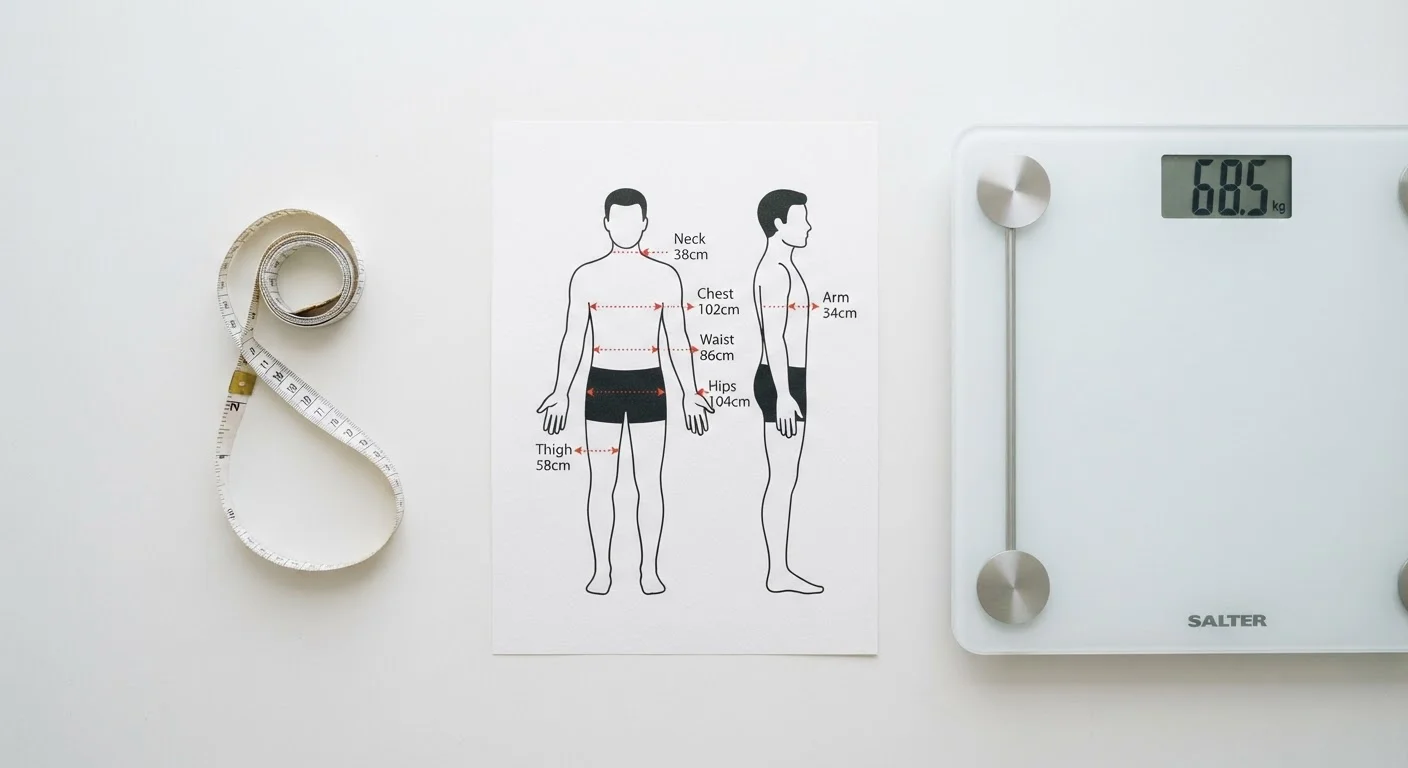
WHR is simple to measure at home with a flexible tape measure, though accuracy depends on consistent technique. It cannot tell you how much total fat you carry - only where it's concentrated.
Using These Metrics Together for a Clearer Picture
Each metric covers different ground, which means each also leaves different gaps. BMI misses tissue quality. Body fat percentage misses fat location. WHR misses total fat burden. When interpreted together - ideally alongside clinical markers like blood pressure, lipid panels (see our cholesterol testing explainer), and fasting glucose - these metrics become substantially more informative than any single number.
If you've recently received body composition results and are trying to make sense of them, our guide on reading body composition results without jumping to conclusions offers useful context. And for a broader look at how metabolism connects to body composition, the metabolism basics hub is a good next step.
The goal of understanding these metrics isn't to chase an ideal number - it's to build a more accurate map of where your body is today so that, with your care team, you can make informed decisions about where you want it to go.
This article is for informational purposes only and is not medical advice. Speak with a qualified healthcare provider for guidance specific to your health situation.