
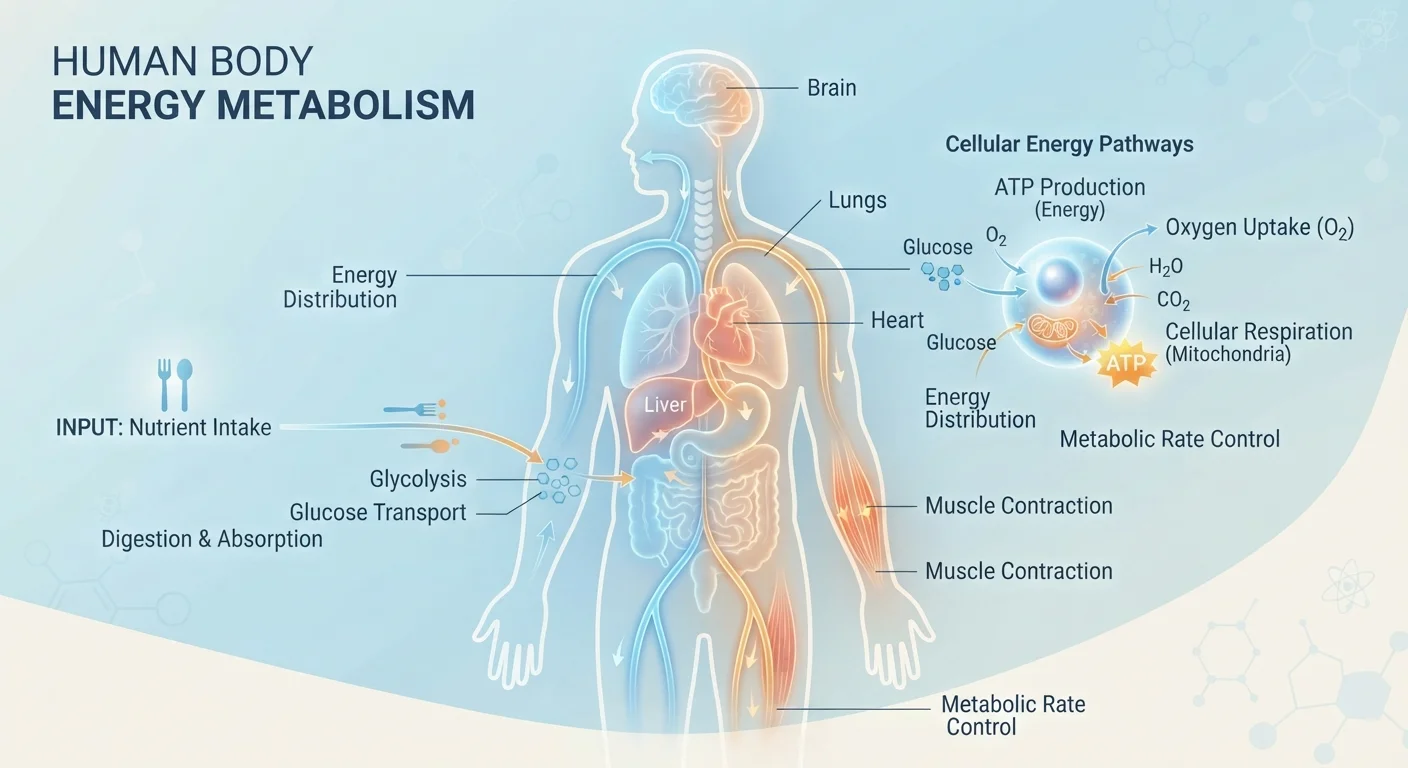
Why These Terms Matter
If you've spent any time reading about nutrition, weight management, or fitness, you've almost certainly encountered the abbreviations BMR, RMR, and TDEE. They're used interchangeably in many popular sources - but they mean different things, and the distinctions are worth understanding.
This reference article defines each term precisely, explains how they relate to one another, and flags where common misconceptions tend to creep in. For a broader look at what metabolism actually is and isn't, see our plain-language metabolism explainer.
| RMR as share of TDEE | Approximately 60-75% for sedentary individuals (General physiological estimate; varies by individual) |
| Thermic effect of food (TEF) | Roughly 10% of total daily energy expenditure (Commonly cited range in nutrition science literature) |
| BMR vs. RMR difference | RMR is typically 10-20% higher than strict BMR (Reflects less controlled measurement conditions) |
| Primary driver of RMR differences | Lean muscle mass (fat-free mass) (Well-established in exercise physiology research) |
| Most common estimation equations | Mifflin-St Jeor and Harris-Benedict (Widely used in nutrition and clinical settings) |
BMR, RMR, and TDEE - Core Definitions
The three terms describe energy expenditure at different levels of activity and measurement precision.
Basal Metabolic Rate (BMR)
BMR is the minimum amount of energy your body requires to sustain vital functions - breathing, circulation, cellular repair, temperature regulation - while at complete rest, in a fasted state, in a thermoneutral environment. It's measured under strict laboratory conditions that are rarely replicated in everyday life, which is why BMR figures are primarily a research benchmark rather than a practical daily number.
Resting Metabolic Rate (RMR)
RMR is a closely related but less rigidly defined measure. It captures energy expenditure at rest without the strict fasting and environmental controls required for true BMR measurement. In practice, RMR tends to run slightly higher than BMR (often 10-20% higher) because it may include minor digestive activity and less controlled conditions. Most equations used in nutrition software and health apps are actually estimating RMR, even when labeled as BMR - a common source of confusion.
Total Daily Energy Expenditure (TDEE)
TDEE is the total number of calories your body uses over a full day, encompassing everything: your resting metabolic processes, physical activity (both structured exercise and incidental movement), and the energy spent digesting food - known as the thermic effect of food. TDEE is the number most relevant to practical energy balance decisions. It's typically estimated by multiplying an RMR figure by an activity multiplier, which is why accuracy depends heavily on how honestly activity levels are assessed. To understand how movement throughout the day contributes to TDEE, the everyday movement terms reference is a useful companion resource.
Basal Metabolic Rate (BMR)
The minimum energy your body needs to maintain vital functions at complete rest, measured under strict laboratory conditions including fasting and temperature control. It represents the floor of your daily energy expenditure.
Resting Metabolic Rate (RMR)
Energy expenditure at rest, measured under less stringent conditions than BMR. RMR is the figure most health and nutrition tools actually calculate, and it tends to be slightly higher than true BMR.
Total Daily Energy Expenditure (TDEE)
The total calories your body burns in a day, including resting metabolism, all physical activity, and the energy used to digest food. TDEE is the most practically relevant figure for understanding energy balance.
Thermic Effect of Food (TEF)
The energy your body expends to digest, absorb, and process the nutrients in food. TEF typically accounts for roughly 10% of total daily energy expenditure, though it varies by macronutrient composition.
Metabolic Adaptation
The body's tendency to adjust its energy expenditure in response to sustained changes in caloric intake or body weight. Adaptation can make continued weight loss more challenging over time.
Activity Multiplier
A numerical factor applied to RMR to estimate TDEE based on a person's average daily activity level. Higher activity levels produce larger multipliers and therefore higher estimated TDEE values.
What Shapes These Numbers
None of these values are fixed. Several well-documented factors influence metabolic rate, and understanding them helps dispel the myth that metabolism is purely genetic or immutable.
- Body composition: Lean muscle mass is metabolically more active than fat tissue, so individuals with greater muscle mass generally have higher RMR values, even at the same body weight.
- Age: RMR tends to decline gradually with age, partly due to shifts in body composition and hormonal changes, though research suggests the decline is more modest than popular belief implies - particularly before the sixth decade of life.
- Sex and hormones: Biological sex influences metabolic rate primarily through differences in average muscle mass and hormonal profiles, not through any fundamental metabolic disadvantage.
- Weight history and adaptation: The body adjusts energy expenditure in response to prolonged caloric restriction or significant weight change - a process called metabolic adaptation. This is one reason weight management becomes more complex over time. Learn more in our article on metabolic adaptation and long-term health.
For a foundational look at how your body converts food into usable energy, Metabolism From Scratch provides a clear, jargon-light walkthrough.
This article is for informational purposes only and is not medical advice. Consult a qualified healthcare professional before making changes to your diet, exercise routine, or any health-related plan.