
What Metabolism Actually Means
The word metabolism gets used constantly - in ads, on nutrition labels, in casual conversation - but it's rarely explained accurately. Metabolism isn't a gear you shift into, a furnace you stoke, or a personal trait that dooms some people to weight gain. It is, quite simply, the complete set of chemical reactions that occur in your body to sustain life.
Every time a cell produces energy, builds a protein, repairs damage, or disposes of a waste product, that's metabolism at work. It encompasses two complementary processes: catabolism (breaking larger molecules down to release energy) and anabolism (building larger molecules using energy). Together, they keep every organ, tissue, and system running continuously - whether you're sleeping or sprinting.
For a deeper look at what metabolism does - and doesn't - explain about weight, see what metabolism actually is.
Metabolism
The complete set of chemical reactions in your body that convert food into energy and support all biological functions, from breathing to cell repair.
Catabolism
The breakdown of larger molecules (like carbohydrates and fats) into smaller ones, releasing energy in the process.
Anabolism
The building of larger molecules (like proteins and tissues) from smaller ones, which requires energy input.
ATP (Adenosine Triphosphate)
The energy currency of the cell - a molecule that stores and delivers the chemical energy cells need to do any kind of work.
Basal Metabolic Rate (BMR)
The number of calories your body needs to maintain basic life functions at complete rest, typically accounting for 60-70% of daily energy use.
Thermic Effect of Food (TEF)
The energy your body expends to digest, absorb, and process the food you eat - usually around 10% of total daily energy expenditure.
How Food Becomes Fuel
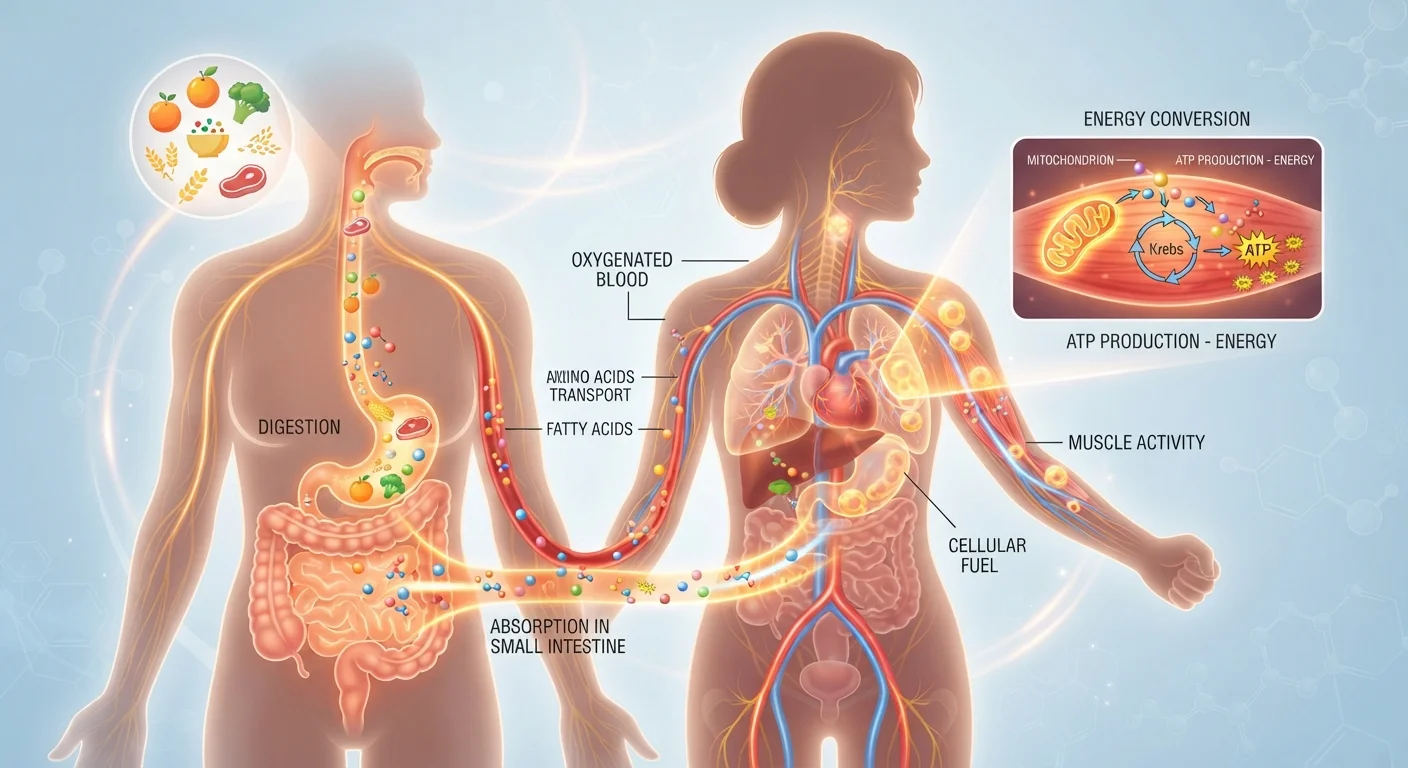
When you eat, your digestive system gets to work dismantling food into its component parts. Macronutrients - carbohydrates, proteins, and fats - are the three main categories, and each follows its own metabolic pathway before being used by cells.
- Carbohydrates are broken down into glucose, which enters the bloodstream and is taken up by cells. Glucose is the body's preferred quick-access fuel, especially for the brain and during intense physical activity.
- Fats are broken into fatty acids and glycerol. Fatty acids are a dense energy source and serve as the primary fuel during rest and lower-intensity activity.
- Proteins are disassembled into amino acids, which are primarily used for building and repairing tissue. In situations where carbohydrate and fat availability is limited, amino acids can also be converted into usable energy.
Inside each cell, a process called cellular respiration converts these molecules - most centrally glucose - into ATP (adenosine triphosphate), the actual energy currency cells use to do work. No ATP, no function. This conversion happens largely in the mitochondria, the organelles often described as the cell's power plants.
The Three Ways Your Body Burns Energy
Your total daily energy expenditure isn't one number - it's the sum of three distinct components:
- Basal Metabolic Rate (BMR): The energy your body needs simply to exist - to keep your heart beating, lungs breathing, and cells maintaining themselves while you're at complete rest. BMR typically accounts for 60-70% of total daily calorie use, making it the dominant factor in your overall energy equation.
- Thermic Effect of Food (TEF): Digesting, absorbing, and processing food costs energy. Protein requires the most metabolic effort to process (roughly 20-30% of its calories), while fat requires the least (around 0-3%). On average, TEF contributes about 10% of total daily energy expenditure.
- Activity Energy Expenditure: This covers everything from structured exercise to incidental movement - walking to your car, fidgeting, climbing stairs. This component is the most variable and the one you have the most direct influence over day to day.
Understanding these three components helps explain why changes to diet and exercise affect people differently. Someone with a naturally higher BMR simply burns more calories at rest, independent of any lifestyle choices.
What Actually Influences Your Metabolism
Several factors shape your metabolic rate, some modifiable and some not:
- Body composition: Muscle tissue is more metabolically active than fat tissue. People with greater lean muscle mass tend to have higher BMRs. This is one reason understanding your body composition goes hand-in-hand with understanding your metabolism.
- Age: Metabolic rate tends to decline with age, largely due to changes in muscle mass and hormonal shifts rather than aging itself in isolation.
- Biological sex: Males generally have higher BMRs than females, primarily because of differences in average muscle mass and body size.
- Genetics: Hereditary factors influence enzyme efficiency and hormonal regulation in ways that can meaningfully affect individual metabolic rates.
- Thyroid function: The thyroid gland produces hormones that directly regulate the pace of metabolic reactions throughout the body. Both overactive and underactive thyroid conditions can cause significant metabolic changes.
- Sleep: Chronic poor sleep disrupts hormones that regulate appetite and energy use, with downstream effects on metabolism.
Resistance Training Supports Metabolic Rate
Building and maintaining muscle mass through resistance training is one of the most evidence-supported strategies for sustaining a healthy metabolic rate over time. Even two sessions per week can make a meaningful difference in your ratio of metabolically active tissue. This is especially relevant as muscle mass naturally tends to decline with age.
If you want to map out what you already understand about your own metabolic health, the metabolism literacy checklist is a useful next step.
Common Myths Worth Dropping
Metabolism is one of the most myth-saturated topics in health and wellness. A few ideas worth reconsidering:
- "Eating small meals frequently boosts metabolism."
- This is not well-supported by evidence. Total energy intake over time matters far more than how often you eat. Meal frequency affects appetite and convenience, not metabolic rate in any meaningful way.
- "Certain foods have fat-burning properties."
- Foods like green tea, cayenne pepper, and grapefruit are frequently marketed as metabolism boosters. While some compounds in these foods have minor, short-lived effects on energy expenditure, the magnitude is too small to meaningfully affect body weight or composition.
- "A slow metabolism is why most people gain weight."
- Research consistently shows that people with obesity often have equal or higher absolute metabolic rates than leaner individuals, because a larger body requires more energy to maintain. The relationship between metabolism and weight is complex and multidirectional.
For a more thorough tour of these misconceptions, see metabolism misconceptions that lead people astray. And if you're also exploring how fat, muscle, and weight relate to one another, the body composition hub is a natural companion resource.
This article is for general informational and educational purposes only and does not constitute medical advice. For questions about your individual metabolic health or any health condition, please consult a qualified healthcare professional.