
What Actually Happens When You Digest a Meal
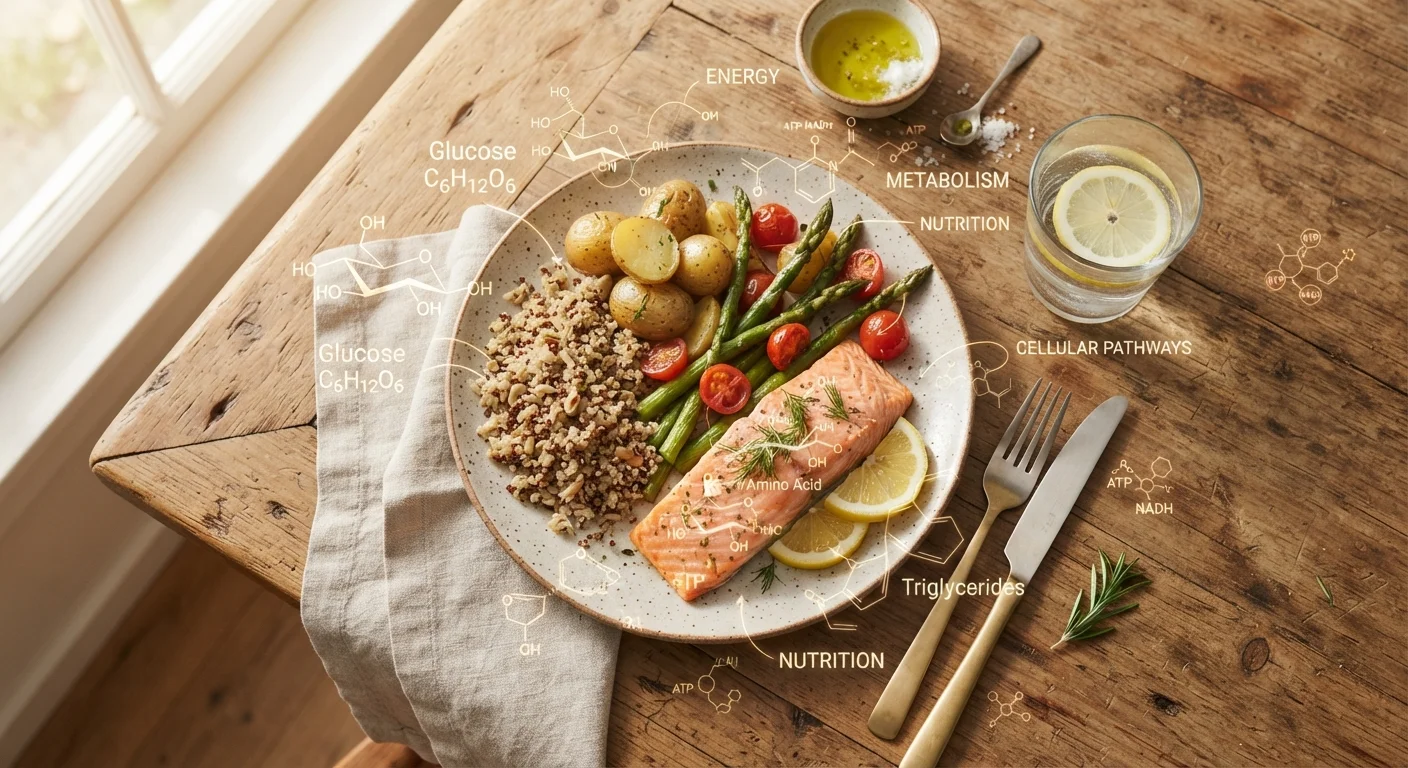
Every time you eat, your body launches a complex series of biochemical processes: enzymes are secreted, stomach acid is produced, nutrients are transported across intestinal walls, and liver cells work to package what's been absorbed. All of this requires adenosine triphosphate (ATP) - the body's energy currency. The cumulative caloric cost of these processes is what scientists call the thermic effect of food.
TEF kicks in within about 30 minutes of eating and can persist for several hours depending on meal size and composition. It is measured by tracking how much oxygen you consume above your resting baseline in the hours following a meal - a technique called indirect calorimetry. On a typical mixed diet, this metabolic overhead totals around 10% of caloric intake, making it the third-largest component of energy expenditure after resting metabolic rate and physical activity.
Understanding TEF is part of a broader picture of what drives energy burn. See our overview of what genuinely influences metabolic rate for the full context.
Why Macronutrients Are Not Created Equal
The single biggest driver of TEF is the macronutrient composition of your meal. Protein is by far the most metabolically expensive to process. The body must break protein into amino acids, transport them, and either incorporate them into tissues or convert them to usable energy - a process requiring substantial enzymatic work. This results in a thermic cost of 20-30% of protein's caloric value.
Carbohydrates sit in the middle range at roughly 5-10%, reflecting the energy needed for glycogen synthesis and glucose transport. Dietary fat has the lowest thermic effect - 0-3% - because it is chemically similar to the fat the body stores and requires minimal conversion. This is why a 500-calorie protein-rich meal effectively delivers fewer net calories to the body than a 500-calorie fat-rich meal of the same total.
~10%
Of daily calories burned through digestion
Research consistently estimates TEF accounts for approximately 10% of total daily energy expenditure on a mixed macronutrient diet.
20-30%
Thermic cost of protein calories
Protein's high thermic effect - established across multiple metabolic studies - reflects the energy-intensive process of amino acid metabolism.
2x
More calories burned digesting whole vs. processed food
A study in Food & Nutrition Research found participants expended roughly twice the post-meal energy after a whole-food meal versus a processed-food meal matched for macronutrients.
This macronutrient difference is one reason higher-protein diets are associated with modest advantages in satiety and energy balance, though the absolute magnitude is smaller than popular nutrition culture often implies. For a deeper dive into how food quality interacts with energy balance, our piece on calorie deficit versus calorie quality examines both sides of that equation.
Whole Foods vs. Processed Foods: A Meaningful Difference
A landmark study published in Food & Nutrition Research tested the same macronutrient profiles using whole foods versus ultra-processed equivalents. Participants burned roughly twice as many post-meal calories after the whole-food meal. The researchers attributed this largely to the food matrix - the physical structure of intact grains, legumes, and proteins that requires more mechanical and enzymatic work to break down.
This has practical implications. Two meals that look identical on a nutrition label may not be metabolically identical. The fiber content, structural complexity, and degree of pre-processing all appear to modulate how much energy the body expends during digestion. None of this suggests processed foods are automatically harmful, but it does add nuance to the idea that calories in isolation tell the whole story.
What TEF Cannot Do: Separating Fact from Hype
Because TEF is a real phenomenon, it has attracted exaggerated claims - particularly around meal timing and eating frequency. A common belief holds that eating six small meals per day "keeps metabolism elevated" through repeated TEF spikes. Research does not support this. Total daily TEF tracks total caloric intake and composition, not the number of eating occasions. Spreading the same food over more meals does not meaningfully increase energy expenditure.
Similarly, claims that specific "fat-burning" foods - celery, grapefruit, green tea - dramatically amplify TEF are not supported by robust clinical evidence. Some compounds like caffeine and capsaicin show small, short-lived thermogenic effects in controlled settings, but these effects are not large enough to produce meaningful changes in body weight on their own.
TEF is best understood as one genuine but modest contributor to total energy expenditure - alongside resting metabolic rate, physical activity, and non-exercise activity thermogenesis (NEAT). It complements, rather than replaces, the fundamentals. Our article on muscle mass and metabolism explores another frequently misunderstood component of energy burn.
This article is for general informational and educational purposes only. It is not a substitute for personalized medical or dietary advice. Please consult a qualified healthcare provider or registered dietitian for guidance specific to your health needs.