
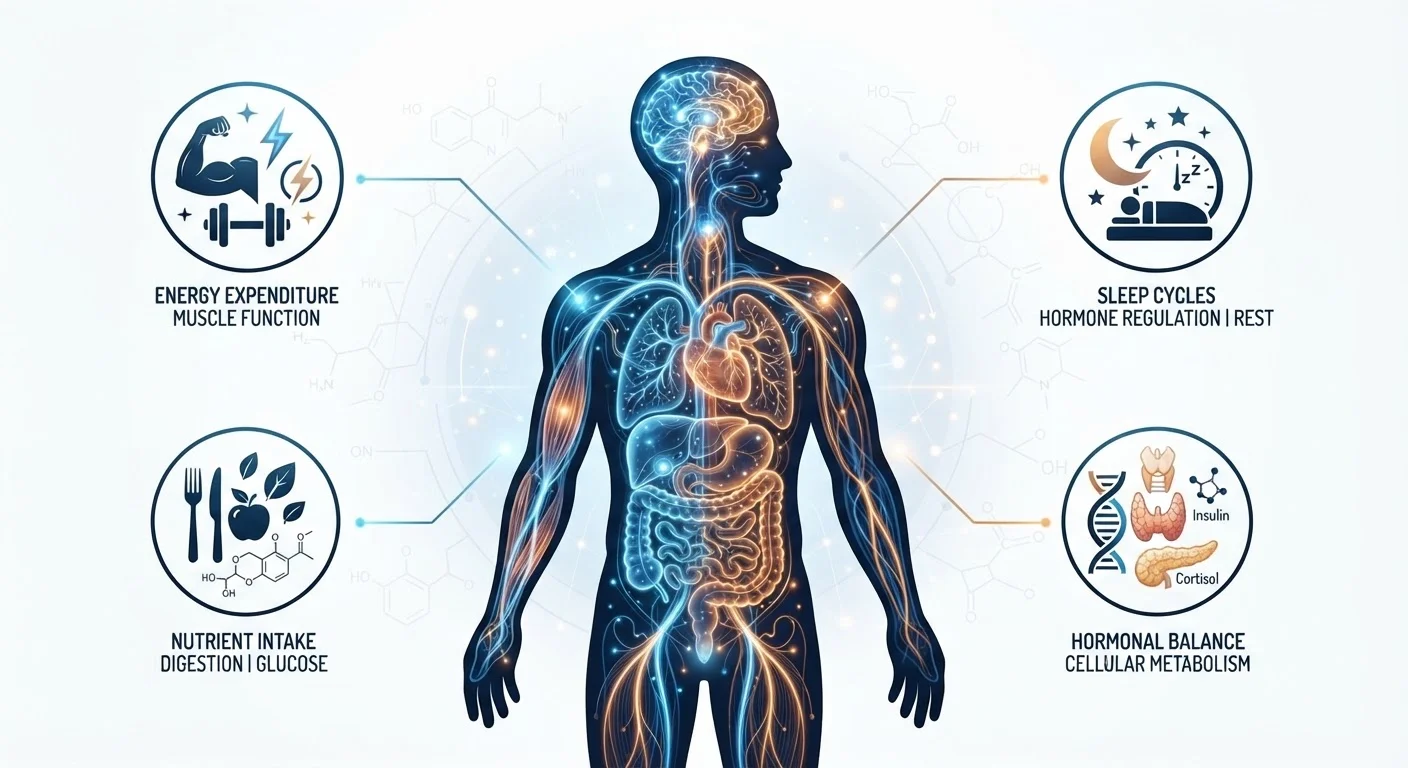
What Metabolism Actually Means
The word metabolism gets used loosely - often as a catch-all explanation for why weight gain or loss feels easier for some people than others. In precise terms, metabolism refers to all the chemical processes your body uses to convert food into energy. Your resting metabolic rate (RMR) - the calories your body burns at rest to keep organs functioning - accounts for roughly 60-70% of total daily energy expenditure for most people. The rest comes from physical activity and the energy used to digest food (the thermic effect of food).
Popular culture tends to frame metabolism as either fast or slow, fixed by fate. The science is more nuanced. Several factors genuinely move the needle on how efficiently and extensively your body burns energy - some modifiable, some less so. Understanding which is which helps cut through the noise.
This is general health information intended to build understanding, not personal medical advice. If you have concerns about your metabolic health, a qualified healthcare provider is your best resource.
Key Factors That Shape Your Metabolic Rate
Research has identified a consistent set of variables that influence metabolic rate across populations. These aren't fringe theories - they're mechanisms with solid physiological grounding.
Lean muscle mass
Skeletal muscle is metabolically expensive tissue - it burns more calories at rest than fat does. Research consistently shows that people with greater lean muscle mass have higher resting metabolic rates. This is why resistance training is often highlighted in discussions of long-term metabolic health: building and preserving muscle creates a sustained upward shift in baseline energy expenditure. The effect isn't dramatic in absolute calorie terms, but it compounds meaningfully over months and years.
Muscle burns more calories at rest than fat, making lean mass a key driver of metabolic rate.
Thyroid hormone levels
The thyroid gland produces hormones - primarily T3 and T4 - that regulate the rate at which cells use energy. An underactive thyroid (hypothyroidism) measurably lowers metabolic rate and is associated with fatigue and weight gain; an overactive thyroid (hyperthyroidism) elevates it. Thyroid disorders are diagnosable medical conditions managed by healthcare providers - this isn't an area where lifestyle adjustments alone are sufficient if a disorder is present.
Thyroid hormones directly set the pace of cellular energy use - disorders in either direction alter metabolic rate.
Body size and composition
Larger bodies - regardless of composition - generally have higher absolute resting metabolic rates because there is simply more tissue requiring energy to maintain. However, the ratio of muscle to fat matters significantly. Two people of identical weight but different body compositions will have meaningfully different RMRs. This is why metabolic rate estimates based on weight alone (such as basic calorie calculators) carry inherent imprecision.
Total body size raises absolute metabolic rate, but the muscle-to-fat ratio determines how efficiently energy is burned.
Age
Metabolic rate does decline with age, but the relationship is more complicated than a simple linear slowdown. Research - including large-scale studies tracking thousands of individuals - suggests metabolic rate is relatively stable between ages 20 and 60, then declines more noticeably afterward. A significant portion of the age-related decline is attributable to the gradual loss of muscle mass (sarcopenia) that occurs with aging, rather than an intrinsic slowing of cellular metabolism itself.
Much of the age-related metabolic decline is driven by muscle loss, not an inevitable slowing of cells.
Sleep quality and duration
Chronic sleep deprivation has documented effects on metabolic function. Short sleep duration is associated with elevated levels of the hunger hormone ghrelin, reduced levels of the satiety hormone leptin, and increased cortisol - a combination that can promote overeating and impair glucose regulation. There is also emerging evidence that sleep affects how efficiently the body oxidizes fat. These mechanisms make sleep hygiene a legitimate metabolic concern, not merely a recovery issue.
Poor sleep disrupts hunger hormones and cortisol in ways that measurably affect how your body manages energy.
Chronic stress and cortisol
Prolonged psychological stress elevates cortisol, the body's primary stress hormone. Chronically high cortisol levels can increase appetite (particularly for energy-dense foods), promote fat storage - especially visceral fat - and may interfere with insulin sensitivity over time. This creates a feedback loop where stress affects both eating behavior and the underlying metabolic environment. Stress management isn't a soft wellness platitude; it has measurable physiological relevance to energy balance.
Chronic cortisol elevation promotes fat storage and appetite dysregulation through well-understood hormonal pathways.
Non-exercise activity thermogenesis (NEAT)
NEAT refers to all the energy expended through movement that isn't formal exercise - walking, fidgeting, standing, household tasks. Research by exercise physiologists has found that NEAT can vary by up to 2,000 calories per day between individuals of similar size, making it a surprisingly powerful lever in total daily energy expenditure. Sedentary desk-bound routines suppress NEAT substantially, and this suppression can persist even when formal exercise is added without increasing general movement throughout the day.
NEAT - everyday movement outside formal exercise - can vary by thousands of calories daily between similar individuals.
Focus on what's modifiable first
Of all the factors listed here, muscle mass, sleep, stress management, and daily movement offer the most practical leverage for most people. Rather than fixating on genetics or age - which aren't controllable - building consistent habits around resistance training and sleep hygiene tends to produce the most durable metabolic benefits. Small, sustained changes outperform dramatic short-term interventions in the research literature.
For a deeper look at how these factors evolve across decades, see our article on weight management across the lifespan.
What You Can - and Can't - Control
It's worth being honest: not every metabolic factor is equally modifiable. Genetics, sex, and age create a baseline that lifestyle changes can shift but not erase. That said, the modifiable variables - muscle mass, sleep, stress, and habitual activity - carry more weight than many people realize. Research on why metabolism slows with age shows that much of the age-related decline is linked to gradual muscle loss, which is partially addressable through resistance training.
Similarly, the connections between sleep, stress, and metabolic health are increasingly well-documented - poor sleep and chronically elevated cortisol can suppress metabolic efficiency and disrupt appetite regulation. Beyond diet and exercise, other factors influencing body composition like hormones and genetics also shape how energy is stored and used over time.
This article is for informational purposes only and is not a substitute for professional medical advice, diagnosis, or treatment. Always consult a qualified healthcare provider with questions about your health.