
What Each Practice Actually Involves
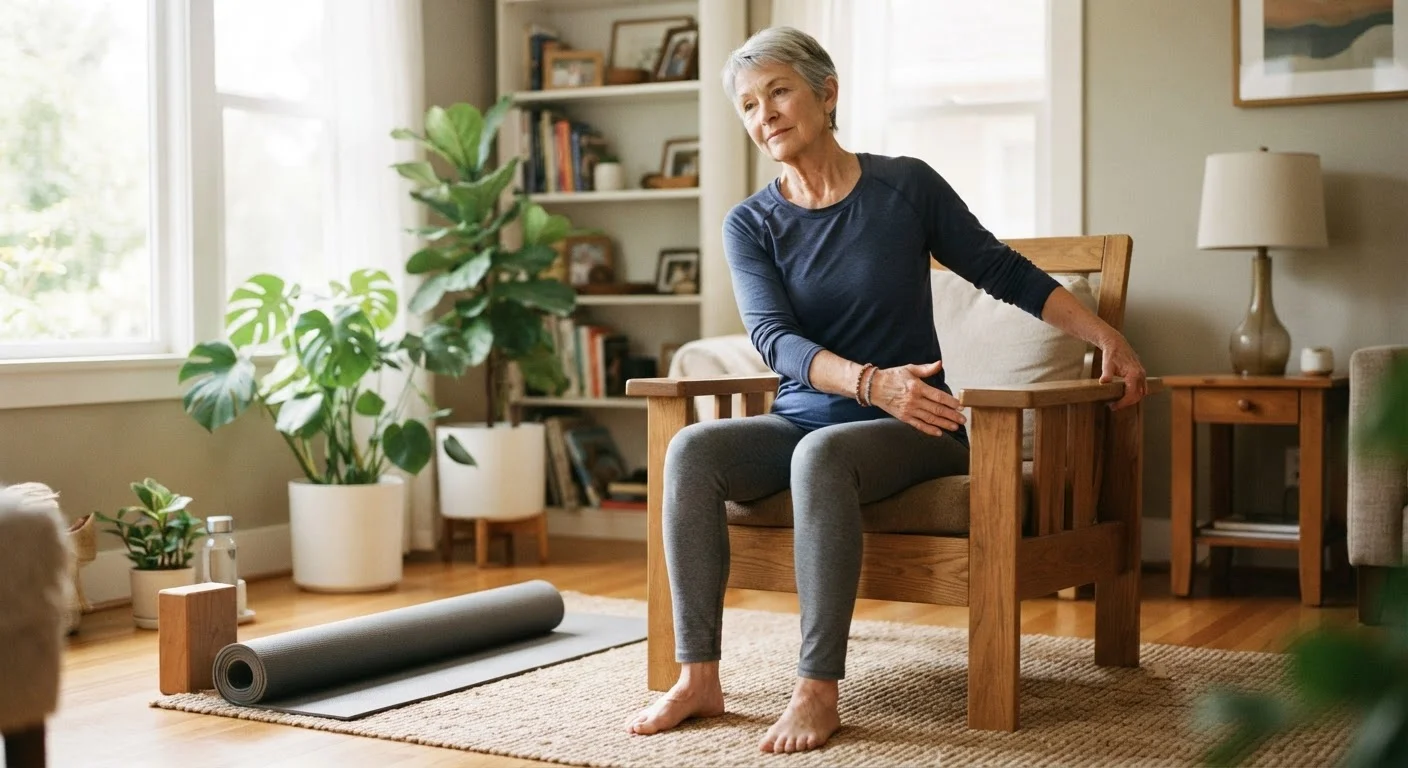
Chair yoga adapts traditional yoga poses — seated in or standing behind a sturdy chair — to make them accessible to people for whom floor work is difficult or unsafe. The chair acts as a prop, enabling spinal extension, hip opening, and gentle twisting without requiring participants to lower themselves to a mat or sustain extended standing balance. Most chair yoga classes last 30–45 minutes and can be practiced almost anywhere.
Traditional, mat-based yoga involves sequences of standing, seated, and lying-down postures. Getting up and down from the floor is a core element of the practice, which itself carries functional benefit — and functional risk. Yoga styles vary widely, from the slow-paced Yin and Hatha traditions to more physically demanding Vinyasa flows. For older adults, gentler Hatha or restorative styles are generally the most appropriate entry point. Understanding how flexibility and mobility differ is useful context before choosing between these two formats.
How Each Approach Affects Key Mobility Markers
Published clinical research — including a randomized controlled trial in older adults with osteoarthritis — has found chair yoga to be effective at reducing pain, improving gait speed, and decreasing fatigue when practiced twice weekly over an eight-week period. These are outcomes that directly map onto functional independence.
Traditional yoga's evidence base for older adults is also well-established. Studies consistently show improvements in static and dynamic balance, lower-extremity flexibility, and self-reported physical function. The floor-level component of mat yoga also trains the ability to rise from the ground — a functional skill that is directly linked to fall survival and independence in later life.
| Criterion | Chair Yoga | Traditional Yoga |
|---|---|---|
| Floor transitions required | No | Yes |
| Fall risk during practice | Low | Moderate (style-dependent) |
| Flexibility improvement | Moderate to strong | Moderate to strong |
| Balance training | Moderate (chair-supported) | Strong (weight-bearing) |
| Strength development | Mild to moderate | Moderate to strong |
| Accessibility for beginners | Very high | Moderate |
| Suitable with joint pain | Yes (with modifications) | Partially (style-dependent) |
| Equipment needed | Sturdy chair | Yoga mat, optional props |
For a broader look at how movement consistency in midlife shapes later-decade function, see the research on long-term movement habits.
Safety, Accessibility, and the Participation Gap
One of the most underappreciated advantages of chair yoga is that it reduces the participation gap — the gap between wanting to exercise and actually doing it consistently. Older adults who are deconditioned, fearful of falling, or managing chronic pain are far more likely to begin and sustain a chair yoga practice than a mat-based class. Consistency, as exercise science repeatedly affirms, outweighs intensity for long-term mobility preservation.
Traditional yoga carries a non-trivial fall risk during transitions, particularly for adults with reduced proprioception (the body's sense of its own position). Stepping into and out of lunges, or moving from standing to the floor, demands both strength and spatial awareness that may have declined. Choosing a class specifically designed for older adults — with an experienced instructor and appropriate props — significantly mitigates this risk.
A structured mobility self-assessment can help you identify which physical domains need attention before selecting a yoga format. This is also a helpful tool to track progress over time.
This article is for general health information purposes only and does not constitute medical advice. Consult a qualified healthcare professional before beginning any new exercise program, especially if you have an existing health condition, recent injury, or surgical history.