
Why Everyday Movement Is Its Own Health Variable
Most fitness guidance focuses on structured workouts — a 30-minute run, a strength-training session, a yoga class. These forms of exercise genuinely matter. But a growing body of research suggests that how you move across the whole day is a separate and equally important predictor of health outcomes as we age.
Scientists refer to non-exercise physical activity as NEAT — the energy spent on everything from walking to the mailbox to shifting position in your chair. Research on NEAT consistently shows that people who accumulate more incidental movement throughout the day tend to have better metabolic profiles, even when their formal exercise habits are similar to those who move less overall.
For adults navigating their 50s, 60s, and beyond, this distinction becomes even more significant. Functional independence — the ability to carry groceries, climb stairs, stand from a low chair — depends on movement patterns practiced daily, not just during gym hours. The habits you build now shape your physical capacity later, often in ways that aren't visible until decades have passed.
The habits below are grounded in current evidence and are designed to complement — not replace — any exercise routine you already have. As always, consult a qualified healthcare professional before making significant changes to your activity level, particularly if you have existing health conditions.
7 Daily Movement Habits That Support Healthy Aging
Interrupt Sitting Every 30–60 Minutes
Prolonged unbroken sitting is associated with elevated cardiometabolic risk independent of how much you exercise. Research, including large prospective studies, indicates that breaking sedentary time with even brief standing or light movement bouts may reduce blood glucose spikes and improve circulation. Sedentary behavior and exercise operate on separate biological pathways — meeting a weekly step goal does not fully cancel out eight hours of sitting.
Practical approach: Set a recurring reminder to stand, walk a short loop, or do a few gentle movements every 30 to 60 minutes. The specific activity matters less than the consistency of the break.
Breaking sitting time with light movement may reduce metabolic risk — independent of how often you exercise.
Walk With Purpose and Variation
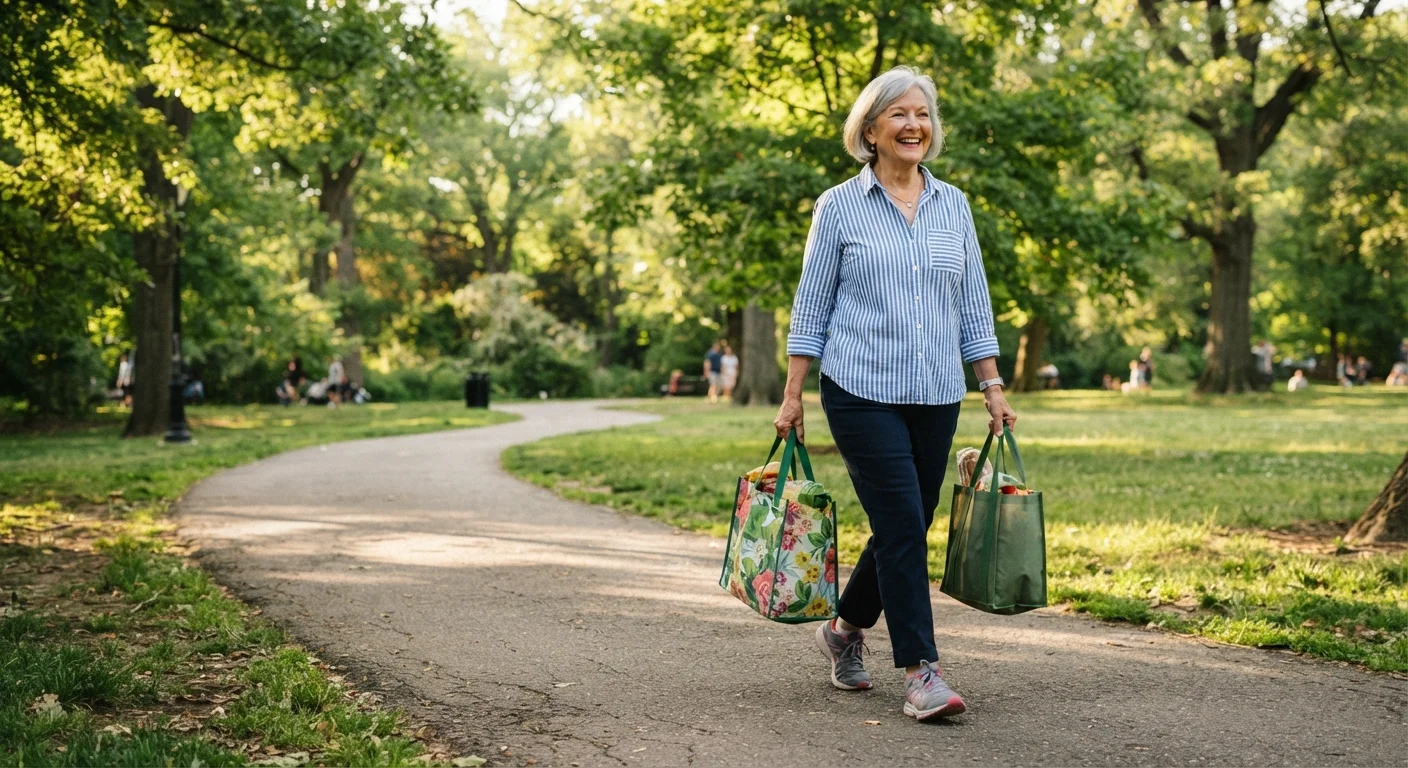
Walking remains one of the most studied and accessible movement habits associated with longevity. But frequency, terrain, and pace variation can meaningfully extend its benefits. Walking on varied surfaces — sidewalks, grass, slight inclines — engages stabilizing muscles that flat treadmill walking does not. Carrying light loads while walking (groceries, a backpack) adds functional resistance.
Walking alone, however, doesn't cover all bases. Adults who walk regularly but neglect balance and strength work may still lose functional capacity in key areas. Think of walking as an anchor habit, not a complete program.
Walking on varied surfaces and carrying light loads adds functional benefit that flat-surface walking alone cannot replicate.
Practice Balance Micro-Habits Daily
Falls are a leading cause of injury and loss of independence in older adults. Balance capacity begins to decline measurably in middle age, but it responds well to regular practice. You don't need a balance board — standing on one foot while brushing your teeth, navigating steps without holding the rail when safe to do so, or pausing on an uneven garden path all challenge proprioception (the body's sense of position in space).
These micro-habits activate the neuromuscular pathways that keep balance reliable under real-world conditions. Consistency across years compounds into meaningful protection. If you have concerns about fall risk, consult a physical therapist for a personalized assessment before attempting balance challenges.
Daily micro-habits like single-leg standing activate the neuromuscular pathways that protect balance for decades.
Use Chores and Errands as Movement Opportunities
Vacuuming, gardening, carrying laundry up stairs, and walking to a local store are all legitimate physical activity. Research categorizes these as NEAT and confirms they contribute to daily energy expenditure and musculoskeletal engagement in ways that matter for aging. Approaching everyday tasks with movement in mind — carrying items farther, choosing stairs, hand-washing instead of the dishwasher — doesn't require extra time.
The key mindset shift is treating incidental movement as a health resource rather than an inconvenience to be minimized through labor-saving shortcuts.
Housework and errands are legitimate physical activity — approaching them intentionally turns unavoidable tasks into health assets.
Maintain Full-Range Movements in Daily Life
Squatting to pick something up from a low shelf, reaching overhead to store an item, rotating to look behind you while driving — these movements use joint ranges that atrophy quickly without regular use. Fundamental movement patterns often decline quietly, without a dramatic moment of loss, until one day they become effortful or painful.
Deliberately including these ranges in daily life — rather than always choosing the most convenient posture — keeps tissues and joints accustomed to their full potential. Mobility-focused training can complement this habit if you want structured practice.
Using joints through their full range daily preserves the movement capacity most people only notice when it is gone.
Build Movement Into Social and Purposeful Activities
Research on cognitively and physically healthy older adults repeatedly identifies active social engagement as a common thread. Walking with a friend, gardening in a community plot, participating in a dance class, or volunteering in ways that require physical engagement combines movement with purpose and social connection — two factors that independently support healthy aging outcomes.
A sense of purpose is linked to lower disease risk in longitudinal research. Pairing it with physical activity appears to compound the benefit. This is not incidental — motivation to move is often sustained more reliably through social obligation and meaning than through willpower alone.
Movement paired with social purpose is more likely to be sustained — and the combination may compound the health benefit.
Adopt a Movement-Conscious Commute or Errand Pattern
For those whose daily routines include commuting, shopping, or local travel, the mode of transport is a significant source of accumulated movement. Parking farther away, taking transit that involves walking, cycling short distances, or walking to a nearby destination rather than driving adds meaningful step counts and light cardiovascular load to the day — without requiring additional time carved from a schedule.
Active commuting has measurable cardiovascular and mental health effects across population studies. Even partial substitution — one or two active trips per week replacing car trips — creates a foundation that can be built upon over time.
Choosing an active travel mode even occasionally accumulates real cardiovascular and metabolic benefit over weeks and months.
Start Small and Build Consistency First
You don't need to overhaul your entire day at once. Behavioral research consistently shows that habit formation is more durable when new behaviors are small, specific, and attached to existing routines. Pick one or two habits from this list and practice them for several weeks before adding more. For guidance on building lasting movement routines, see principles for making movement stick.
This article is for general informational purposes only and is not a substitute for personalized medical advice. Speak with your healthcare provider before beginning any new movement or exercise program.