
What Body Composition Actually Measures
Body composition refers to the proportion of fat mass, lean mass (muscle, bone, organs, and water), and bone mineral density that make up your total body weight. Unlike the number on a scale, these internal ratios are far more informative about functional health - and they change continuously from birth through late adulthood.
As our companion piece explains, the scale can stay perfectly flat while significant internal shifts are underway. That's why tracking body composition over a lifetime requires looking beyond weight alone.
Sarcopenia
The progressive, age-related loss of skeletal muscle mass, strength, and function. It typically accelerates after age 60 and is associated with reduced mobility and increased fall risk.
Visceral fat
Fat stored deep within the abdominal cavity, surrounding internal organs. Higher amounts are associated with metabolic risk factors such as insulin resistance and cardiovascular disease.
Lean mass
All body tissue that is not fat - including skeletal muscle, bone, organs, and water. Preserving lean mass is a key goal in healthy aging.
Osteopenia
A condition characterized by lower-than-normal bone mineral density that is not yet low enough to be classified as osteoporosis. It represents an intermediate stage of bone loss.
Body composition
The proportion of fat mass versus lean mass (muscle, bone, organs, and water) in the body. It provides more health-relevant information than body weight alone.
Decade-by-Decade Shifts in Muscle and Fat
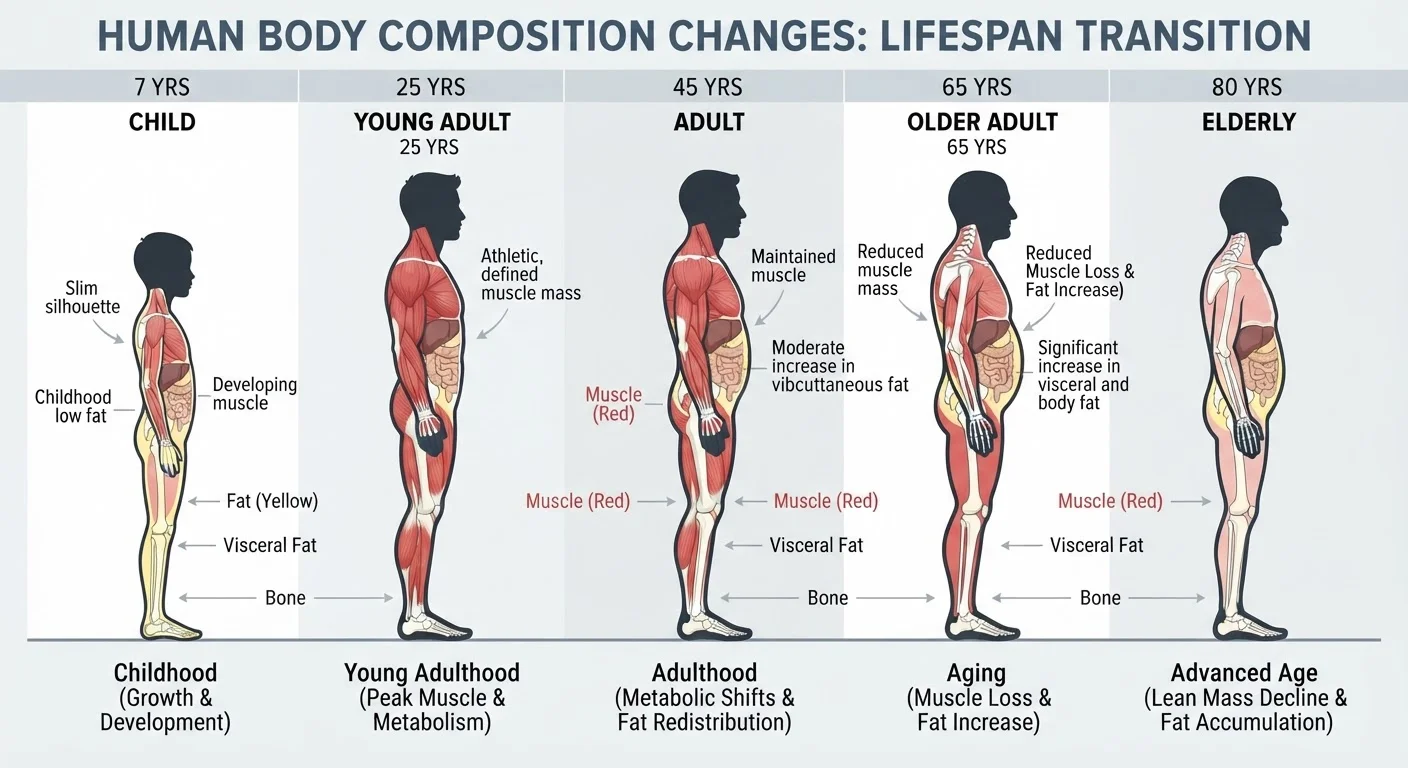
Childhood through adolescence: Lean mass grows rapidly, especially during puberty. Sex hormones drive divergent trajectories - males accumulate more skeletal muscle, while females develop proportionally higher fat mass. These differences are physiologically normal and reflect reproductive biology rather than health deficits.
Young adulthood (20s-30s): For most people, this represents peak lean mass. Muscle fiber size and number are at their highest. Fat mass remains relatively stable when lifestyle factors are consistent, though gradual gains often begin in the late 20s as activity levels tend to decline.
Middle adulthood (40s-50s): This is when sarcopenia - the age-related loss of skeletal muscle mass and strength - begins to accelerate meaningfully. Research suggests adults can lose roughly 3-8% of muscle mass per decade after age 30, with the rate increasing after 60. Simultaneously, fat tends to redistribute toward the abdomen and visceral deposits, even when total body weight stays constant. Hormones, sleep quality, and stress levels all contribute to this redistribution.
Older adulthood (60s and beyond): Sarcopenia and bone density loss (osteopenia or osteoporosis) become more clinically significant. Muscle quality - not just quantity - also declines as fast-twitch fibers shrink preferentially. These changes directly affect mobility, balance, and fall risk. See the Aging & Mobility hub for more on maintaining functional movement.
| Muscle loss rate after 30 | ~3-8% per decade (Commonly cited range in gerontology literature; rate accelerates after age 60) |
| Peak muscle mass timing | Typically mid-to-late 20s (Varies by sex, genetics, and training history) |
| Primary fat shift with age | Subcutaneous to visceral (Particularly pronounced after menopause in women) |
| Peak bone mass established by | Approximately age 30 (National Institutes of Health, general reference) |
| Key modifiable factor | Resistance training (Consistently supported by exercise physiology research) |
What Influences the Trajectory
Biological aging is inevitable, but the rate and severity of body composition change are not fixed. Several modifiable factors influence the trajectory significantly:
- Resistance training: Consistently one of the most evidence-supported strategies for preserving lean mass across age groups. Muscle-building capacity doesn't disappear after 40 - the physiology shifts, but adaptations remain possible.
- Protein intake: Older adults appear to require higher protein intake relative to younger adults to achieve the same muscle protein synthesis response. The relationship between protein and muscle maintenance is an active area of research with important practical implications.
- Hormonal health: Estrogen decline at menopause accelerates both muscle loss and visceral fat gain. Testosterone declines gradually in males across midlife. These shifts are real drivers - not simply consequences of lifestyle choices.
- Bone density: Peak bone mass is largely established by early adulthood. Weight-bearing activity, calcium, and vitamin D all play supporting roles. Physical activity guidelines for bone health differ importantly when bone loss is already significant.
- Sleep: Poor sleep is associated with unfavorable body composition changes, partly through hormonal disruption affecting appetite regulation and muscle repair.
This article is for informational purposes only and is not a substitute for personalized medical advice. Speak with a qualified healthcare professional regarding your individual health circumstances.