
The Scale Tells One Number - Your Body Tells a More Complex Story
Most people use the scale as their primary health gauge. It's simple, immediate, and familiar. But body weight is a single, blunt number that sums up everything inside you - bones, organs, water, muscle, and fat - without distinguishing between any of them. As our article on what body weight actually measures explains, that number leaves out critical information.
Body composition, by contrast, describes the proportion of different tissues that make up that total weight. The most clinically relevant split is between fat mass and lean mass - the latter including muscle, bone, connective tissue, and water. When the balance between these shifts, your physiology, appearance, and health risk profile all change, even if the scale never moves.
Body Weight Is Not a Health Outcome
Clinical and public health research increasingly distinguishes between body weight as a measurement and metabolic health as an outcome. Two individuals with identical BMIs can have dramatically different muscle-to-fat ratios, visceral fat levels, and health risk profiles. Weight is a useful and easy-to-collect data point, but it was never designed to be a comprehensive health indicator on its own.
How Fat and Muscle Can Swap Without Changing the Total
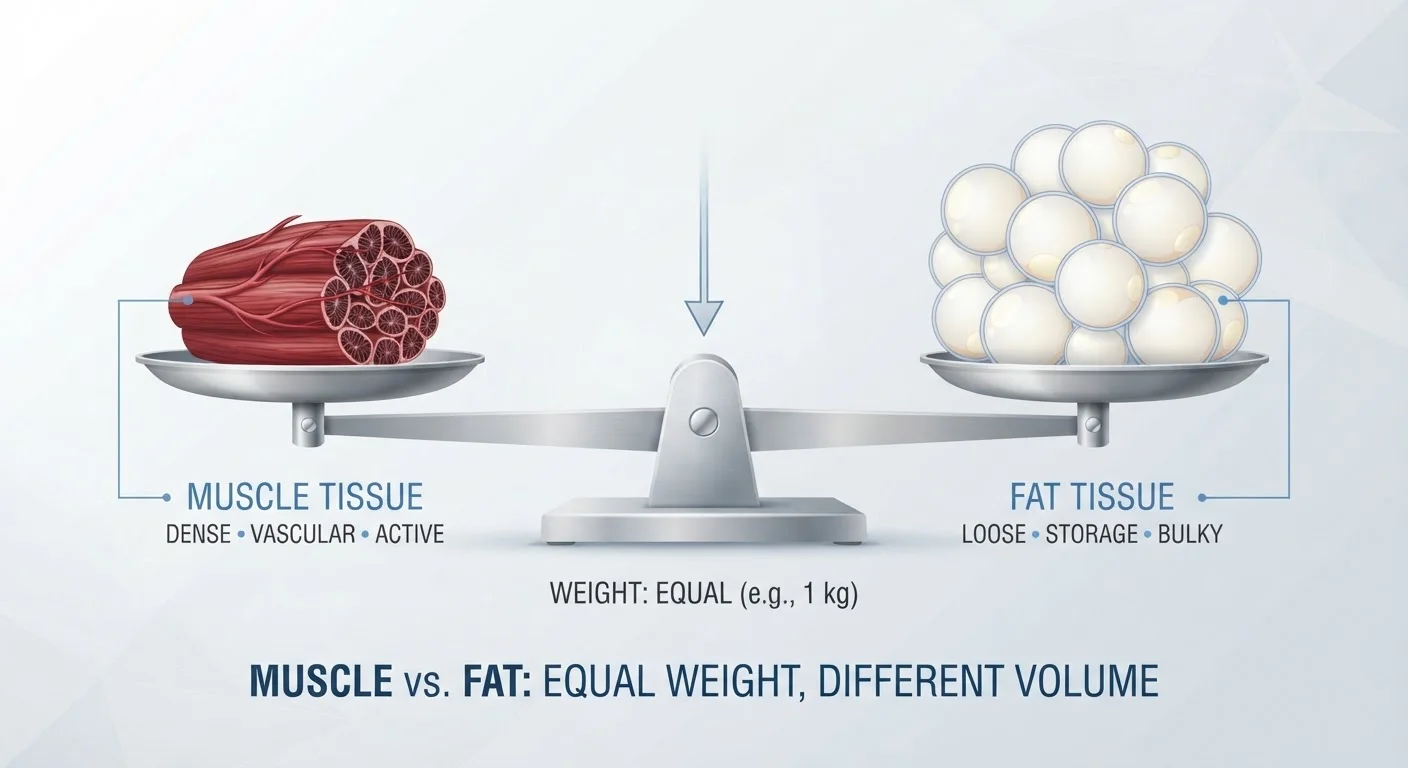
Fat tissue and muscle tissue have different densities. A pound of muscle occupies roughly 20% less volume than a pound of fat. This means that as your body loses fat and builds muscle in roughly equal amounts, your total weight can stay flat while your silhouette, clothing size, and metabolic function shift noticeably.
This is the core mechanism of body recomposition. Research consistently shows it is most pronounced in people who are new to resistance training, resuming training after a hiatus, or who carry a higher proportion of body fat at the outset - because these individuals can more readily mobilize stored fat as fuel while simultaneously building new muscle protein under a training stimulus.
The key biological drivers include: adequate dietary protein to supply amino acids for muscle protein synthesis; progressive resistance training to create a mechanical stimulus for muscle growth; and recovery - particularly sleep - during which much of that synthesis occurs. Hormones, stress, and age also play significant roles that are easy to overlook.
Why This Matters for Functional Health - Not Just Appearance
The health implications of body composition go well beyond aesthetics. Lean muscle mass is metabolically active - it burns more calories at rest than fat tissue does, and it plays a central role in glucose regulation, insulin sensitivity, and physical function. Higher muscle mass is consistently associated with better long-term metabolic health markers.
Visceral fat - the fat stored around internal organs rather than under the skin - carries particular metabolic risk. Two people with identical body weights can have very different visceral fat levels, and consequently very different risk profiles for cardiovascular disease, type 2 diabetes, and related conditions. The scale cannot distinguish between these individuals at all.
~18%
Greater density of muscle vs. fat tissue
Muscle tissue is approximately 18% denser than fat tissue by volume, which explains why body shape and clothing size can change without a shift in total weight.
3-8%
Muscle mass lost per decade after age 30
Research estimates adults lose between 3% and 8% of muscle mass per decade starting around age 30, with the rate accelerating after 60 - a process that can occur even at stable body weight.
~6 lbs
Simultaneous fat loss and muscle gain in beginners
Some studies on previously sedentary individuals starting resistance training programs have documented meaningful simultaneous fat loss and muscle gain - often in the range of several pounds each - over 8-12 weeks.
Understanding this distinction can reframe how you interpret progress. Someone who has started resistance training may feel stronger, notice their clothes fitting better, and see improved bloodwork - all while the scale barely budges. These are genuine, measurable health gains. As detailed in our piece on how body composition shifts with age, preserving muscle across decades is one of the most impactful things a person can do for healthy aging.
Measuring What the Scale Misses
If body weight is an incomplete signal, what should you track instead - or alongside it? Several accessible approaches exist. Body measurements (waist circumference in particular), the fit of clothing over time, and strength benchmarks are low-cost, practical indicators. More precise options include DEXA (dual-energy X-ray absorptiometry) scans, bioelectrical impedance devices, and skinfold caliper assessments - each with different trade-offs in accuracy, cost, and accessibility.
No single metric tells the whole story on its own, and consistency of method matters more than which method you choose. Our guide on tracking body composition over time outlines how to build a reliable monitoring routine. And if you encounter common claims like "muscle weighs more than fat" used to explain stalled scale progress, our article on body composition myths separates fact from persistent misunderstanding.
This article is for general informational and educational purposes only and is not a substitute for professional medical advice. Consult a qualified healthcare provider for guidance specific to your health situation.