
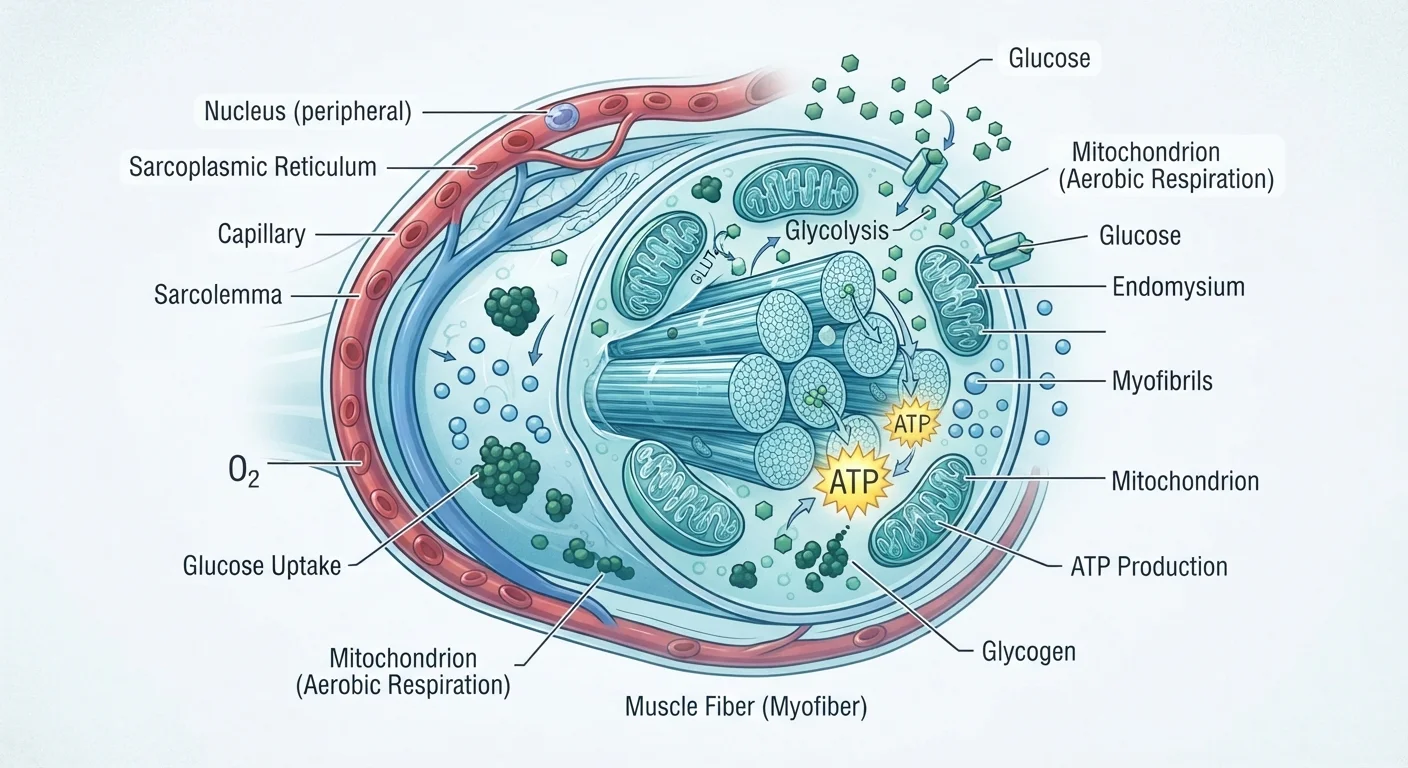
Why Skeletal Muscle Is More Than a Movement Machine
Most people think of muscle primarily in mechanical terms - as tissue that moves limbs and lifts objects. But skeletal muscle is also a major endocrine and metabolic organ. It secretes signaling proteins called myokines during contraction, communicates with fat tissue and the liver, and serves as the body's primary disposal site for dietary glucose after a meal.
This metabolic role means the quantity and quality of your muscle tissue has broad implications for long-term health, extending well beyond athletic performance or appearance. As research into body composition has deepened, scientists have recognized that muscle mass is one of the strongest predictors of metabolic resilience across the lifespan. Understanding this relationship is central to the metabolism basics that govern everyday energy use.
Muscle, Insulin, and Blood Sugar Regulation
After you eat a carbohydrate-containing meal, blood glucose rises and the pancreas releases insulin. Insulin signals cells - particularly muscle cells - to absorb that glucose from the bloodstream. In healthy individuals with adequate muscle mass, this process is efficient: blood sugar normalizes quickly and cells receive the fuel they need.
When muscle mass is low or muscle cells become less responsive to insulin - a condition called insulin resistance - glucose lingers in the bloodstream longer. The pancreas compensates by releasing more insulin, and over time this cycle can contribute to chronically elevated blood sugar and, eventually, type 2 diabetes.
70-80%
Of insulin-stimulated glucose uptake handled by skeletal muscle
Research in metabolic physiology consistently identifies skeletal muscle as the dominant site of postprandial glucose disposal in healthy adults.
~1% per year
Rate of muscle mass loss after age 30 without resistance training
Estimates from longitudinal studies suggest adults lose roughly 1% of muscle mass annually from the fourth decade onward without countermeasures.
3-5x
Greater diabetes risk associated with low muscle mass
Studies including data from the National Health and Nutrition Examination Survey (NHANES) have associated the lowest muscle mass quartiles with substantially elevated type 2 diabetes risk.
This is why researchers increasingly look at muscle quality alongside fat mass when assessing metabolic risk. Two people with identical body weights can have dramatically different blood sugar regulation depending on how much of their body is composed of lean muscle versus adipose tissue. Body composition metrics capture this distinction in a way the scale simply cannot.
Muscle Mass, Resting Metabolism, and Energy Balance
Muscle tissue requires energy to maintain even at rest. This contributes to your basal metabolic rate (BMR) - the calories your body burns just to sustain basic physiological functions. Because muscle is more metabolically costly than fat tissue at rest, individuals with greater muscle mass tend to have a higher BMR, meaning they expend more energy throughout the day even without deliberate exercise.
It's worth being precise about the magnitude here: research suggests a pound of muscle burns roughly 6-10 calories per day at rest, compared to approximately 2-3 calories for a pound of fat. The practical difference from adding a few pounds of muscle is modest - but compounded across months and years, and combined with the activity-related energy expenditure of maintaining and using that muscle, the effect on overall energy balance becomes more meaningful. For a fuller picture of what drives metabolic rate, see the factors that genuinely influence metabolic rate.
Sarcopenia: The Metabolic Cost of Muscle Loss
Muscle mass naturally declines with age - a process known as sarcopenia - beginning as early as the mid-thirties and accelerating in the decades that follow without deliberate countermeasures. This gradual loss has well-documented metabolic consequences: reduced insulin sensitivity, lower resting energy expenditure, and increased risk of type 2 diabetes and cardiovascular disease.
Sarcopenia is not inevitable in its severity, however. Resistance training is the most robustly supported strategy for preserving and building muscle across the lifespan. Evidence consistently shows that older adults who engage in regular strength training maintain better insulin sensitivity, glucose regulation, and functional capacity than sedentary peers - even when total body weight doesn't change significantly. Why muscle mass matters more after 50 explores this in greater depth for those navigating the aging process.
Practical Implications: Building Muscle for Metabolic Benefit
Improving muscle mass for metabolic health doesn't require competitive weightlifting. Progressive resistance training - consistently challenging muscles with load over time - is the primary driver of muscle protein synthesis. Combined with adequate dietary protein to supply building blocks for repair and growth, this approach supports both muscle retention and metabolic function.
Importantly, metabolic improvements from resistance training often appear before dramatic changes in body composition are visible. Studies have documented improvements in insulin sensitivity, blood glucose regulation, and inflammatory markers within weeks of beginning a consistent strength training program. This reinforces a key principle: metabolic health gains and aesthetic changes are related but distinct outcomes. Strength training for weight management provides a practical overview of what to realistically expect from resistance exercise programs.
This article is for general informational and educational purposes only and is not a substitute for professional medical advice, diagnosis, or treatment. Always consult a qualified healthcare provider before making changes to your exercise, nutrition, or health management plan.