
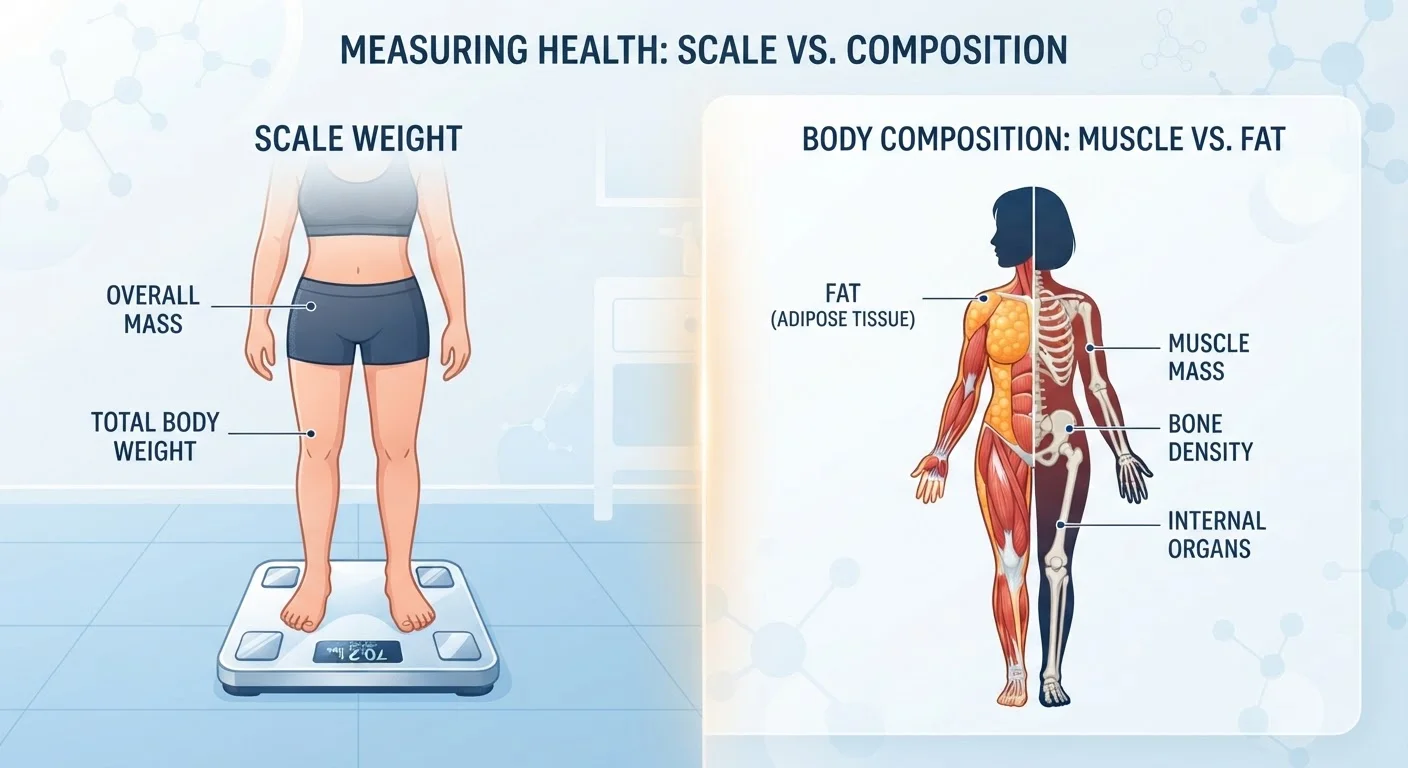
What the Scale Is Actually Measuring
Step on a bathroom scale and it returns a single number: your total body weight. That figure is the sum of everything inside you - muscle, fat, bone, organs, blood, and water. It makes no distinction between a pound of metabolically active muscle tissue and a pound of stored fat. As a standalone metric, body weight is surprisingly limited.
This matters because health outcomes are far more closely tied to what your body is composed of than to how much it weighs in total. Research consistently shows that individuals with higher proportions of lean muscle mass tend to have better metabolic markers, stronger functional capacity, and lower rates of cardiometabolic disease - regardless of their absolute weight. For a deeper look at what weight actually captures, see what body weight actually measures.
The Two Core Components: Fat Mass and Lean Mass
Body composition is typically discussed in terms of two primary compartments:
- Fat mass: All adipose (fat) tissue in the body. This includes essential fat - necessary for hormone production, nerve function, and organ protection - and storage fat, which accumulates as surplus energy. Excess storage fat, particularly visceral fat surrounding the abdominal organs, is associated with elevated metabolic and cardiovascular risk.
- Lean mass: Everything that is not fat - skeletal muscle, bone mineral, organs, connective tissue, and body water. Skeletal muscle is the largest and most modifiable component of lean mass and plays a central role in metabolism and physical function.
The ratio between these compartments - not total weight - is what most strongly predicts health trajectories. Understanding how muscle mass specifically connects to your metabolic function is worth exploring further: how muscle mass relates to metabolic health.
~36%
U.S. adults classified as obese by body fat
CDC data estimates that obesity - defined by excess body fat rather than weight alone - affects approximately one in three American adults.
Up to 30%
BMI misclassification rate in some studies
Research published in the International Journal of Obesity found BMI misclassified cardiometabolic health status in a substantial proportion of individuals when compared against direct body fat measurement.
~6 lbs
Average muscle mass loss per decade after 30
Without targeted resistance training and adequate protein, adults may lose roughly 3-8% of muscle mass per decade, a process called sarcopenia, with accelerating effects after age 60.
Why Body Fat Percentage Outperforms BMI
BMI (body mass index) is widely used in clinical settings because it requires only height and weight. But it carries a fundamental flaw: it cannot differentiate fat from muscle. A highly trained athlete may carry significant muscle mass and register as overweight by BMI standards, while someone with low muscle and high fat mass could fall within the so-called normal range - a condition sometimes called normal-weight obesity.
Body fat percentage directly addresses this limitation by expressing fat mass as a proportion of total weight. It provides a more accurate signal of metabolic risk and physical health, though it still represents just one dimension of a complex picture. For a full overview of assessment tools, body composition testing methods offers a clear breakdown of available options including DEXA, BIA, and skinfold calipers.
How Composition Can Shift Without Weight Changing
One of the most counterintuitive aspects of body composition is that it can change substantially while the scale barely moves. When someone begins a resistance training program combined with adequate protein intake, muscle synthesis can increase at roughly the same rate that fat mass decreases - a process known as body recomposition. The number on the scale remains relatively static, yet the internal makeup of the body shifts meaningfully.
This explains why using weight as the sole indicator of progress can be misleading - and sometimes discouraging. A person might be improving their metabolic health, gaining strength, and reducing fat while watching the scale report no change. Why body composition can change when weight stays flat explores this phenomenon in detail.
This article is for general informational and educational purposes only and does not constitute medical advice. For personalized guidance on body composition or health goals, consult a qualified healthcare professional.