
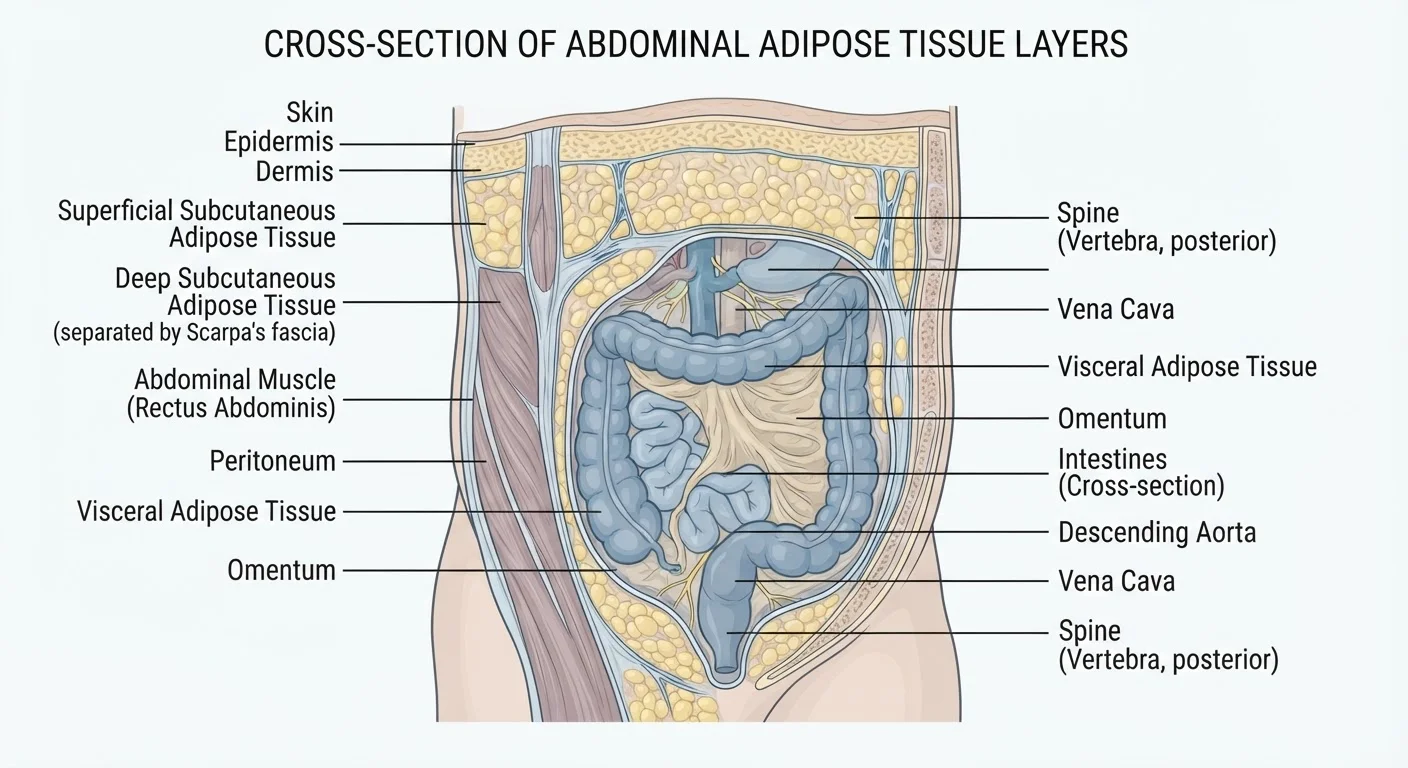
Where Each Fat Type Lives - and Why That Matters
Body fat is not a single, uniform tissue. Its metabolic behavior and health implications depend heavily on where it is stored, not simply how much of it exists. Two primary depots dominate this picture: visceral fat and subcutaneous fat.
Subcutaneous fat is the layer deposited directly beneath the skin. You can pinch it on your abdomen, thighs, arms, and hips. It provides thermal insulation, cushions muscles and bones, and stores energy the body draws on during sustained caloric deficits. It also participates in hormone signaling - subcutaneous adipose tissue releases adiponectin, a hormone associated with improved insulin sensitivity. While excess subcutaneous fat can contribute to obesity-related conditions, its metabolic profile is relatively benign compared to its counterpart.
Visceral fat is stored within the peritoneal cavity - the space that houses the liver, pancreas, intestines, and other organs. Unlike subcutaneous fat, you cannot see or feel visceral fat from the outside. It is metabolically hyperactive, meaning it releases fatty acids, inflammatory cytokines (chemical messengers that promote inflammation), and hormones directly into the portal vein, which feeds the liver. This proximity to vital organs is what makes visceral fat a clinically significant concern. To understand how dietary fat - including what you eat - influences these depots, see what dietary fat actually does in the body.
Head-to-Head: Key Differences at a Glance
The table below compares visceral and subcutaneous fat across the dimensions most relevant to health and body composition.
| Criterion | Visceral Fat | Subcutaneous Fat |
|---|---|---|
| Location | Surrounding internal organs (abdominal cavity) | Beneath the skin surface |
| Visibility | Not visible or palpable externally | Visible and pinchable |
| Metabolic Activity | Highly active; releases fatty acids and cytokines | Less metabolically reactive |
| Disease Risk Link | Strongly linked to diabetes, CVD, metabolic syndrome | Weakly linked at moderate levels |
| Hormonal Role | Promotes insulin resistance, inflammation | Releases adiponectin (improves insulin sensitivity) |
| Measurement | Waist circumference, DEXA, CT/MRI | Skinfold calipers, DEXA |
| Response to Exercise | Reduces preferentially with aerobic training | Reduces with sustained caloric deficit over time |
One important nuance: the ratio of visceral to subcutaneous fat matters as much as the absolute amounts. Two people with identical BMIs can have dramatically different visceral fat levels - a phenomenon sometimes called metabolically obese, normal weight (MONW), underscoring why the scale alone is an incomplete health tool. For a broader look at why fat loss and weight loss are distinct concepts, see weight loss vs. fat loss.
How Visceral Fat Affects Metabolic Health
The mechanisms linking visceral fat to disease are well-characterized. Visceral adipocytes (fat cells) are more lipolytically active - they break down fat and release free fatty acids more readily than subcutaneous cells. These fatty acids flow directly into the liver, promoting elevated triglyceride production, reduced insulin clearance, and hepatic insulin resistance. Over time, this contributes to a cluster of conditions known as metabolic syndrome: elevated blood glucose, high triglycerides, low HDL cholesterol, high blood pressure, and abdominal obesity.
Visceral fat also secretes higher levels of pro-inflammatory molecules such as interleukin-6 (IL-6) and tumor necrosis factor-alpha (TNF-α), which promote low-grade systemic inflammation - a known driver of cardiovascular disease, type 2 diabetes, and certain cancers. Research has consistently found that waist circumference, which partially reflects visceral fat accumulation, is a stronger predictor of cardiovascular mortality than BMI alone.
~30%
Greater CVD risk with high waist circumference
Population studies have found that elevated waist circumference is associated with roughly 30% higher cardiovascular mortality risk independent of BMI.
5-10%
Visceral fat reduction from aerobic exercise
Meta-analyses of aerobic exercise trials report average visceral fat reductions of 5-10% with regular moderate-intensity cardio, even without significant weight loss.
~25%
Normal-weight adults with metabolic obesity
Research estimates suggest roughly one in four normal-BMI adults may carry metabolically significant levels of visceral fat, elevating disease risk despite healthy body weight.
Measuring What You Can't See
Because visceral fat is internal, standard measurements fall short. BMI captures weight relative to height but says nothing about fat distribution. Skinfold calipers measure subcutaneous fat only. More informative options include:
- Waist circumference: A practical proxy for abdominal fat. Elevated risk thresholds are generally cited as above 40 inches (102 cm) for men and above 35 inches (88 cm) for women, though these are population-level benchmarks, not individual diagnoses.
- Waist-to-hip ratio (WHR): Compares waist to hip circumference to assess fat distribution patterns.
- DEXA scan (dual-energy X-ray absorptiometry): Provides detailed body composition data including regional fat distribution.
- CT or MRI imaging: The gold standard for quantifying visceral fat, though typically reserved for clinical research contexts due to cost and radiation exposure (CT).
No single measurement is perfect. Combining waist circumference with fasting metabolic markers (blood glucose, triglycerides, blood pressure) provides a more complete picture. Always work with a qualified healthcare provider to interpret these measurements in the context of your individual health history.
What Actually Reduces Visceral Fat
The good news: visceral fat tends to respond to lifestyle change more readily than subcutaneous fat. Aerobic exercise in particular has robust evidence for preferentially reducing visceral adiposity, even when total weight loss is modest. A consistent pattern in research shows measurable reductions in visceral fat from regular moderate-to-vigorous cardio - even without caloric restriction. For guidance on structuring cardio toward fat-loss goals specifically, see cardio for fat loss vs. endurance.
Resistance training improves insulin sensitivity and preserves lean mass, which indirectly helps manage visceral fat accumulation. Dietary patterns emphasizing whole foods, fiber, and reduced ultra-processed food intake are also associated with lower visceral fat levels across population studies. Sleep quality and stress management also matter - chronically elevated cortisol promotes visceral fat storage via hormonal pathways.
There is no supplement, spot-reduction exercise, or shortcut with established evidence for specifically targeting visceral fat. Sustainable lifestyle changes across multiple domains - movement, nutrition, sleep, stress - remain the foundation of evidence-based intervention. Consult a healthcare provider before making significant changes to your diet or exercise routine, particularly if you have existing health conditions.
This article is for general informational and educational purposes only and does not constitute medical advice. For personalized guidance, please consult a qualified healthcare professional.