
Why Balance Declines With Age
Balance depends on three systems working in concert: the vestibular system, vision, and proprioception. Each of these degrades gradually with age. Inner ear sensitivity diminishes, vision becomes less sharp, and proprioceptive nerve signals slow down. Muscle mass — which provides the reactive strength needed to correct a stumble — also declines through a process called sarcopenia.
The result is that many adults over 60 experience a measurable reduction in postural stability, even without any single disease or injury. According to the Centers for Disease Control and Prevention (CDC), falls are the leading cause of injury-related death among adults 65 and older in the United States. Importantly, this is not an inevitable outcome — it is a trajectory that targeted training can meaningfully alter.
Vestibular system
The inner ear structures responsible for detecting head movement and helping the body maintain balance and spatial orientation.
Proprioception
The body's ability to sense its own position and movement in space, transmitted through receptors in muscles, tendons, and joints.
Sarcopenia
The gradual, age-related loss of muscle mass and strength that begins around the fourth decade of life and accelerates after 60.
Postural stability
The ability to maintain the body's center of mass over its base of support — essentially, the capacity to stay upright during standing and movement.
Tandem stance
A balance exercise position where one foot is placed directly in front of the other, heel to toe, creating a narrow base of support.
The Case for Starting Balance Training Now
Balance is not a fixed trait. Like cardiovascular fitness or muscular strength, it responds to training. Studies published in journals including Age and Ageing and the British Journal of Sports Medicine have found that structured balance programs can reduce fall rates in older adults by 20 to 30 percent or more, depending on program design and participant adherence.
The earlier adults begin, the greater the protective window. However, meaningful gains are achievable even for those starting in their 70s or 80s. Pairing balance work with resistance training amplifies benefits — stronger legs and hips give the body more to work with when stability is challenged. For a deeper look at how aging muscles respond to resistance exercise, see our guide to strength training in your 60s and 70s.
Foundational Balance Exercises to Begin With
Beginners should start with stationary, supported exercises before progressing to more dynamic movements. The following are widely used in evidence-based fall-prevention programs:
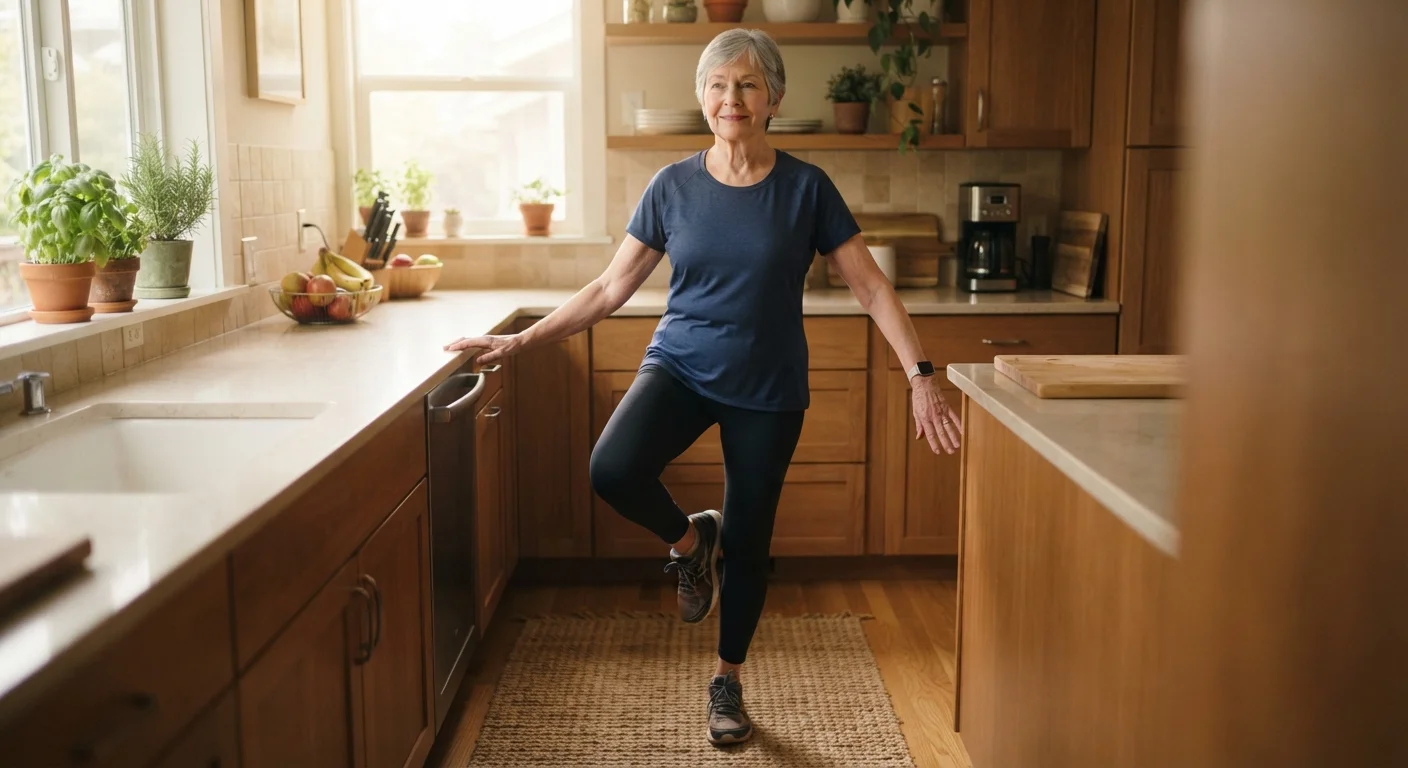
- Supported single-leg stand: Stand behind a sturdy chair with both hands lightly on the back. Slowly lift one foot an inch off the floor and hold for up to 10 seconds. Alternate feet. As stability improves, reduce hand contact to fingertips only.
- Tandem stance: Place one foot directly in front of the other, heel to toe, and hold the position for up to 30 seconds. Use a countertop for support as needed. This stance challenges the narrow base of support that walking demands.
- Weight shifting: Stand with feet hip-width apart, hands resting on a counter. Slowly shift your weight from one foot to the other, pausing momentarily on each side. This builds dynamic stability without requiring a full weight transfer.
- Sit-to-stand: Rise from a chair without using your arms when possible. This exercise strengthens the quadriceps and glutes — muscles critical for fall recovery — while reinforcing postural control.
Progress gradually. The goal is to build neural confidence in addition to muscle function. For readers interested in complementary low-impact movement, comparing low-impact exercise options can help identify additional activities suited to aging joints.
Safety Principles Every Beginner Should Know
A Simple Safety Check Before Every Session
Before practicing balance exercises, take 30 seconds to scan your environment: secure any loose rugs, move furniture or cords out of your path, and confirm a stable surface is within arm's reach. This brief habit significantly reduces the chance of an accidental fall during training.
Balance training carries a small inherent risk — you are practicing in positions where a misstep could cause a fall. These principles reduce that risk significantly:
- Always have a stable surface within reach. A countertop, sturdy chair back, or wall should be within arm's reach throughout every session until your balance is well established.
- Clear the space. Remove loose rugs, pets, cords, or other tripping hazards from your practice area before each session.
- Wear footwear. Socks on hardwood floors are a common fall hazard. Supportive, flat, non-slip footwear provides better proprioceptive feedback than bare feet on slick surfaces.
- Never train through dizziness. If you experience vertigo or lightheadedness during an exercise, stop immediately. Dizziness during balance work can indicate a vestibular issue that warrants medical evaluation.
- Consult a professional first. If you have a history of falls, osteoporosis, joint replacement, or chronic neurological conditions, speak with your physician or a physical therapist before beginning. They can identify specific risks and adapt exercises appropriately. If osteoporosis is a concern, our article on osteoporosis and physical activity outlines the key principles for bone-safe movement.
Building a Sustainable Routine
Consistency outweighs intensity at this stage. A manageable starting point is two to three sessions per week, each lasting 10 to 15 minutes. Many older adults find it easiest to attach balance practice to an existing habit — performing exercises while waiting for coffee to brew or during a television commercial break.
Progress should feel gradual. A general progression might move from two-handed support to fingertip support, then to unsupported standing, and eventually to dynamic challenges like walking heel-to-toe or stepping onto a folded towel for a mildly unstable surface. Each step should feel controlled before the next is attempted.
Balance training works best as part of a broader movement practice. Building a sustainable strength routine after 50 provides a complementary framework for adults who want to address both stability and muscle health simultaneously.
This article is for general informational purposes only and does not constitute medical advice. Always consult a qualified healthcare provider before beginning any new exercise program, particularly if you have existing health conditions, a history of falls, or concerns about your balance.