
Why Low-Impact Exercise Matters as You Age
Physical function — the ability to rise from a chair, carry groceries, climb stairs — is one of the strongest predictors of independence in later life. Research consistently links regular moderate aerobic activity to reduced risk of cardiovascular disease, type 2 diabetes, and cognitive decline. Yet high-impact activities like running become harder to sustain as cartilage thins, balance shifts, and recovery slows.
Low-impact exercise threads a critical needle: it delivers enough cardiovascular stimulus to produce health benefits without the repetitive joint loading that accelerates wear or raises injury risk. For adults managing osteoarthritis, recovering from a joint replacement, or simply noticing that their knees protest a morning jog, these options aren't a consolation prize — they're often the smarter long-term strategy. See how habits formed now influence physical function in later decades.
Comparing the Four Leading Options
Walking, swimming, water aerobics, and cycling are the most widely researched and broadly accessible low-impact activities for older adults. Each has a distinct profile of benefits, limitations, and practical considerations.
| Walking | Swimming | Water Aerobics | Cycling | |
|---|---|---|---|---|
| Joint impact level | Low (weight-bearing) | Very low (buoyant) | Very low (buoyant) | Very low (non-weight-bearing) |
| Bone density benefit | Yes (weight-bearing) | Minimal | Minimal | Minimal |
| Cardiovascular benefit | Moderate–high | High | Moderate–high | Moderate–high |
| Balance challenge | Moderate | Low | Low–moderate | Low (stationary) / Moderate (outdoor) |
| Fall risk | Low–moderate | Very low | Very low | Low (stationary) / Moderate (outdoor) |
| Cost / access barrier | Very low | Moderate (pool needed) | Moderate (pool + class) | Low–moderate (bike or gym) |
| Social opportunity | Optional | Low | High (group class) | Variable |
| Weather dependent | Yes (outdoor) | No (indoor pool) | No (indoor pool) | Yes (outdoor) / No (stationary) |
Walking is uniquely valuable for bone density because it is weight-bearing — meaning the skeleton bears the body's load, which stimulates bone remodeling. Swimming and water aerobics, by contrast, are nearly weightless environments. This makes them outstanding for pain relief and joint decompression, but they do not carry the same bone-strengthening signal. For adults with osteoporosis concerns, this distinction is clinically meaningful — a topic explored further in bone-safe movement principles.
Cycling sits in the middle: it is not weight-bearing in the traditional sense, but stationary cycling in particular allows precise control over resistance and intensity, making it adaptable to a wide range of fitness levels. Outdoor cycling adds balance demands and terrain variability, which can be either a benefit or a risk depending on the individual.
Balance, Coordination, and Fall Risk Considerations
Balance is a dimension that distinguishes these activities in ways that cardiovascular metrics alone don't capture. Walking on varied surfaces — grass, gravel, slight inclines — passively challenges proprioception (the body's sense of position) over time. Outdoor cycling demands dynamic balance but carries fall risk if that balance is compromised. Stationary cycling and water-based exercise are the most fall-safe options, making them particularly suitable for adults who've had a recent fall or who have identified balance deficits.
Water aerobics deserves special mention here: the buoyancy reduces fall consequences while the resistance of water provides gentle proprioceptive feedback through the lower limbs. For a dedicated approach to fall prevention, balance training fundamentals for adults over 60 offers a practical complement to any aerobic routine.
None of these activities fully substitutes for dedicated strength work. Muscle mass and leg strength are primary fall-prevention mechanisms — something covered in depth in how aging muscles respond to resistance exercise.
Practical Access, Cost, and Sustainability
Real-world adherence often comes down to logistics. Walking requires nothing beyond functional footwear and a safe route. Swimming and water aerobics require pool access, which may involve a membership fee or facility proximity — meaningful barriers for many older adults in rural or underserved areas. Cycling requires either a bicycle and safe roads, or a stationary bike, both of which carry upfront costs.
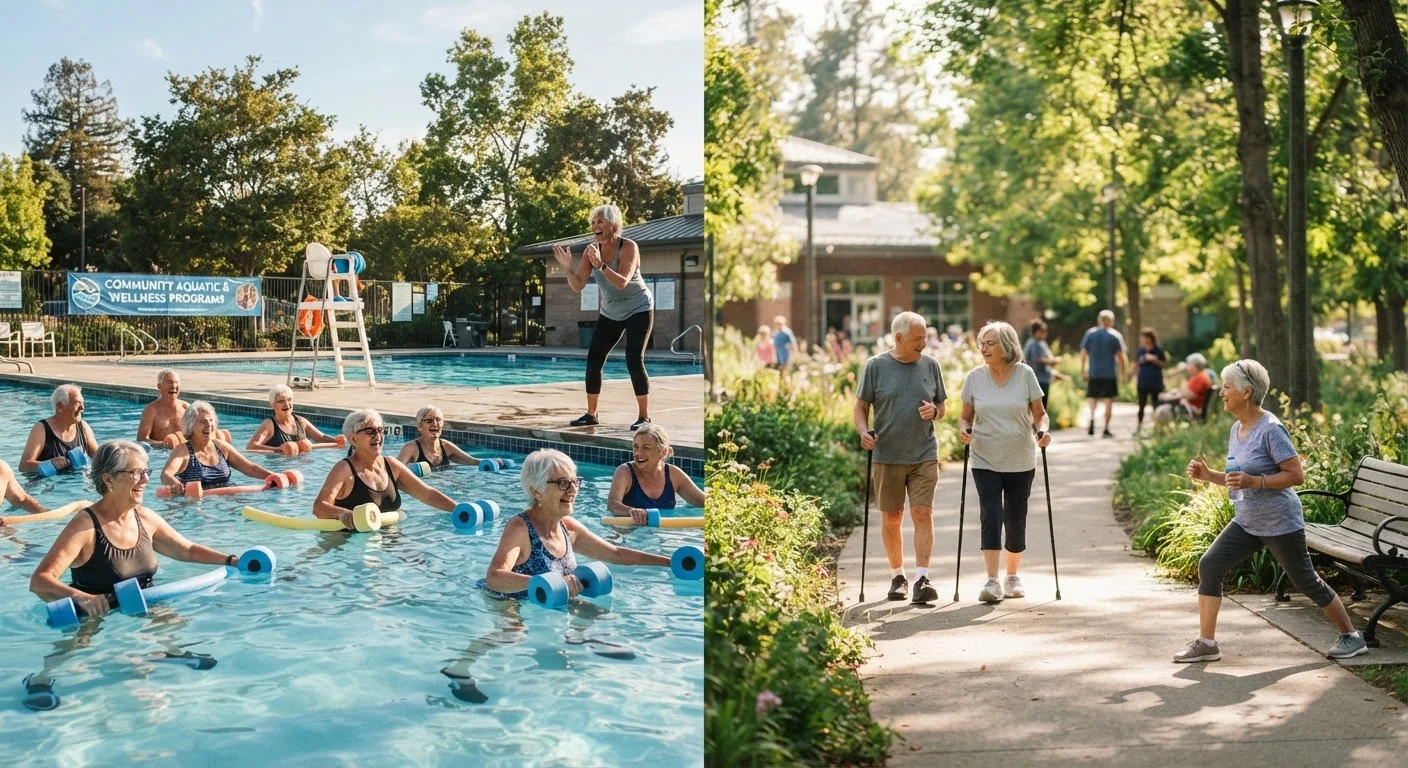
Social structure also shapes long-term adherence. Water aerobics classes provide built-in community, instructor feedback, and scheduled accountability — factors that research suggests support sustained participation. Walking can be social or solitary. Cycling and lap swimming tend to be more individual pursuits, though group cycling classes exist in many community fitness centers.
Weather is a real constraint for outdoor walking and cycling. Adults in colder or wet climates often find these activities impractical for months at a time unless indoor alternatives are arranged in advance. Stationary cycling and pool-based activities sidestep seasonal barriers entirely.
This article is for general informational purposes only and does not constitute medical advice. Always consult a qualified healthcare provider before beginning a new exercise program, especially if you have a chronic condition, recent injury, or have undergone surgery.