Why Desk Workers Are Rethinking Their Workstations
Most American office workers spend six to eight hours a day seated, and research consistently links prolonged, uninterrupted sitting with elevated risks for cardiovascular disease, metabolic disruption, and musculoskeletal discomfort. Our article on the real risks of sitting all day unpacks what the science does — and doesn't — confirm about sedentary work habits.
Standing desks (also called height-adjustable or sit-stand desks) have surged in popularity as a practical fix. The logic is appealing: if sitting too much is harmful, standing more should help. But the picture is more nuanced. Both extremes carry trade-offs, and the most honest approach is to weigh them directly before rearranging your workspace.
The Case For Standing Desks
Reduces uninterrupted sitting time with minimal friction
A height-adjustable desk makes switching postures a low-effort habit, which research suggests can reduce daily seated time more effectively than prompts alone.
May ease low-back discomfort for some workers
Alternating between sitting and standing can relieve sustained load on lumbar structures, particularly when the desk is correctly set to elbow height.
Supports posture variety throughout the workday
No single posture is ideal for the full workday; sit-stand desks enable transitions that distribute mechanical stress across different muscle groups.
May support post-meal blood glucose regulation
Some studies suggest light standing after meals modestly improves glucose metabolism compared to remaining seated, though evidence is still developing.
The primary benefit of a sit-stand desk is that it makes posture variety easy and habitual. Rather than requiring deliberate effort to stand up, the desk removes friction from the behavior. Studies published in journals such as Occupational and Environmental Medicine have found that height-adjustable desks, combined with behavioral prompting, can meaningfully reduce daily sitting time in office settings.
There is also some evidence — though not yet definitive — that breaking up sitting with standing may support blood glucose regulation and reduce fatigue after meals. For workers who experience low-back discomfort from sustained sitting, alternating postures can provide relief, provided the desk height and monitor position are set correctly.
The Honest Drawbacks
Static standing has its own musculoskeletal risks
Prolonged standing without movement is associated with foot pain, lower-limb swelling, and varicose veins — problems common in occupations requiring all-day standing.
Does not substitute for actual physical movement
Standing burns only marginally more calories than sitting and does not provide the circulatory, cardiovascular, or metabolic stimulus that walking and other movement does.
Can impair concentration over extended periods
Research indicates that sustained standing beyond roughly 90 minutes may reduce performance on tasks requiring focused cognitive effort.
Requires a proper ergonomic setup to avoid new injuries
Without correct monitor height, keyboard position, and anti-fatigue matting, a standing desk can introduce wrist strain, neck tension, and shoulder discomfort.
Adjustment period can cause early fatigue and discomfort
Workers new to standing desks often experience leg and foot fatigue if they increase standing time too quickly; a gradual ramp-up over several weeks is typically recommended.
Standing more is not the same as moving more. When a person stands at a desk for long stretches without shifting weight or walking, the physiological benefits are modest — and the downsides accumulate. Prolonged static standing is associated with lower-limb swelling, foot pain, varicose veins, and increased musculoskeletal load on the knees and hips. Workers in occupations that require standing all day — retail, manufacturing — show elevated rates of these complaints.
Cognitive performance also warrants attention. Some research indicates that extended standing can impair tasks requiring sustained concentration, particularly after the 90-minute mark. And without an ergonomic setup — monitor at eye level, anti-fatigue mat underfoot, wrists in a neutral position — standing desks can create new discomfort even as they resolve old patterns.
Ergonomic Setup Matters as Much as the Desk Itself
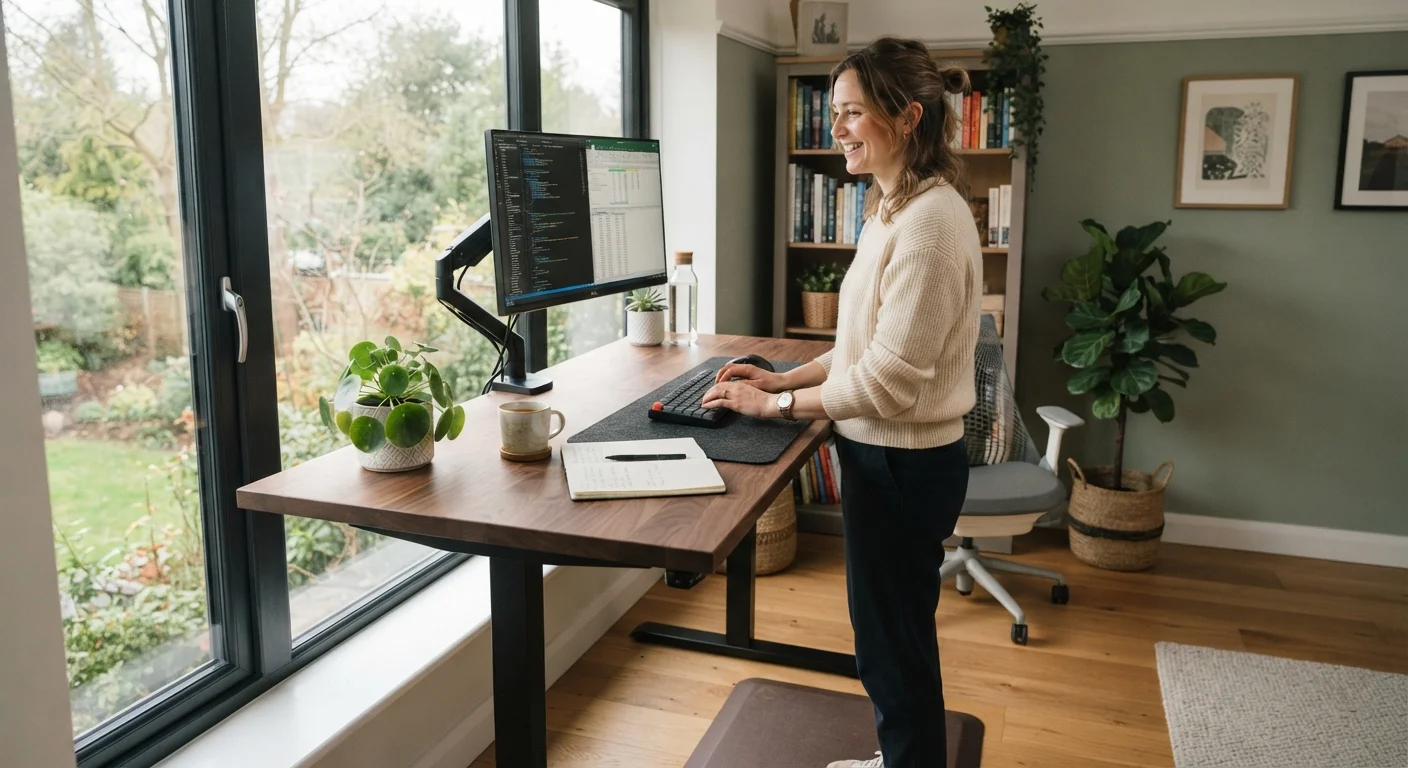
A standing desk used at the wrong height or without adequate footwear support can create new problems while solving old ones. When standing, elbows should rest near 90 degrees, the monitor top should be at or just below eye level, and an anti-fatigue mat underfoot is strongly recommended. An ergonomics consultant or occupational therapist can assess your specific setup if discomfort persists.
Movement Breaks: The Underrated Alternative
The strongest evidence in this space does not point to standing as the solution — it points to movement interruptions. Brief walks, stretching, or light activity every 30 to 60 minutes appear to interrupt the metabolic and circulatory consequences of prolonged posture more effectively than simply switching from seated to upright. This holds whether the interruption comes from a standing desk prompt or a deliberate habit.
For practical strategies on building movement into a desk-bound day without disrupting workflow, see our guide on adding real movement to a desk-bound workday. These approaches require no equipment and can be adapted to remote or in-office environments alike.
~6–8 hrs
Average daily sitting time for U.S. office workers
Estimates from multiple occupational health surveys consistently place prolonged sitting as a defining feature of modern desk work.
30 min
Recommended maximum before an activity break
Several health organizations suggest interrupting sitting at least every 30 minutes with brief standing or light movement to mitigate sedentary risk.
It's also worth auditing how much incidental movement your day actually contains. Our daily lifestyle audit can help you identify gaps you may be underestimating.
Who Should — and Shouldn't — Prioritize a Standing Desk
A standing desk makes the most sense for someone who already has a foundation of regular movement breaks and wants an additional tool for posture variety. It is less useful — and potentially counterproductive — for someone hoping it will replace structured physical activity or solve sedentary habits without accompanying behavior change.
Individuals with pre-existing conditions affecting the lower limbs, circulation, or joints should consult a healthcare professional before making significant changes to their workstation setup. The same applies to those managing chronic pain conditions. For older adults especially, sedentary time and exercise interact in important ways that go beyond a simple posture switch.
This article is for general informational purposes only and does not constitute medical advice. Consult a qualified healthcare professional before making changes to your workstation or activity habits if you have an existing health condition.