Why Desk-Bound Days Deserve a Movement Strategy
Most Americans spend the majority of their waking hours sitting — at a desk, in a car, on a couch. Research published by the American Heart Association and other public health bodies has consistently linked prolonged sedentary time to increased risk of cardiovascular disease, metabolic issues, and musculoskeletal discomfort, even among people who exercise regularly outside of work hours.
That last point matters: a structured gym routine is genuinely valuable, but it can't fully counteract eight or nine hours of near-continuous sitting. The solution isn't to abandon your desk — it's to interrupt sedentary patterns throughout the day with intentional, realistic movement. As explored in our guide to building a daily movement habit without a gym membership, structured exercise is just one path to an active life.
The strategies below are practical, low-disruption, and supported by established exercise science principles. None require gym access, special gear, or significant time away from your responsibilities.
Set a Recurring Movement Reminder Every Hour
The simplest, most evidence-supported intervention for desk workers is breaking up sitting time at regular intervals. Setting a timer or using a wearable device to prompt you every 45–60 minutes can be enough to shift your movement profile significantly over the course of a day.
When the reminder fires, stand up and move for 2–5 minutes: walk to a window, do a few calf raises, or simply stand and sway. The goal isn't intensity — it's interruption of the sedentary pattern. Over an eight-hour workday, those breaks add up to 16–40 minutes of light activity.
Breaking up sitting time every hour is one of the most evidence-supported strategies for desk workers.
Take Walking Meetings Whenever Possible
One-on-one phone calls and audio-only meetings are natural candidates for walking. Instead of sitting at your desk, take the call on foot — around your office building, down the block, or through your home if you're remote. Research suggests that walking can actually enhance creative thinking, making this a productivity win as well as a physical one.
For video calls where walking isn't feasible, try standing for at least the first half of the meeting. The shift from seated to upright posture engages different muscle groups and reduces cumulative spinal load.
Walking during audio calls turns passive meeting time into genuine physical activity.
Use the Stairs as a Default, Not a Backup
Stair climbing is moderate-intensity aerobic activity. For office workers with stairwell access, committing to stairs as the default — rather than the elevator or escalator — can add meaningful cardiovascular stimulus across the day with zero schedule disruption.
If your workplace has multiple floors, try taking a longer route to a restroom, printer, or colleague's desk rather than the closest option. Distance and incline, however modest, accumulate across dozens of daily micro-trips.
Choosing stairs as a daily default adds real cardiovascular stimulus without extra time.
Integrate Bodyweight Exercises Into Natural Transitions
Transitions between tasks — finishing a report, ending a call, sending a batch of emails — are natural breakpoints to insert brief movement. Ten squats before opening a new browser tab, a set of push-ups before lunch, or a 60-second plank before your afternoon coffee break are all low-friction ways to build strength-oriented activity into a busy day.
This approach requires no equipment, minimal space, and roughly 60–90 seconds per set. Over five working days, these moments add up to a modest but real training stimulus on top of your regular routine. See workout fundamentals for principles on how even short efforts contribute to a coherent fitness picture.
Brief bodyweight sets during task transitions build strength stimulus without leaving your workspace.
Walk During Your Lunch Break — Even Briefly
A 10-minute walk after eating offers multiple benefits: it supports post-meal blood glucose regulation (a finding replicated across several studies), provides a genuine mental reset, and accumulates aerobic activity minutes that count toward weekly physical activity goals.
The walk doesn't need to be brisk to be beneficial. A relaxed pace around a nearby block or through a building corridor still interrupts the sedentary cycle and exposes you to daylight, which supports circadian rhythm and alertness in the afternoon.
A 10-minute post-lunch walk supports blood glucose regulation and provides a genuine mental reset.
Reconfigure Your Workspace to Encourage Standing
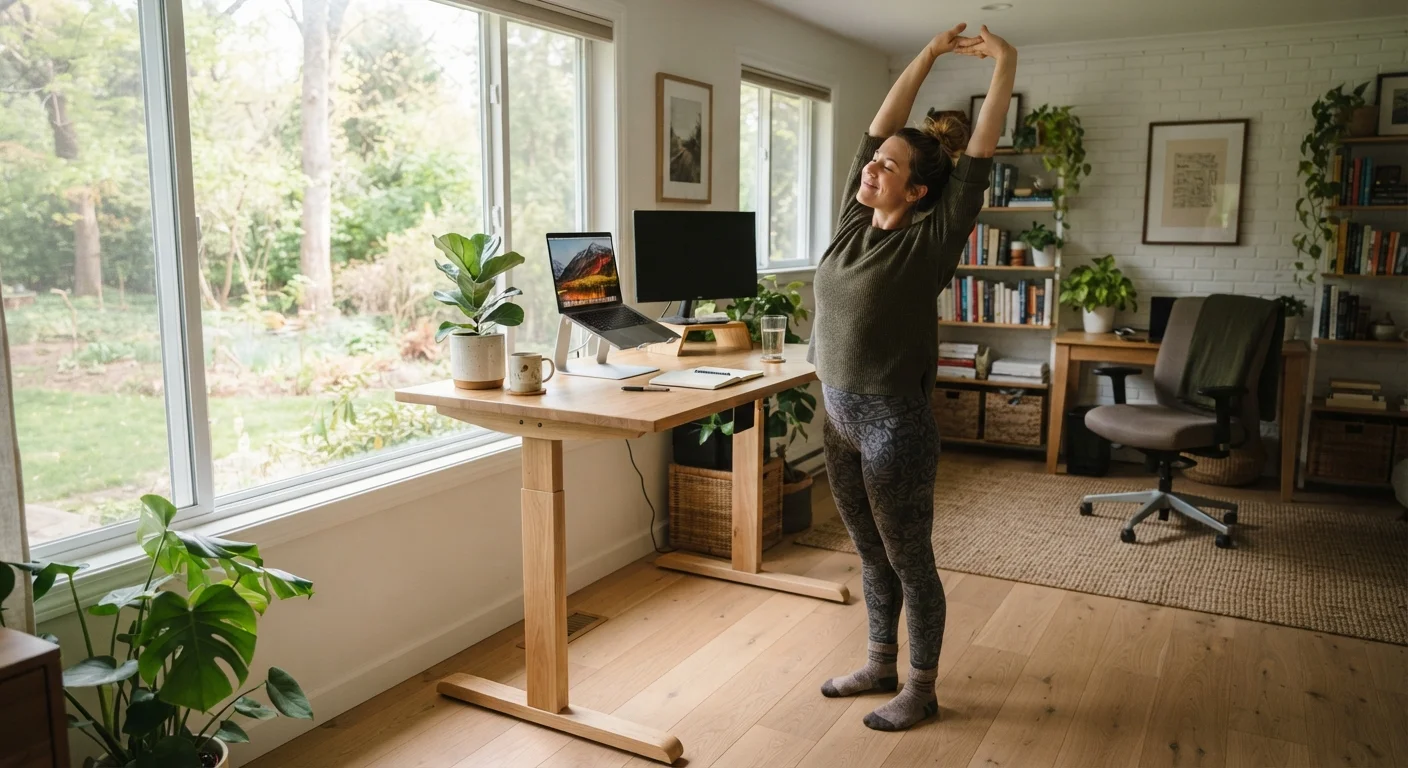
You don't need a full standing desk to spend more time on your feet. Placing your laptop on a stack of books or a sturdy box can create a temporary standing surface. Standing while reading a document, reviewing notes, or listening to a recorded meeting costs nothing and reduces cumulative seated time.
Alternating between sitting and standing — rather than standing all day — is the evidence-informed approach. Static standing for hours carries its own drawbacks, including lower-limb fatigue and varicose vein risk. Think of standing as an additional posture in your repertoire, not a replacement for sitting. Our related piece on standing desk trade-offs goes deeper on this balance.
Alternating between sitting and standing is more effective — and safer — than standing all day.
Making It Stick Over the Long Term
Individual strategies matter less than the habit system that holds them together. The most effective approach tends to be habit-stacking — anchoring movement to cues that already exist in your day. Standing during every phone call, walking at the start of your lunch break, doing a short stretch before you open your inbox: these micro-commitments require almost no willpower once they're conditioned.
Start With One Anchor Habit
Rather than overhauling your entire workday at once, choose a single movement anchor — such as standing during every phone call — and practice it consistently for two weeks before adding more. Behavioral research consistently shows that layering new habits gradually produces more durable change than wholesale routine overhauls. Once one behavior feels automatic, it becomes the foundation for the next.
It's also worth remembering that small increments accumulate. Physical activity guidelines from the U.S. Department of Health and Human Services count moderate-intensity activity in bouts as short as 10 minutes. Walking, stair climbing, and dynamic stretching all qualify. The daily movement habits that support healthy aging framework makes clear: how you move throughout the entire day may matter just as much as formal exercise sessions.
If you're considering workspace changes like a standing desk, weigh the trade-offs carefully — our honest look at standing desks and movement breaks covers the evidence in detail. And for a broader foundation, explore building a more active life from the ground up as a starting point.
This article is for general informational purposes only and does not constitute medical advice. If you have an existing health condition or injury, consult a qualified healthcare professional before changing your physical activity patterns.