
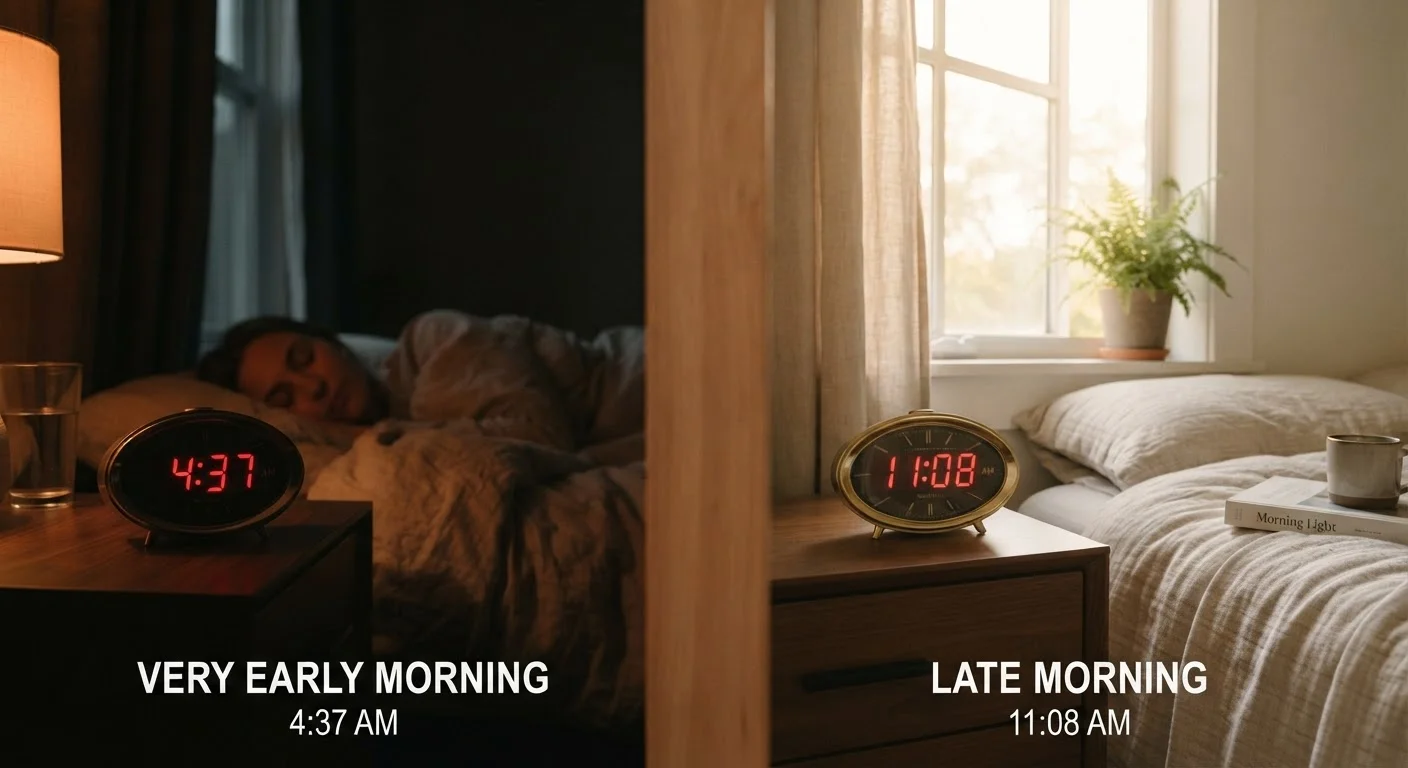
Why Sleep Duration Sits at the Center of the Conversation
Most Americans have heard the advice to get more sleep — and for good reason. But the conversation rarely addresses what happens at the other end of the dial. Spending too many hours in bed carries its own set of signals that are worth understanding. Sleep duration is one of the most accessible windows into overall health, and patterns that consistently stray from the middle — short or long — are worth paying attention to.
The American Academy of Sleep Medicine and the Sleep Research Society both recommend that adults aim for 7 to 9 hours of sleep per night for optimal health. That range isn't arbitrary; it reflects decades of population research linking durations within that window to better cognitive function, emotional regulation, and physical resilience. For a deeper look at the biology behind this, sleep science research continues to reveal how each stage of the night contributes to restoration.
Short Sleep: What Consistently Getting Too Little Actually Does
Short sleep — typically defined in research as fewer than six hours per night — is well-documented as a stressor on nearly every body system. The effects aren't just about feeling groggy the next morning.
- Cognitive performance: Sleep is when the brain consolidates memory and clears metabolic waste. Chronic short sleep is associated with reduced attention, slower reaction time, and impaired decision-making — even when people report feeling accustomed to less sleep.
- Mood and emotional regulation: The amygdala (the brain's threat-detection center) becomes more reactive with sleep loss, while the prefrontal cortex — which moderates emotional responses — functions less efficiently. This contributes to irritability, anxiety sensitivity, and reduced stress tolerance.
- Physical health signals: Research associates habitual short sleep with elevated markers of inflammation, disrupted glucose metabolism, and changes in appetite-regulating hormones. These are associations, not direct cause-and-effect guarantees, but they appear across multiple large studies.
What sleep deprivation actually does to the body over time goes deeper into the physiological changes that accumulate with sustained sleep loss — it's more nuanced than most people expect.
| Short Sleep (< 6 hrs) | Optimal Range (7–9 hrs) | Long Sleep (> 9 hrs) | |
|---|---|---|---|
| Cognitive function | Impaired attention and memory | Supported consolidation and clarity | Variable; often unrefreshing |
| Mood regulation | Increased irritability and reactivity | Stable emotional processing | Often linked to low mood or depression |
| Physical health associations | Elevated inflammation markers | Balanced metabolic function | May reflect underlying illness |
| Common causes | Work demands, poor habits, anxiety | Consistent routine and healthy sleep | Depression, sleep apnea, chronic pain |
| What it typically signals | Insufficient recovery time | Adequate nightly restoration | Potential underlying health issue |
| Recommended action | Review habits; consult provider if chronic | Maintain consistency | Consult a healthcare provider |
Long Sleep: When More Hours Isn't the Answer
Oversleeping — often defined as consistently exceeding nine hours — tends to fly under the radar. It can feel virtuous, even healthy. But when long sleep is a pattern rather than occasional recovery, it's usually a signal rather than a solution.
Researchers generally believe that long sleep is more often a symptom of an underlying issue than a cause of problems on its own. Conditions commonly associated with hypersomnia (excessive sleepiness or prolonged sleep) include depression, sleep apnea, thyroid disorders, chronic pain, and certain medications. When a person sleeps long and still wakes unrefreshed, that's a meaningful clue that something else may be disrupting sleep architecture.
That said, large epidemiological studies do find associations between habitual long sleep and elevated health risks — though interpreting these findings requires care. People with serious illness may sleep more because of their condition, which can make the data look as though long sleep causes the outcome when the relationship may run the other direction.
Understanding what happens during the night — not just how long it lasts — is key. Light sleep vs. deep sleep breaks down why hours alone don't tell the full story.
What Both Patterns Have in Common — and What to Do
Whether sleep is chronically short or long, both patterns share a common thread: they often reflect something happening in the body or mind that deserves attention. Neither extreme is simply a matter of willpower or scheduling.
If short sleep is your pattern, exploring sleep habits — including consistency of bedtime, light exposure, and evening routines — can be a useful starting point. Research consistently shows that regularity of sleep timing is among the most impactful modifiable factors. For a broader perspective, why consistent sleep may be the most underrated longevity tool frames sleep regularity within long-term health outcomes.
If long sleep is your pattern, particularly if it comes with daytime fatigue, low mood, or unrefreshing rest, that's a conversation to have with a healthcare provider. Tracking your sleep — including how you feel upon waking — can provide useful context. Understanding what sleep tracking data can and cannot tell you is worth reading before drawing firm conclusions from any device or app.
Track How You Feel, Not Just Hours
Total sleep time is a useful starting point, but how you feel within 30 minutes of waking is often more informative. Feeling alert and mentally clear most mornings — regardless of whether you slept 7 or 8.5 hours — generally suggests your sleep is working for you. Persistent grogginess, difficulty concentrating, or low mood are worth noting and discussing with a provider.
This article is for general informational purposes only and is not a substitute for professional medical advice, diagnosis, or treatment. If you are experiencing persistent sleep disturbances, please consult a qualified healthcare provider.