How Each Tool Actually Works
Understanding the mechanism behind each device helps clarify why they're not simply interchangeable.
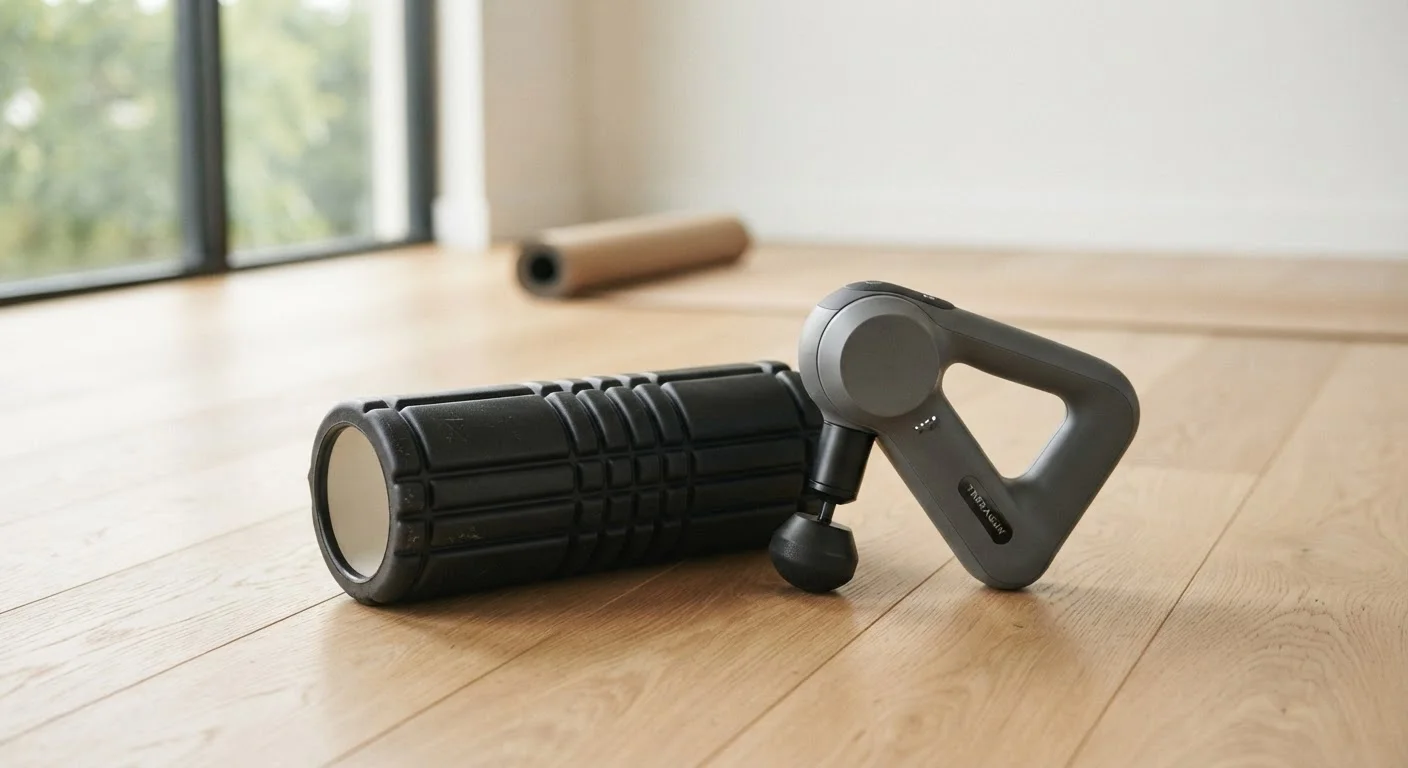
Foam rolling is categorized as self-myofascial release (SMR). When you roll over a muscle, you apply sustained, broad-surface compression that deforms the fascia — the connective tissue wrapping muscles and muscle groups. This sustained pressure is thought to stimulate mechanoreceptors (pressure-sensitive nerve endings) in the tissue, which in turn promotes a neurological relaxation response. The effect is partly mechanical and partly mediated by the nervous system. Research published in journals such as the Journal of Athletic Training suggests SMR can temporarily improve range of motion and reduce perceived muscle soreness, though the precise tissue-level mechanisms remain an active area of study.
Massage guns operate on percussive therapy: a motorized head oscillates at high frequency — typically 1,400 to 3,200 percussions per minute — delivering rapid, repetitive pulses into the muscle belly. Unlike the broad compression of a foam roller, a massage gun concentrates force on a small surface area. The pulsing action is hypothesized to activate the same mechanoreceptors but with greater specificity, while also promoting local circulation and potentially interrupting pain-signal feedback loops. Some research indicates that percussive devices may reduce muscle stiffness acutely and lower perceived effort in the following workout, though effect sizes are modest.
| Criterion | Foam Roller | Massage Gun |
|---|---|---|
| Primary mechanism | Sustained broad compression (SMR) | Rapid percussive pulses |
| Target area | Large muscle groups and fascia | Specific, focal muscle points |
| Depth of effect | Superficial to mid-depth fascia | Deeper muscle belly penetration |
| User control | Body weight adjusts pressure | Speed settings and attachment heads |
| Portability | Bulky; requires floor space | Compact; battery-powered |
| Typical cost | Lower cost | Higher cost |
| Learning curve | Low — intuitive for beginners | Moderate — risk of misuse |
| Noise level | Silent | Audible motor noise |
Practical Trade-Offs in Everyday Use
Mechanism matters, but so does real-world usability. Each tool has strengths that map to different situations.
Foam rollers excel at covering large, superficial muscle groups — quadriceps, hamstrings, thoracic spine, calves — with efficient, broad pressure. They require no battery, produce no noise, and the user controls intensity simply by shifting body weight. The learning curve is low, making them accessible for beginners. The main limitation is precision: it's difficult to isolate a single, deep trigger point in, say, the piriformis or the upper trapezius.
Massage guns shine in targeted, localized work. Because the device does the work rather than the user's body weight, the therapist-like force can be precisely directed. This makes them particularly useful post-exercise on specific fatigued muscles, or for warming up a single joint before activity. The trade-off is cost — quality percussive devices carry a higher price point — and the risk of applying too much pressure if the user is unfamiliar with the tool. Hard, bony structures and areas with significant nerve proximity (like the neck) require caution.
~20%
Reduction in DOMS perception after SMR
A meta-analysis in the International Journal of Sports Physical Therapy found foam rolling reduced DOMS perception by roughly 20% compared to control conditions.
1,400–3,200
Percussions per minute in typical devices
Most consumer-grade massage guns oscillate within this range, a frequency thought to saturate mechanoreceptors and modulate local pain signaling.
5–10 min
Effective SMR session duration studied
Most peer-reviewed protocols studying foam rolling benefits used sessions in the 5-to-10-minute range targeting individual muscle groups.
A practical guideline supported by sports science practitioners: use a foam roller for general mobility work covering multiple muscle groups, then follow with a massage gun on any focal areas that remain tight. The two tools complement rather than compete with each other.
This article is for general informational and educational purposes only and does not constitute medical advice. If you are experiencing persistent muscle pain, injury, or a chronic condition, please consult a qualified healthcare professional before beginning any recovery protocol.