Two Biological Systems, One Outcome
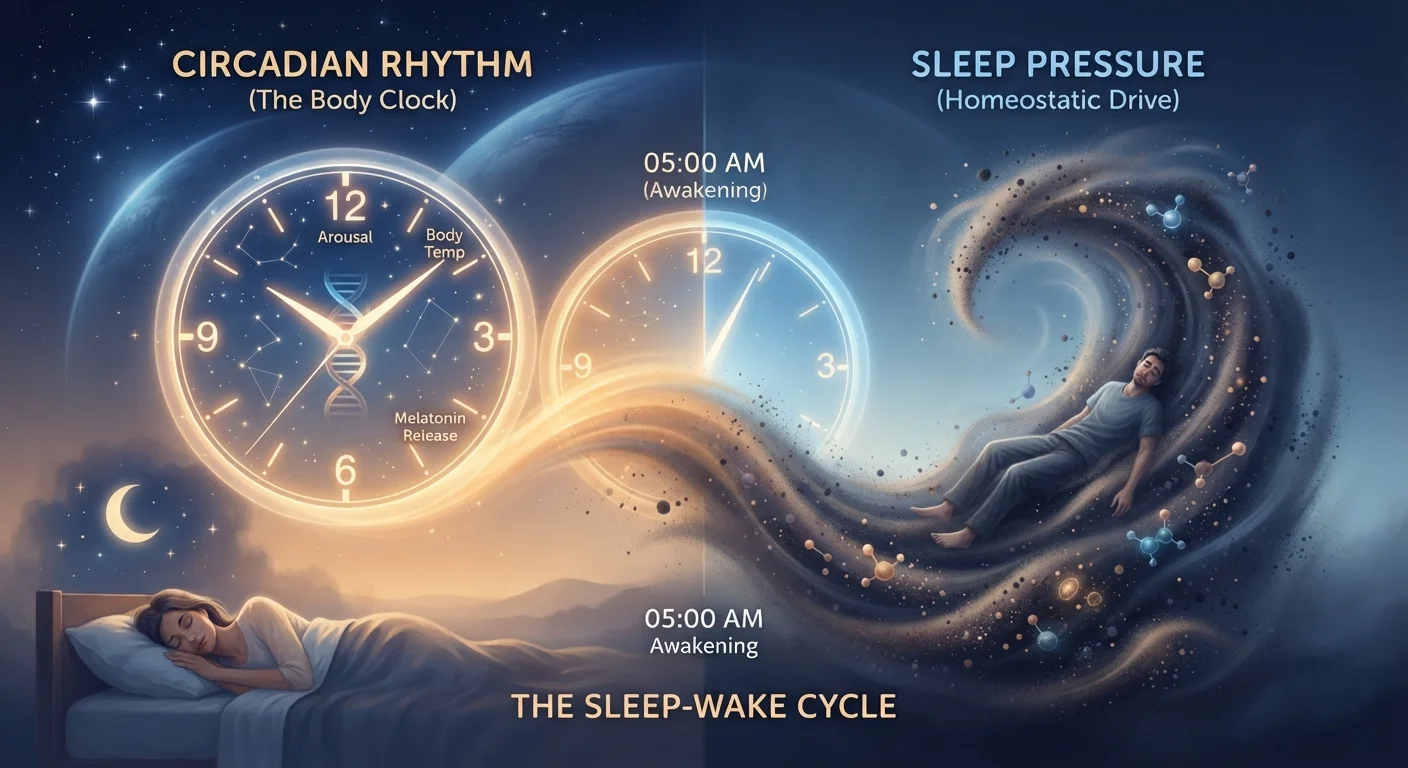
Sleep researchers describe the regulation of sleep and wakefulness through what is known as the two-process model, first formalized by sleep scientist Alexander Borbély in the 1980s. According to this model, two independent but interacting processes determine when you fall asleep, how long you stay asleep, and how restorative that sleep is.
Process C refers to the circadian rhythm — a roughly 24-hour biological clock embedded in a region of the brain called the suprachiasmatic nucleus (SCN). Process S refers to homeostatic sleep pressure, the progressively intensifying biological drive to sleep that accumulates during waking hours. Neither system alone dictates your sleep. Together, they create the conditions — or the obstacles — for quality rest.
As your body clock often matters more than your bedtime, the timing of sleep is frequently more consequential than total hours logged — and that's a direct reflection of how these two systems interact.
Circadian Rhythm: Your Internal 24-Hour Clock
The circadian rhythm is a genetically encoded timekeeping system found in virtually every cell of the body. The master pacemaker — the SCN, located in the hypothalamus — receives direct input from specialized light-sensitive cells in the retina called intrinsically photosensitive retinal ganglion cells (ipRGCs). These cells are particularly sensitive to blue-spectrum light, which is abundant in morning sunlight and in many artificial light sources.
Light exposure early in the day anchors the circadian clock to the local environment. In response, the SCN coordinates the release of hormones — most notably melatonin from the pineal gland — that signal to the body when it's time to sleep. Melatonin levels typically begin rising two hours before habitual sleep onset and suppress with morning light, effectively acting as a darkness signal rather than a sedative.
The circadian system also actively promotes wakefulness during the day through a mechanism researchers call the wake-maintenance zone — a period in the late afternoon and early evening when the clock sends its strongest alerting signals, often counteracting rising sleep pressure. This is why many people experience a paradoxical second wind in the early evening even after a long day.
Disrupting the circadian clock — through night shift work, irregular schedules, or extensive travel across time zones — has measurable effects on metabolic, immune, and cognitive function. Morning and evening light send opposite signals to your brain, making light exposure one of the most powerful levers for managing circadian alignment.
Sleep Pressure: The Accumulating Drive to Rest
Sleep pressure — formally called homeostatic sleep drive or Process S — operates entirely separately from the circadian clock. It is governed by the progressive buildup of adenosine, a byproduct of neuronal metabolism that accumulates in the brain throughout the waking day. The longer you are awake, the more adenosine accumulates, and the stronger the biological urge to sleep becomes.
During sleep, particularly slow-wave (deep) sleep, adenosine is cleared from the brain. This is why a full night of sleep feels restorative: it essentially resets the adenosine slate. Shorter or fragmented sleep only partially clears it, leaving residual pressure — commonly experienced as grogginess, impaired concentration, or the kind of fatigue that persists even after feeling like you slept enough.
Caffeine works by blocking adenosine receptors rather than reducing adenosine itself. This is an important distinction: caffeine masks the subjective sensation of sleepiness without eliminating the underlying pressure. When caffeine wears off, the accumulated adenosine reasserts itself — a mechanism behind the familiar afternoon energy crash.
| Criterion | Circadian Rhythm | Sleep Pressure |
|---|---|---|
| Biological basis | SCN master clock; gene expression cycles | Adenosine accumulation in the brain |
| Primary driver | Light-dark cycle (especially blue light) | Duration of continuous wakefulness |
| Key hormone/molecule | Melatonin, cortisol | Adenosine |
| Resets with | Consistent light exposure and sleep timing | Sleep (especially slow-wave sleep) |
| Disrupted by | Irregular schedules, night light, shift work | Naps, insufficient sleep, caffeine use |
| Role in sleep quality | Determines timing and sleep stage architecture | Determines depth of slow-wave (deep) sleep |
| Can be "tricked"? | Partially, via light therapy or melatonin | Temporarily, via caffeine (masks adenosine) |
Sleep pressure also explains why naps require careful timing. A brief nap dissipates some adenosine and reduces pressure, which can make falling asleep at your regular bedtime harder if the nap occurs too late in the day. Fixed sleep schedules and flexible approaches each carry trade-offs that are deeply rooted in how sleep pressure behaves over the course of a day.
When the Two Systems Align — and When They Don't
Optimal sleep occurs when circadian timing and homeostatic sleep pressure converge. When your circadian clock signals that it's nighttime and your adenosine levels are high after a full day of wakefulness, sleep onset is typically rapid, sleep architecture is well-organized, and both deep and REM sleep occur in appropriate proportions.
Misalignment between the two systems is the root cause of many common sleep difficulties. A night owl who must wake at 5 a.m. for work is fighting a circadian system still in its nighttime phase. Someone who sleeps in on weekends resets their clock later — a phenomenon called social jet lag — making Monday mornings feel like international travel. And anyone pulling an all-nighter accumulates extreme adenosine pressure while simultaneously disrupting the circadian architecture of the following sleep episode.
Stress adds another layer of complexity. Elevated cortisol, the body's primary stress hormone, can suppress melatonin secretion and fragment sleep architecture, effectively interfering with both systems at once. Poor sleep raises cortisol, and elevated stress disrupts sleep — a cycle that is easier to break once you understand the underlying biology.
Individual variation matters here too. Genetic chronotype — the biological tendency to be a morning type or an evening type — shifts the circadian clock's timing relative to the clock on the wall. Night owls and early birds differ in ways that go beyond mere habit, with real consequences for sleep health when schedules don't accommodate those differences.
This article is for general informational and educational purposes only and is not a substitute for professional medical advice, diagnosis, or treatment. If you have concerns about your sleep health, consult a qualified healthcare provider.