
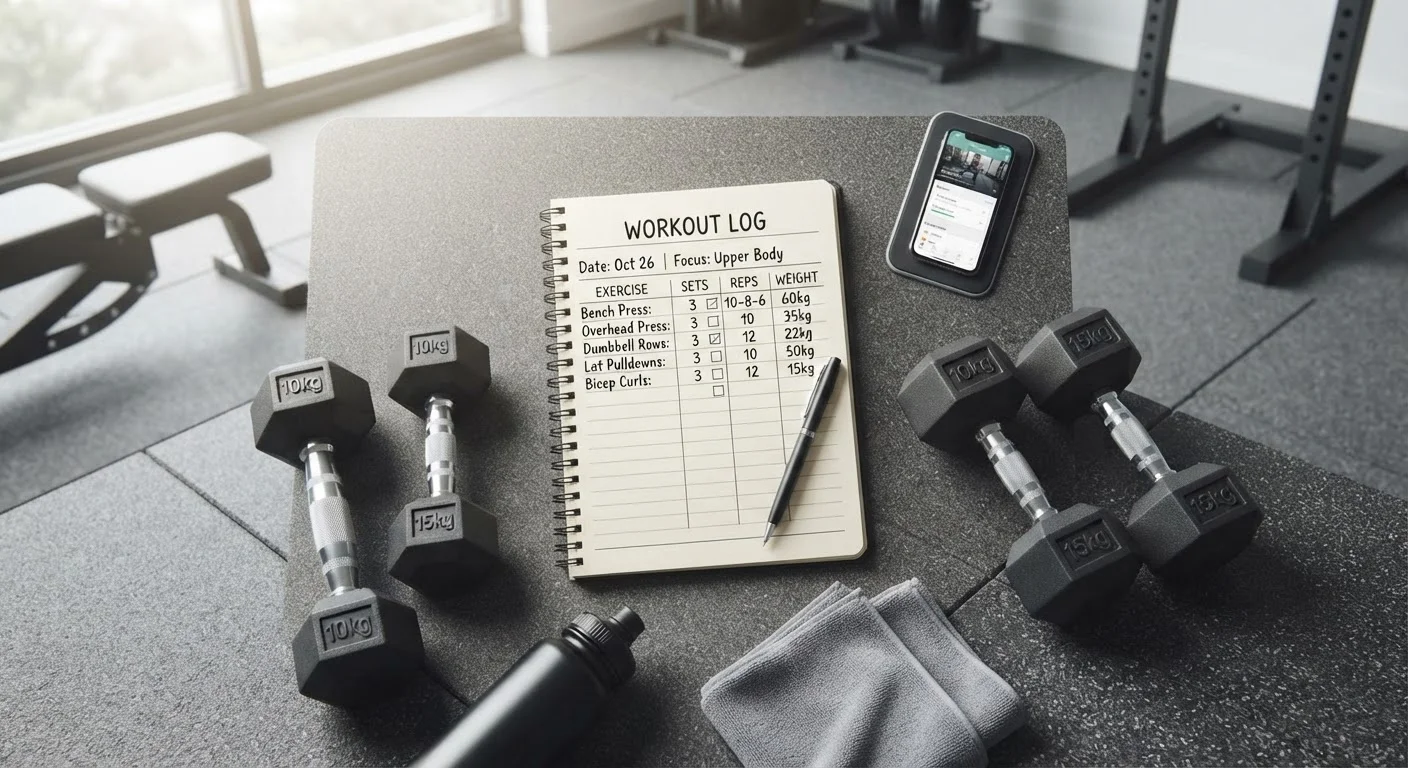
The Core Building Blocks: Rep, Set, and Rest Defined
If you've ever stared at a workout plan and felt lost at "3x10" or "rest 90 seconds," you're not alone. These shorthand instructions describe the fundamental structure of almost every resistance and cardio program. Once you understand what they mean, reading and following a workout becomes far less intimidating.
Rep (Repetition)
One complete execution of a movement from start to finish. For example, lowering and raising a dumbbell counts as one rep of a bicep curl.
Set
A group of consecutive reps performed without a rest break. "Three sets" means you perform the exercise group three separate times, with rest in between.
Rest Period
The deliberate pause between sets that allows muscles to partially recover. Appropriate rest duration depends on your training goal.
Progressive Overload
The principle of gradually increasing training demand over time — through more weight, more reps, or less rest — to continue stimulating adaptation.
Volume
The total amount of work in a session or week, often estimated as sets × reps × load. Managing volume is key to balancing stimulus and recovery.
Hypertrophy
The physiological process by which muscle fibers increase in size, typically stimulated by moderate-to-high rep training with adequate tension and volume.
A rep (short for repetition) is one complete movement — one push-up from start to finish, for example. A set is a group of consecutive reps performed without stopping. So "3 sets of 10 reps" means you perform 10 push-ups, rest, do 10 more, rest again, then do a final 10. The notation "3x10" is simply shorthand for the same thing.
Rest is the deliberate pause between sets. It isn't optional — it's when your muscles partially recover so you can perform the next set with adequate effort. For a broader look at how rest and recovery fit into your overall program, see why rest days are part of your training.
How Rep Ranges Shape Your Training Outcome
Not all rep ranges are created equal. Exercise science generally associates different rep ranges with different physiological adaptations, though there is meaningful overlap and individual variation matters.
| Low rep range (1–5 reps) | Primarily targets maximal strength (NSCA Essentials of Strength Training and Conditioning) |
| Moderate rep range (6–12 reps) | Associated with muscle hypertrophy (size) (NSCA Essentials of Strength Training and Conditioning) |
| Higher rep range (15+ reps) | Emphasizes muscular endurance (NSCA Essentials of Strength Training and Conditioning) |
| Overlap in outcomes | Muscle can be built across a wide rep range when effort is sufficient (Schoenfeld et al., Journal of Strength and Conditioning Research, 2017) |
These ranges are starting points, not rigid rules. Research suggests that muscle can be built across a fairly wide rep range when effort is appropriately high. What matters most is that you're working with enough challenge to stimulate adaptation — this is the principle of progressive overload, meaning you gradually increase the demand on your muscles over time.
If you're new to structured training and want context for how these concepts fit into a complete program, Starting a Workout Routine From Scratch covers frequency, effort levels, and realistic expectations in plain terms.
Rest Periods: Why the Pause Is Part of the Work
Rest duration between sets directly affects what your body can do in the next set — and by extension, what adaptations you're training for.
Shorter rest periods (30–60 seconds) keep metabolic stress high, which is often used in muscular endurance or conditioning-style circuits. Moderate rest (60–90 seconds) suits general fitness and hypertrophy (muscle-building) work. Longer rest (2–5 minutes) is typical for strength-focused training, where you need near-full recovery to lift heavy loads safely and effectively.
Ignoring rest and rushing through sets often leads to degraded form and reduced output — not more efficiency. Think of rest as the space where your next set is prepared, not time wasted.
Rest between workouts matters just as much. Building a recovery routine from scratch is a practical guide to the pillars of recovery — rest, nutrition, and stress management — that support your training between sessions.
Putting It Together: Reading a Workout Plan
Most written workout plans follow a predictable format. Here's how to decode common notation:
- 3x10 @ RPE 7 — 3 sets of 10 reps at a perceived exertion of 7 out of 10 (moderately hard)
- 4x6, rest 3 min — 4 sets of 6 reps with 3 minutes of rest between each set
- 2x12–15 — 2 sets, aiming for anywhere from 12 to 15 reps depending on how you feel
- AMRAP (As Many Reps As Possible) — perform as many quality reps as you can in a set or time window
Volume — the total amount of work done, roughly calculated as sets × reps × load — is one of the key variables coaches and trainers adjust to manage your training stimulus. Beginners typically start with lower volume and build gradually.
For a deeper look at common fitness terminology including RPE, HIIT, and periodization, Key Terms Every New Exerciser Should Understand is a clear, no-fluff glossary worth bookmarking.
This article is for general informational and educational purposes only and is not a substitute for personalized guidance from a qualified fitness or healthcare professional. If you have any health conditions or concerns, consult a professional before starting a new exercise program.