
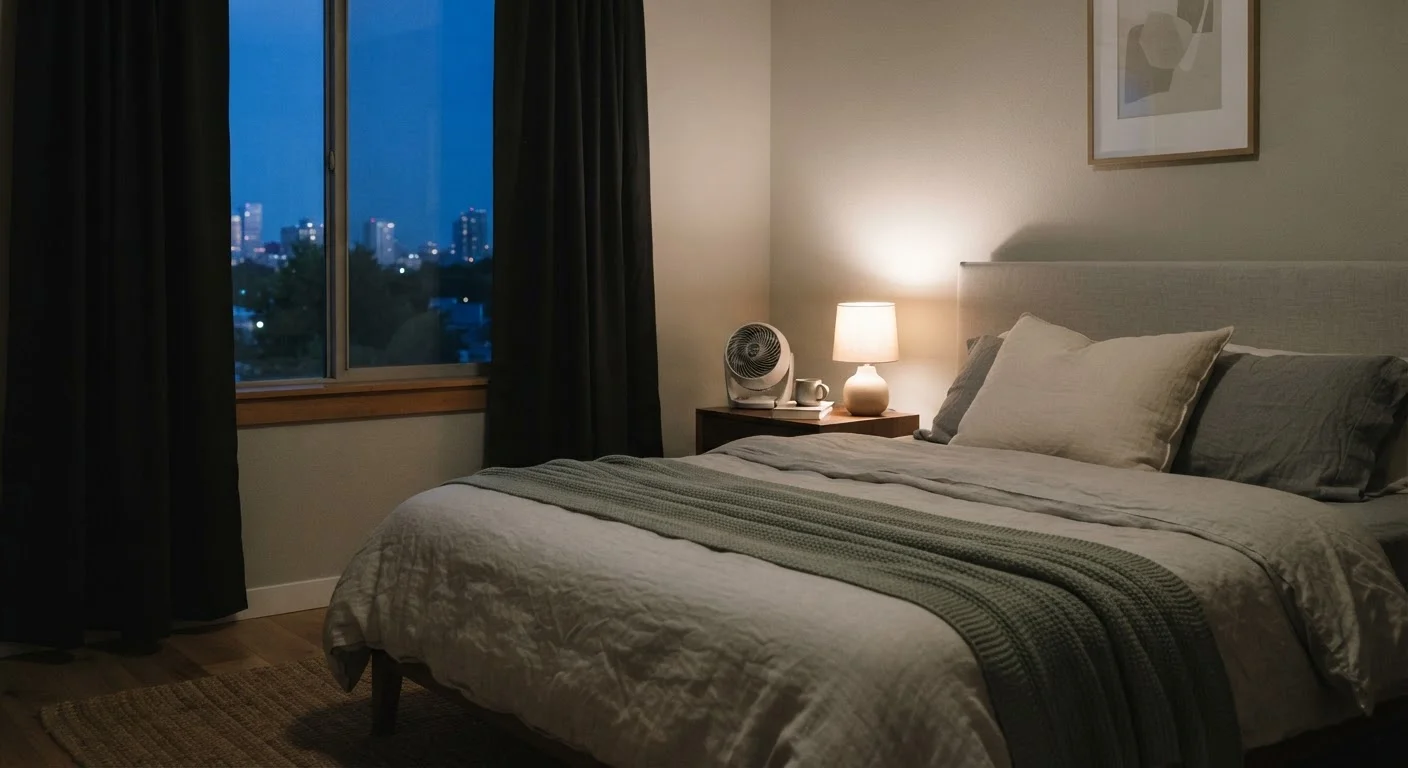
Why Your Sleep Environment Is a Mental Wellness Tool
Most conversations about sleep focus on habits: consistent bedtimes, limiting caffeine, winding down with a book. Those matter — but the physical space where you sleep is equally important and often overlooked. Your bedroom environment sends continuous signals to your nervous system throughout the night, influencing how quickly you transition between sleep stages and how deeply you stay there.
To understand why environment matters so much, it helps to know how sleep architecture works. As explained in our guide to sleep cycles and stages, your brain moves through light sleep, deep sleep, and REM sleep in repeating cycles. Disruptions to any cycle — triggered by a noise spike, a sudden temperature change, or a flash of light — can push you back into lighter sleep stages, reducing the restoration your brain and body actually need. Over time, that adds up to impaired mood, attention, and emotional resilience.
The good news: temperature, light, and noise are all modifiable. Here's what the research suggests and how to put it to work.
Temperature: The Most Underrated Sleep Variable
Your core body temperature naturally drops as you approach sleep — a process your bedroom environment can support or fight against. Research consistently points to a room temperature somewhere in the range of 65–68°F (18–20°C) as conducive to quality sleep for most adults, though individual comfort varies.
Set your thermostat between 65–68°F before bed
A cooler room temperature supports the natural drop in core body temperature that initiates sleep. Sleeping in an environment that is too warm tends to increase nighttime waking and reduce time spent in deep, restorative sleep stages.
Use blackout curtains or a sleep mask to achieve genuine darkness
Even low-level ambient light during sleep can interfere with melatonin levels and sleep quality. True darkness signals to the brain that nighttime is underway and helps sustain deeper sleep stages through the night.
Use consistent background sound to mask unpredictable noise
Sudden, variable sounds trigger brief arousals from sleep that fragment sleep cycles without full waking. A steady ambient sound masks these spikes and creates a more predictable acoustic environment your brain can tune out.
Remove or cover all light-emitting devices in the bedroom
Standby indicators, charging lights, and alarm clock displays contribute to cumulative light exposure during sleep. Covering or eliminating these sources reinforces the darkness your brain needs to maintain melatonin production overnight.
Choose breathable, natural-fiber bedding to support temperature regulation
Synthetic bedding traps heat and moisture more readily than natural fibers, which can undermine the body's attempts to cool down during sleep. Materials like cotton and linen allow better air circulation and moisture wicking.
If cooling your whole home isn't practical, a fan directed at the bed, breathable natural-fiber bedding, or a cooling mattress pad can help approximate that thermal drop. Conversely, sleeping too warm tends to fragment sleep, particularly during the deep slow-wave stages your body needs most for physical recovery and immune function.
Light: How Even a Little Undoes a Lot
Light is the most powerful external regulator of circadian rhythm — the internal 24-hour clock that governs when you feel sleepy or alert. Your eyes contain specialized cells that are especially sensitive to blue-spectrum light (the kind emitted by screens and many LED bulbs). Exposure to this light in the hour or two before bed suppresses melatonin, the hormone that signals it's time to sleep.
But light matters at night too, not just before bed. Research from Harvard Medical School and other institutions has shown that even low-level light exposure during sleep — from a streetlight seeping under a curtain, a TV on standby, or a glowing phone — can affect sleep quality and next-day alertness. Blackout curtains or a well-fitted sleep mask offer the most reliable solution. If you need a light on for safety or navigation, a dim amber or red-toned nightlight minimizes circadian disruption compared to white or blue light.
This is also where evening screen habits and bedroom design intersect. Moving the TV out of the bedroom and charging your phone in another room are among the most evidence-supported changes you can make. For a practical starting point, our bedroom environment checklist walks through an easy room-by-room audit.
Noise: Finding Your Optimal Acoustic Environment
Complete silence isn't necessarily the goal — and for many people, it's actually harder to sleep in. What disrupts sleep most is unpredictable, variable noise: a car alarm, a partner's movements, or a phone notification. Your brain continues monitoring the auditory environment during sleep, and sudden sounds can trigger brief arousals even without fully waking you.
Consistent background sound — often called "white noise," though pink noise and brown noise have also been studied — can mask these unpredictable spikes and create a more stable acoustic environment. A basic fan, a white noise machine, or a free audio app can serve this function. If your environment is relatively quiet but still disruptive, earplugs rated for sleep comfort are another option. The key is consistency: your brain habituates to steady sounds over time, allowing deeper sleep.
Partners who snore present a particular challenge. Addressing snoring — which can be a sign of sleep apnea and warrants a conversation with a healthcare provider — benefits both people in the bedroom. In the meantime, positional changes, nasal strips, or separate sleep schedules for part of the night may reduce disruption while longer-term solutions are explored.
All three of these environmental factors — temperature, light, and noise — complement the behavioral habits described in our nightly sleep hygiene routine guide. Together, they form the foundation of consistent, restorative sleep that supports everyday emotional balance.
This article is for general informational purposes only and is not a substitute for professional medical advice. If you have ongoing sleep difficulties or suspect a sleep disorder, please speak with a qualified healthcare provider.