From Lights Out to Morning: The Cycle Framework
Sleep is not a uniform off switch. From the moment you fall asleep, your brain moves through a predictable architectural sequence — a cycle of distinct stages that repeats throughout the night. Understanding this structure is foundational to understanding why sleep quality, not just duration, shapes how you feel and function.
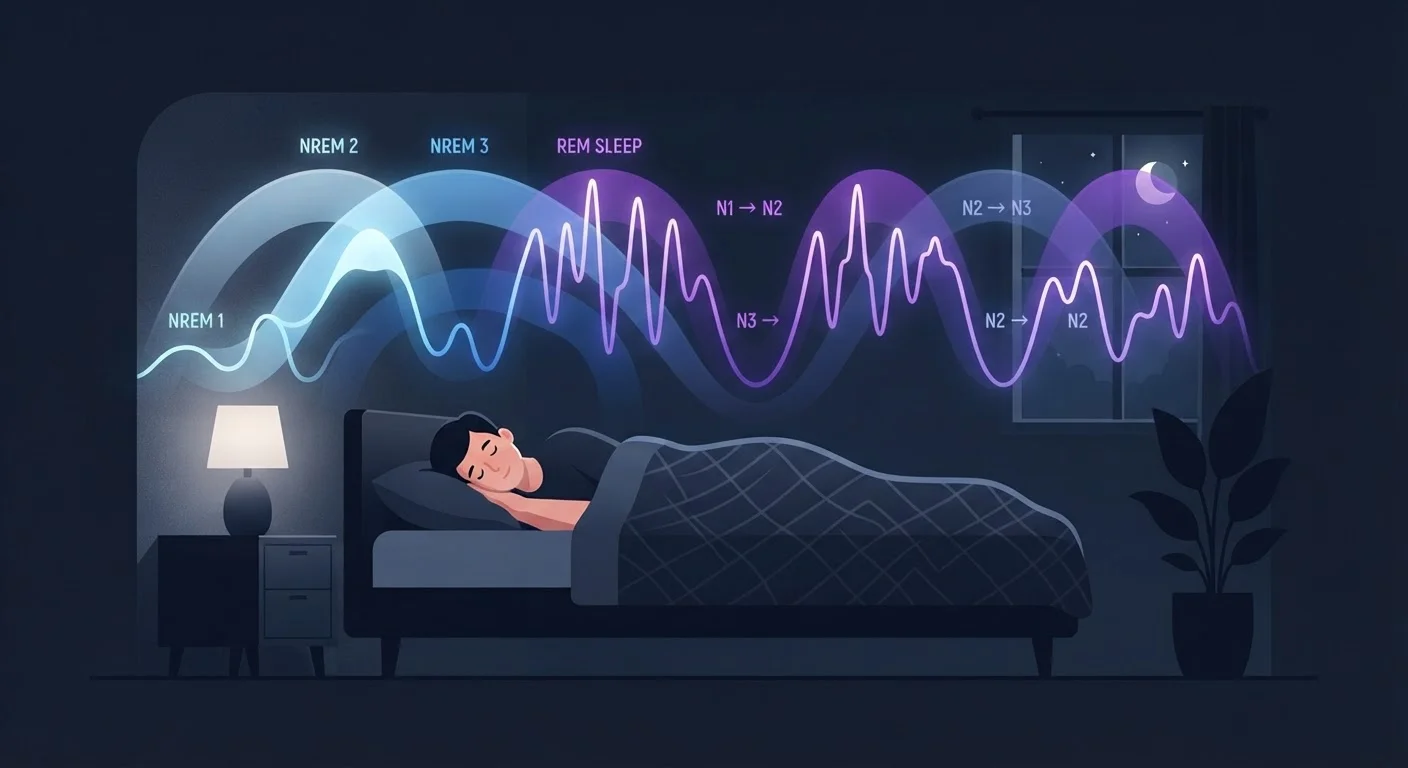
Each cycle runs approximately 90 minutes and passes through four stages: three non-REM (NREM) stages designated N1, N2, and N3, followed by REM sleep. The cycle then restarts. A typical 7–8 hour night produces four to five complete cycles, though the internal composition of those cycles changes dramatically as the night unfolds. For a broader orientation to how sleep works, see our plain-language introduction to sleep science.
The Four Stages: What Each One Does
N1 — The Transition (1–7 minutes): The lightest stage, N1 is the brief bridge between wakefulness and sleep. Muscle activity slows, eye movements become rolling and slow, and the brain shifts from alert beta waves toward slower theta waves. This stage is easily disrupted — a noise or light touch can return you to full wakefulness without your awareness that you'd drifted off at all.
N2 — Consolidated Light Sleep (10–25 minutes per cycle): N2 accounts for the largest share of total sleep time across a full night — roughly 45–55% in healthy adults. The brain produces bursts of activity called sleep spindles and isolated high-voltage waves called K-complexes, both associated with memory consolidation and the brain's effort to stay asleep despite external stimuli. Core body temperature drops and heart rate slows during this stage.
N3 — Deep or Slow-Wave Sleep (20–40 minutes in early cycles): The most physically restorative stage, N3 is characterized by high-amplitude, low-frequency delta waves. Growth hormone secretion peaks during this stage. Tissue repair, immune function, and cellular restoration are concentrated here. N3 dominates the first two cycles of the night and shrinks substantially in later cycles.
REM — Rapid Eye Movement Sleep: REM is the stage most associated with vivid dreaming, though dreaming can occur in NREM as well. The brain is electrically active — patterns resemble wakefulness — while voluntary muscles are temporarily paralyzed, a state called atonia. REM supports emotional memory processing, learning consolidation, and cognitive flexibility. REM periods are shortest early in the night (often 10–20 minutes) and can extend to 45–60 minutes in the final cycles before waking.
~90 min
Duration of one full sleep cycle
The American Academy of Sleep Medicine describes each NREM-REM cycle as lasting approximately 90 minutes in healthy adults.
45–55%
Proportion of sleep spent in N2
N2 light sleep accounts for the largest single share of total sleep time across a healthy adult night, according to established polysomnographic norms.
4–6
Cycles completed in a typical night
A standard 7–8 hour sleep period produces approximately four to five complete NREM-REM cycles for most healthy adults.
Up to 60 min
REM duration in final cycles
REM periods grow progressively longer through the night, with the last REM episode before waking sometimes lasting up to an hour.
Why the Balance Between Stages Matters
The sequential shift across the night — more deep sleep early, more REM late — is not arbitrary. Early slow-wave sleep clears the brain's adenosine load (the chemical signal that builds sleep pressure throughout the day) and primes the biological systems that regulate growth and repair. Late-night REM then performs the cognitive and emotional processing work that requires a relatively rested brain.
Disrupting either end of the night carries specific costs. Going to bed late or waking artificially early both disproportionately cut REM, since most REM is concentrated in the final 90 minutes. For a side-by-side look at how light and deep sleep contribute differently to recovery, see what each stage contributes to recovery.
Alcohol, certain medications, and irregular sleep schedules can suppress specific stages without eliminating sleep entirely — a distinction that explains why someone may log eight hours and still feel unrested. Total time in bed is only one dimension; architectural integrity is the other.
Practical Implications for Sleep Health
Knowing how sleep cycles work translates into a few consistent, evidence-informed principles. First, consistency matters more than catch-up: keeping a stable sleep and wake time stabilizes your circadian rhythm and helps ensure you enter N3 efficiently at the start of each night. Second, the last hour before your alarm is disproportionately rich in REM — cutting sleep short by even 60–90 minutes significantly reduces REM exposure. Third, behaviors that fragment sleep — late caffeine, bright light exposure close to bedtime, or untreated sleep apnea — interrupt cycle completion, even if total hours appear adequate.
For practical routines that support the full cycling process, building a nightly routine that actually sticks offers evidence-informed habit guidance. And if you're looking for a deeper dive into the individual stages, sleep stages decoded provides a detailed breakdown of REM, light, and deep sleep.
This article is for general informational and educational purposes only and does not constitute medical advice. If you have concerns about your sleep health, please consult a qualified healthcare professional.