
The Case for Consistent Bedtimes
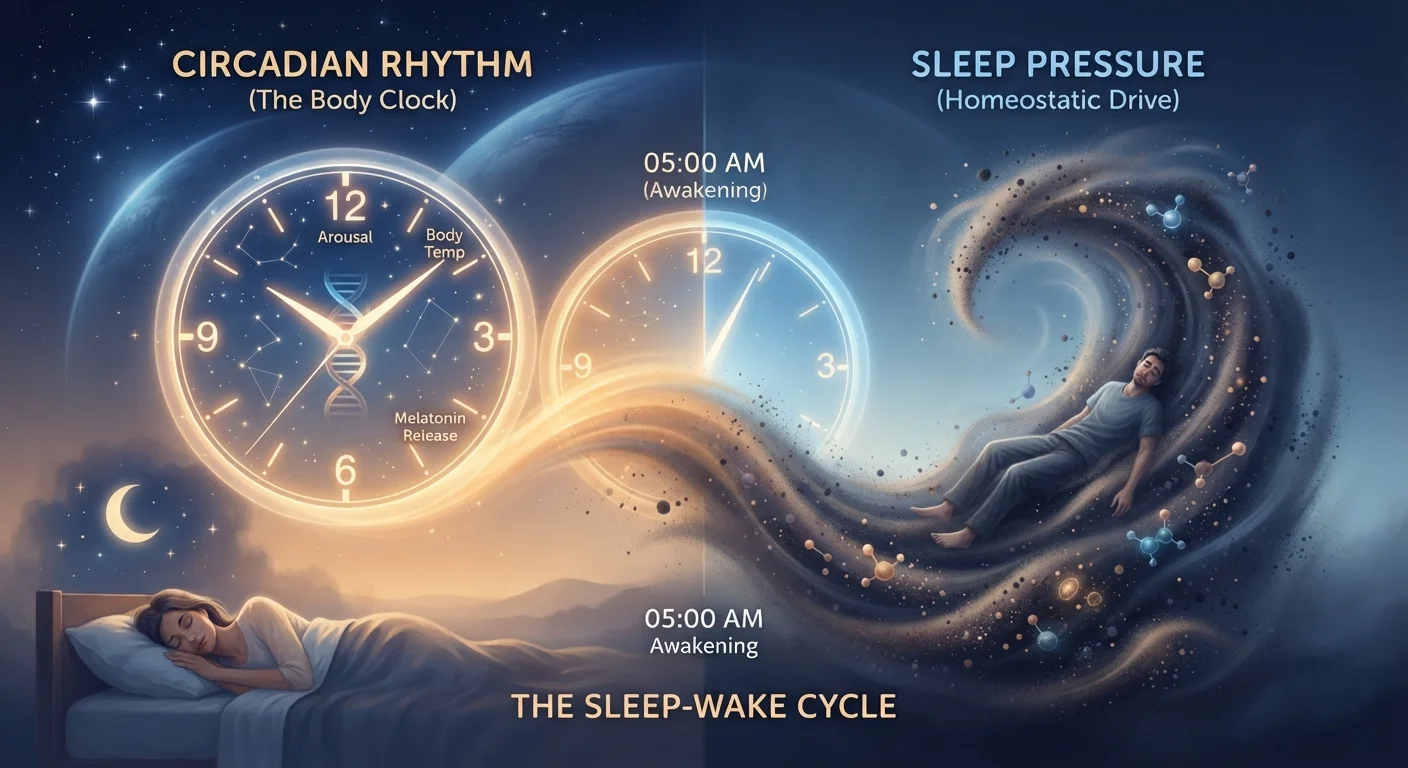
Your body runs on a roughly 24-hour internal clock — the circadian rhythm — governed primarily by the suprachiasmatic nucleus in the brain. This clock regulates not just sleepiness but also hormone release, metabolism, immune function, and body temperature. When your sleep and wake times are predictable, these systems synchronize efficiently.
Research consistently shows that sleep regularity — going to bed and waking at the same times each day — is independently associated with better sleep quality, faster sleep onset, and improved mood and cognitive function. A large 2023 study published in Sleep found that irregular sleep timing predicted worse metabolic health markers even when total sleep duration was adequate. The concept of social jetlag — the misalignment between your biological clock and your social schedule — captures this well: people whose weekend sleep schedules drift more than two hours from their weekday pattern show increased risk of obesity, cardiovascular issues, and depressive symptoms.
To understand why timing matters so much, see why your body clock matters more than your bedtime. A fixed schedule also builds sleep pressure predictably: the steady accumulation of adenosine (a sleep-promoting molecule) throughout the day peaks at a consistent time, making it easier to fall asleep and stay asleep.
| Consistent Bedtimes | Listening to Your Body | |
|---|---|---|
| Circadian alignment | Strong — anchors internal clock reliably | Variable — depends on signal accuracy |
| Sleep onset ease | Improves with routine over time | Can be good if fatigue cues are genuine |
| Flexibility for lifestyle | Lower — requires discipline on weekends | Higher — adapts to daily variation |
| Risk of social jetlag | Low when schedule is maintained | Higher with irregular timing patterns |
| Suited to modern lifestyle | Yes — counteracts artificial-light disruption | Less so — modern cues distort fatigue signals |
| Best evidence base | Strong clinical and population-level research | Supported in controlled / low-stimulation settings |
The Case for Listening to Your Body
The intuitive approach — sleeping when you feel tired and waking without an alarm — is rooted in the idea that your body knows what it needs. In controlled conditions, this logic holds: research on hunter-gatherer populations with minimal artificial light exposure shows that people naturally synchronize with environmental cues and sleep at times aligned with their chronotype.
There are legitimate situations where following fatigue signals makes sense. During recovery from illness, intense exercise blocks, or periods of significant stress, your body may genuinely require more sleep than a fixed schedule provides. Forcing yourself awake at a rigid time when your body is mid-repair is unlikely to serve you well.
The problem is that modern life degrades the accuracy of fatigue signals. Artificial light suppresses melatonin into the late evening, creating a misleading sense of alertness. Caffeine blocks adenosine receptors, masking real sleepiness. Screens and social stimulation override natural wind-down cues. When these factors are in play, "listening to your body" can translate to staying up two hours past your biological optimal and then sleeping in to compensate — a cycle that fragments circadian alignment. Those evening habits that work against a restful night frequently distort the very signals people are trying to follow.
How to Choose — and How to Combine Both
The practical answer for most adults is a structured-flexible hybrid: anchor your wake time rigidly (within 30 minutes, even on weekends) while allowing your bedtime modest flexibility based on genuine sleepiness cues. The fixed wake time is the more powerful lever — it consistently resets circadian timing and controls sleep pressure buildup regardless of when you fell asleep.
Chronotype matters here. If you are a confirmed evening type ("night owl"), a 10 p.m. bedtime imposed externally may produce worse outcomes than a midnight-to-8 a.m. schedule that respects your biology. Where your life allows, aligning your schedule to your chronotype reduces the biological cost of structure. If you cannot shift your schedule, gradual 15-minute adjustments toward your target bedtime — rather than abrupt changes — tend to be better tolerated by the circadian system.
A few practical guidelines:
- Protect your wake time above all else — it is the strongest circadian anchor available to you.
- Use sleepiness, not just the clock, to decide when to get into bed — lying awake in bed erodes the brain's association between bed and sleep.
- Audit your evening environment before concluding your body wants to stay up; dim lights and limiting screens for 60–90 minutes before your target bedtime often reveal fatigue that was masked.
- Track patterns over weeks, not nights — single-night variation is less meaningful than consistent trends.
For a broader view of why this consistency pays dividends over time, consistent sleep is among the most underrated longevity tools available. And if you want to understand the disease-prevention dimension, the research on sleep consistency and long-term disease prevention is compelling.
This article is for general informational and educational purposes only and does not constitute medical advice. If you are experiencing persistent sleep difficulties or have an underlying health condition, consult a qualified healthcare professional.