
What Your Body Clock Actually Does
Most people think of sleep as something that simply happens when they are tired enough. In reality, the timing of sleep is actively orchestrated by a biological timekeeping system that runs continuously — even when you are awake. This system, your circadian rhythm, generates near-24-hour oscillations in physiology that determine when your body expects to sleep, eat, and perform peak cognitive or physical work.
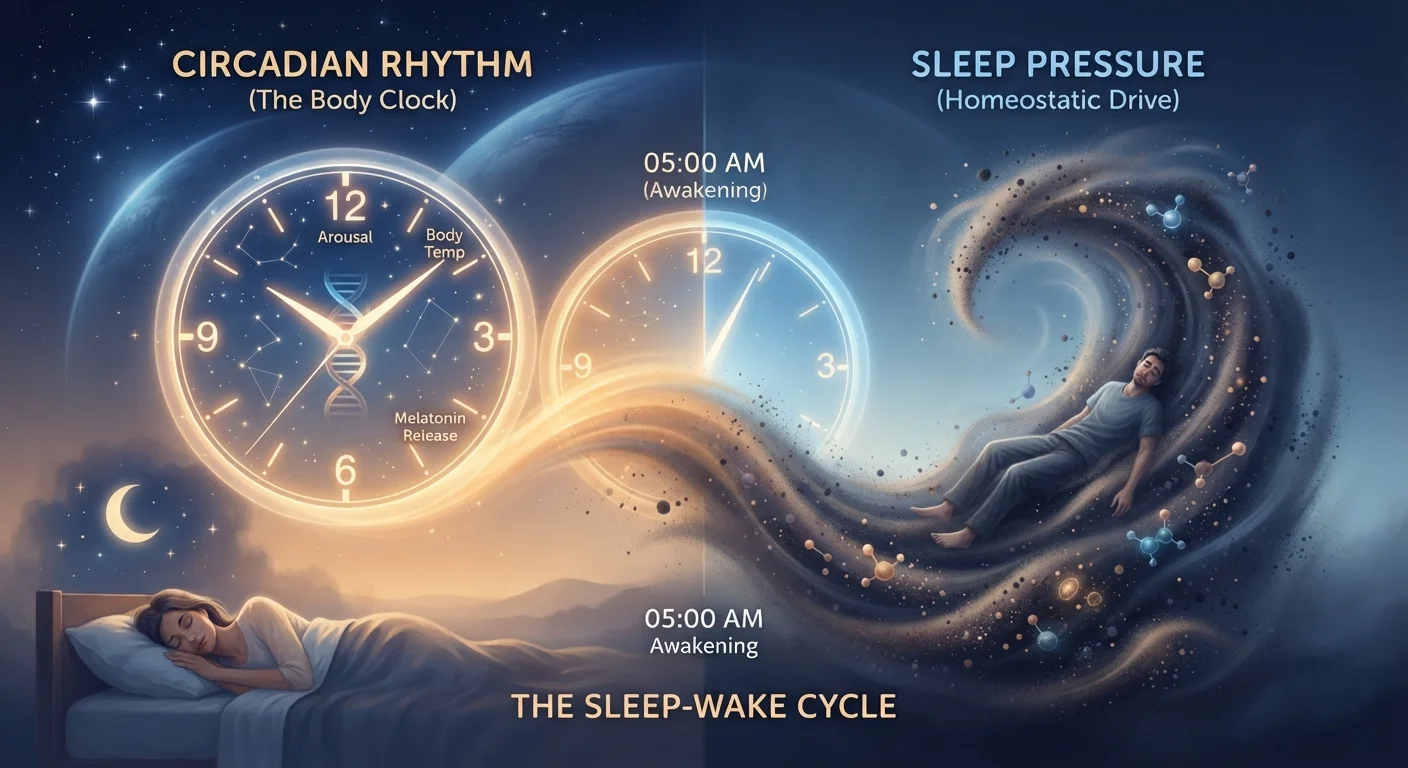
The master pacemaker is a region of the hypothalamus called the suprachiasmatic nucleus (SCN). It receives direct input from light-sensitive cells in the retina and uses that information to synchronize your biology with the external environment. When light dims in the evening, the SCN signals the pineal gland to release melatonin, a hormone that promotes sleep onset. Core body temperature also begins to drop — a process tightly linked to circadian timing and explored further in our article on how temperature affects sleep.
Critically, the SCN does not just govern the brain — it coordinates peripheral clocks in the liver, gut, heart, and skeletal muscle. When your behavioral schedule falls out of sync with these clocks, the downstream effects extend well beyond grogginess.
Why Timing Beats Total Hours
A common belief is that sleeping eight hours guarantees good rest regardless of when those hours occur. The science tells a more nuanced story. Sleep is not a uniform state; it cycles through distinct stages — light non-REM, deep slow-wave sleep (SWS), and rapid eye movement (REM) sleep — and the proportion of each stage shifts across the night. SWS, which is most critical for physical repair and memory consolidation, is heavily front-loaded in the early part of the night. REM sleep, important for emotional processing and cognitive integration, predominates in the final hours before a natural wake time.
When you routinely shift your sleep window later or vary it from night to night, you disrupt the alignment between these sleep stages and the circadian signals that promote them. The result can be a full eight hours that is nevertheless low in SWS or REM — and you may wake feeling unrefreshed despite adequate duration. For a deeper look at the two biological drives governing this process, see our explainer on circadian rhythm vs. sleep pressure.
~2 hrs
Average social jet lag in working-age adults
Population studies estimate that roughly half of adults in industrialized countries experience at least one hour of social jet lag, with the average around two hours on weekends.
40%
Increased metabolic syndrome risk linked to shift work
A meta-analysis published in Occupational and Environmental Medicine found shift workers face roughly 40% higher odds of metabolic syndrome compared to day workers.
~25 min
Reduction in sleep onset time from morning light exposure
Controlled trials have demonstrated that consistent morning bright-light exposure can shorten sleep onset latency and stabilize circadian phase within days.
The Hidden Cost of an Inconsistent Schedule
Many people maintain reasonable total sleep hours during the week but shift their schedule significantly on weekends — sleeping in two or more hours later. Researchers call this pattern social jet lag, and epidemiological data consistently associate larger social jet lag with higher body mass index, poorer glycemic control, elevated cardiovascular risk markers, and depressive symptoms. The underlying mechanism is circadian misalignment: the body's clocks are repeatedly asked to operate on conflicting schedules.
Shift workers represent the most studied example of chronic circadian disruption. Decades of occupational health research link rotating shift work with elevated risks for metabolic syndrome, type 2 diabetes, and cardiovascular disease — outcomes that persist even after controlling for lifestyle factors. While most readers do not work rotating shifts, the underlying biology is identical: biology that expects regularity suffers measurable stress when regularity is denied. Our sister article on sleep consistency and long-term disease prevention examines this evidence in more detail.
Practical Ways to Anchor Your Body Clock
Because the circadian clock is responsive to external cues, deliberate behavior can meaningfully reinforce its timing. The following strategies are grounded in established sleep science:
- Prioritize a consistent wake time. Research suggests that a stable morning wake time is more effective at anchoring circadian timing than a consistent bedtime, because morning light exposure is the strongest daily reset signal your SCN receives.
- Seek morning light within an hour of waking. Even on overcast days, outdoor light is substantially brighter than most indoor environments and is sufficient to advance and stabilize your clock. This is especially important in winter months at higher latitudes.
- Limit bright and blue-spectrum light in the two hours before bed. Screen brightness, overhead lighting, and LED sources can suppress melatonin onset and push your biological clock later than your intended sleep time.
- Keep meal timing consistent. Peripheral clocks in the liver and gut are entrained partly by food timing. Irregular meal times — especially large late-night meals — can create misalignment between peripheral clocks and the SCN.
- Understand your chronotype. Your natural tendency toward morning or evening alertness is partly genetic. Forcing an extreme early-bird schedule on a biologically late chronotype creates its own form of circadian stress. Our article on chronotypes explains what these differences mean in practice.
This article is for general informational purposes only and is not medical advice. If you are experiencing persistent sleep difficulties or excessive daytime fatigue, please consult a qualified healthcare professional.