
Why Sleep Stages Matter for Your Mind and Body
Most of us think of sleep as a single, uniform state — you close your eyes, you rest, you wake up. In reality, a healthy night of sleep is a carefully orchestrated sequence of distinct stages, each performing specific jobs that no other stage can substitute. Missing or disrupting those stages doesn't just leave you tired; it can affect your mood, memory, immune function, and emotional regulation in measurable ways.
Explore the biology behind restorative sleep to understand why this architecture matters so much. For a deeper introduction, our plain-language sleep science overview is a helpful starting point.
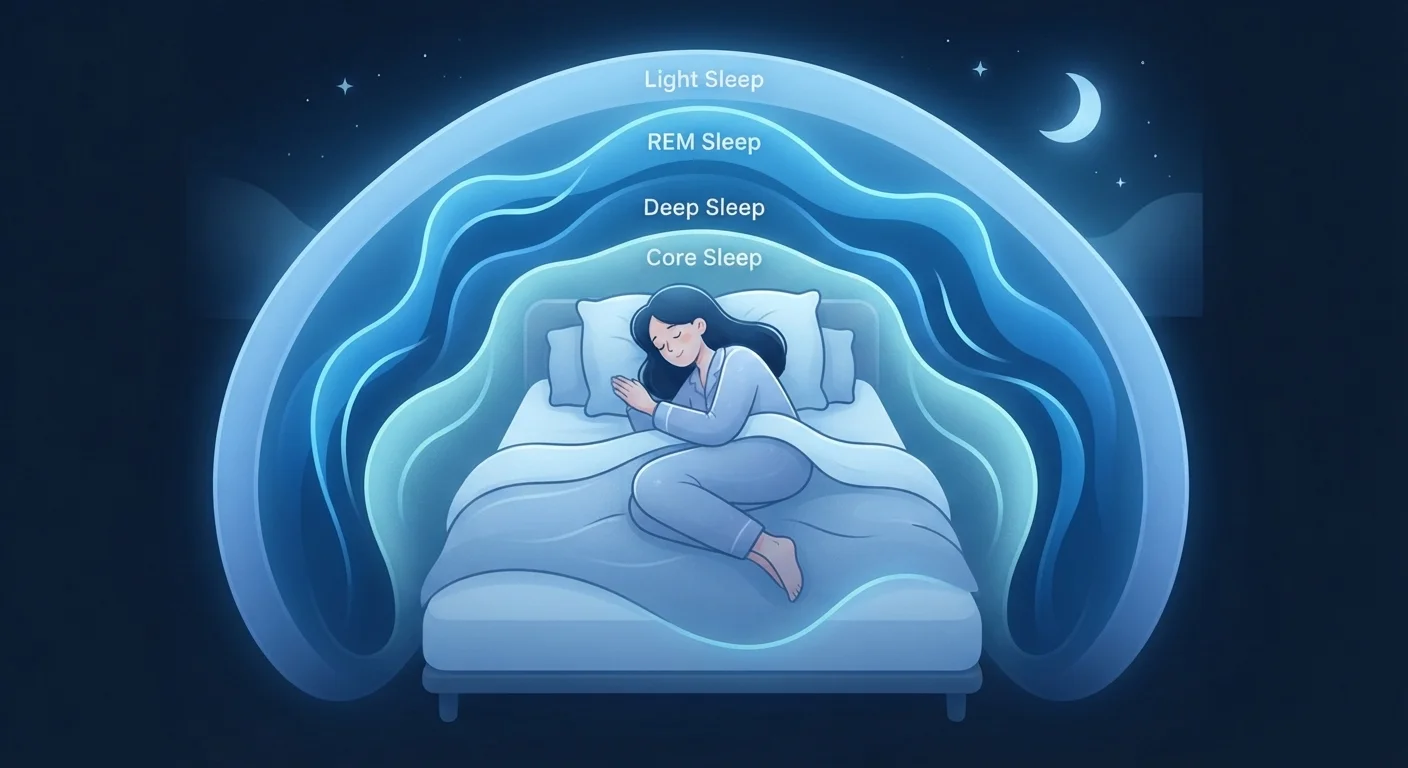
Sleep is organized into roughly 90-minute cycles, and a full night typically contains four to six of them. Each cycle passes through several distinct stages: light sleep (N1 and N2), deep sleep (N3), and REM (rapid eye movement) sleep. Together, they form what researchers call sleep architecture — the blueprint of a restorative night.
| Number of sleep stages | 4 (N1, N2, N3, and REM) (American Academy of Sleep Medicine) |
| Average sleep cycle length | Approximately 90 minutes (National Sleep Foundation) |
| Proportion of night in N2 (light sleep) | ~45–55% (Sleep Medicine Reviews) |
| Proportion of night in deep sleep (N3) | ~15–20% in healthy adults (American Academy of Sleep Medicine) |
| When REM sleep peaks | During the second half of the night (National Institutes of Health) |
| Recommended nightly sleep for adults | 7–9 hours (American Academy of Sleep Medicine & Sleep Research Society) |
The Four Sleep Stages at a Glance
Here is what each stage involves and why it matters:
Stage N1 — Light Sleep (Transition)
N1 is the brief doorway between wakefulness and sleep, typically lasting just one to seven minutes. Your muscles begin to relax, your heart rate slows, and brain activity starts to shift. You're easy to wake at this stage, and you may experience sudden muscle twitches called hypnic jerks. N1 accounts for only about 5% of total sleep time in healthy adults.
Stage N2 — Light Sleep (Consolidation)
N2 is where you spend the most time — roughly 45–55% of total sleep. Body temperature drops, heart rate slows further, and the brain produces bursts of activity called sleep spindles and K-complexes. These bursts are believed to play a role in memory consolidation and protecting sleep from interruption. For a detailed comparison of what N1 and N2 contribute versus deeper stages, see our article on what light and deep sleep each contribute to recovery.
Stage N3 — Deep Sleep (Slow-Wave Sleep)
N3 is the most physically restorative stage. Brain waves slow dramatically — these are called delta waves — and the body enters a state of deep repair. Growth hormone is released, tissues are rebuilt, the immune system is strengthened, and energy stores are replenished. Deep sleep dominates the first half of the night and is hardest to wake from. Adults typically spend 15–20% of sleep time here, though this share tends to decrease with age.
REM Sleep — The Mental Maintenance Stage
REM sleep, named for the rapid eye movements that characterize it, is when most vivid dreaming occurs. The brain becomes highly active — almost as active as when awake — while the body's voluntary muscles are temporarily paralyzed. REM is critical for emotional processing, creativity, and memory integration. It becomes more prominent in the second half of the night, which is one reason cutting sleep short is especially costly for mental wellness. Our article REM Sleep Demystified explores this stage in depth.
Sleep Architecture
The overall structure of a night's sleep, including the pattern, sequence, and proportion of each sleep stage across multiple cycles.
REM Sleep
Rapid Eye Movement sleep — a stage characterized by vivid dreaming, high brain activity, and temporary muscle paralysis. It plays a key role in emotional regulation and memory consolidation.
Slow-Wave Sleep (SWS)
Another name for Stage N3 (deep sleep), defined by slow delta brain waves. It is the most physically restorative sleep stage.
Sleep Spindles
Bursts of rhythmic neural activity that occur during Stage N2. They are thought to support memory processing and protect sleep from environmental disturbances.
Delta Waves
Slow, high-amplitude brain waves that dominate Stage N3 (deep sleep) and signal the deepest level of rest and physical restoration.
Hypnic Jerk
A sudden, involuntary muscle twitch that commonly occurs as the body transitions into Stage N1 sleep. It is generally harmless.
How the Stages Cycle — and What Disrupts Them
Stages don't occur just once. Throughout the night, your brain cycles through them repeatedly, roughly every 90 minutes. Early cycles are weighted toward deep sleep; later cycles contain more REM. This is why a full seven to nine hours — not just the first few — is necessary to harvest the benefits of all stages.
Common disruptors include alcohol (which suppresses REM sleep), caffeine consumed too late in the day, irregular sleep schedules, screen light exposure near bedtime, and stress or anxiety. Even small losses in a single stage can ripple into daytime mood, focus, and resilience. For a broader look at how all the stages fit together across a full night, see The Architecture of a Night's Sleep.
Understanding your sleep stages isn't about obsessing over data from a wearable device. It's about recognizing that quality sleep is a foundational pillar — one with real, measurable consequences for how you think, feel, and cope every day. If you want to build your vocabulary around this topic further, the Sleep Science Glossary is a useful companion reference.
This article is for general informational and educational purposes only and is not a substitute for professional medical advice. If you have concerns about your sleep or health, please consult a qualified healthcare provider.