Why Sleep Terminology Matters
Sleep science has a language of its own. When a clinician mentions sleep architecture or a study references slow-wave activity, those aren't just jargon — they describe precise biological processes that influence how rested, healthy, and mentally sharp you feel each day. This reference guide defines the core terms you're most likely to encounter when reading sleep research, talking with a healthcare provider, or exploring resources like our beginner's introduction to sleep science.
Definitions here reflect established scientific and clinical consensus. Where the evidence is still evolving, that is noted. As always, this content is for general education — not a substitute for guidance from a qualified healthcare professional.
Adenosine
A naturally occurring chemical that accumulates in the brain during wakefulness and promotes sleepiness. Its build-up represents the homeostatic sleep drive; it is cleared during sleep, particularly slow-wave sleep.
Circadian Rhythm
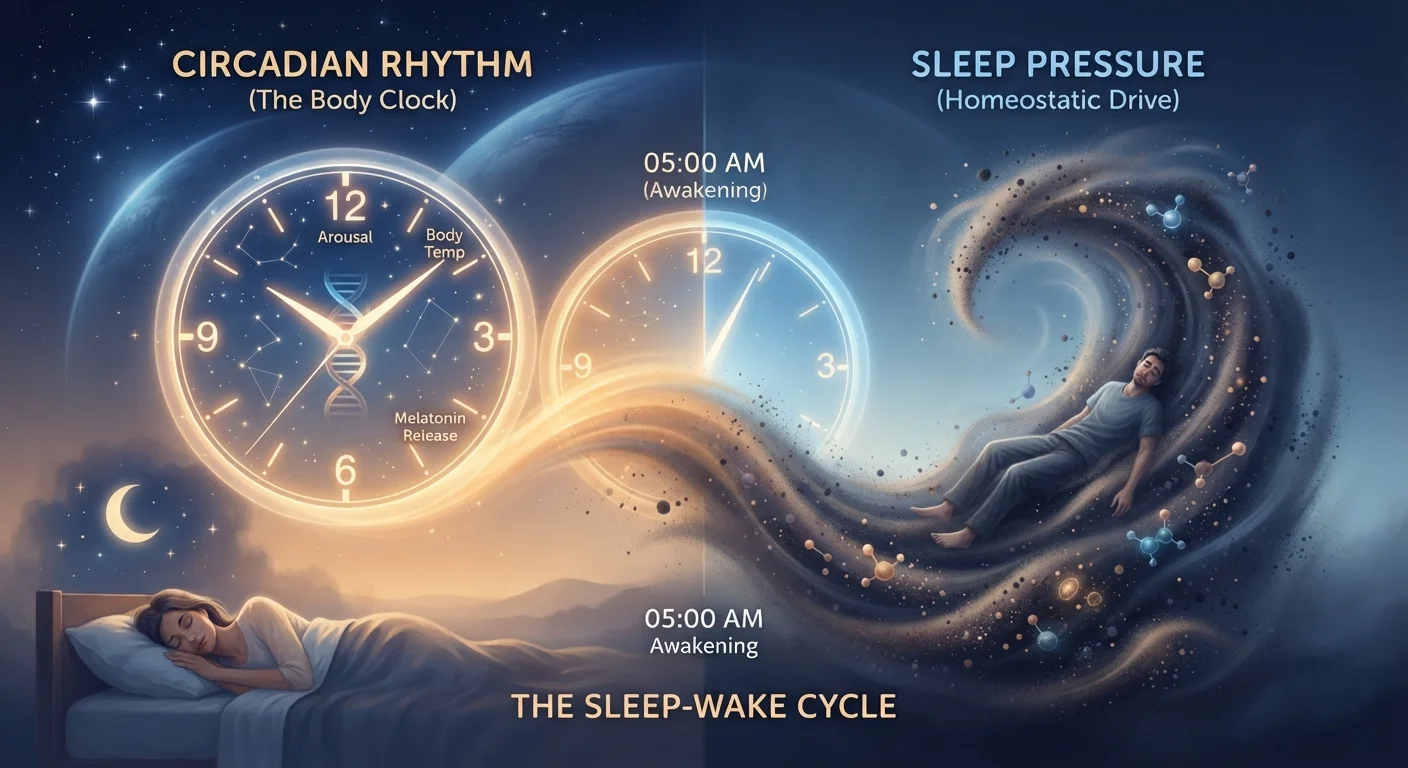
The body's internal approximately 24-hour biological clock that regulates the timing of sleep, wakefulness, hormone release, and other physiological processes. It is primarily synchronized by light and darkness.
Sleep Architecture
The structural organization of sleep stages across a full night, including the sequence, duration, and proportion of NREM and REM stages. Disruptions to architecture can impair restoration even when total sleep time is adequate.
Slow-Wave Sleep (SWS)
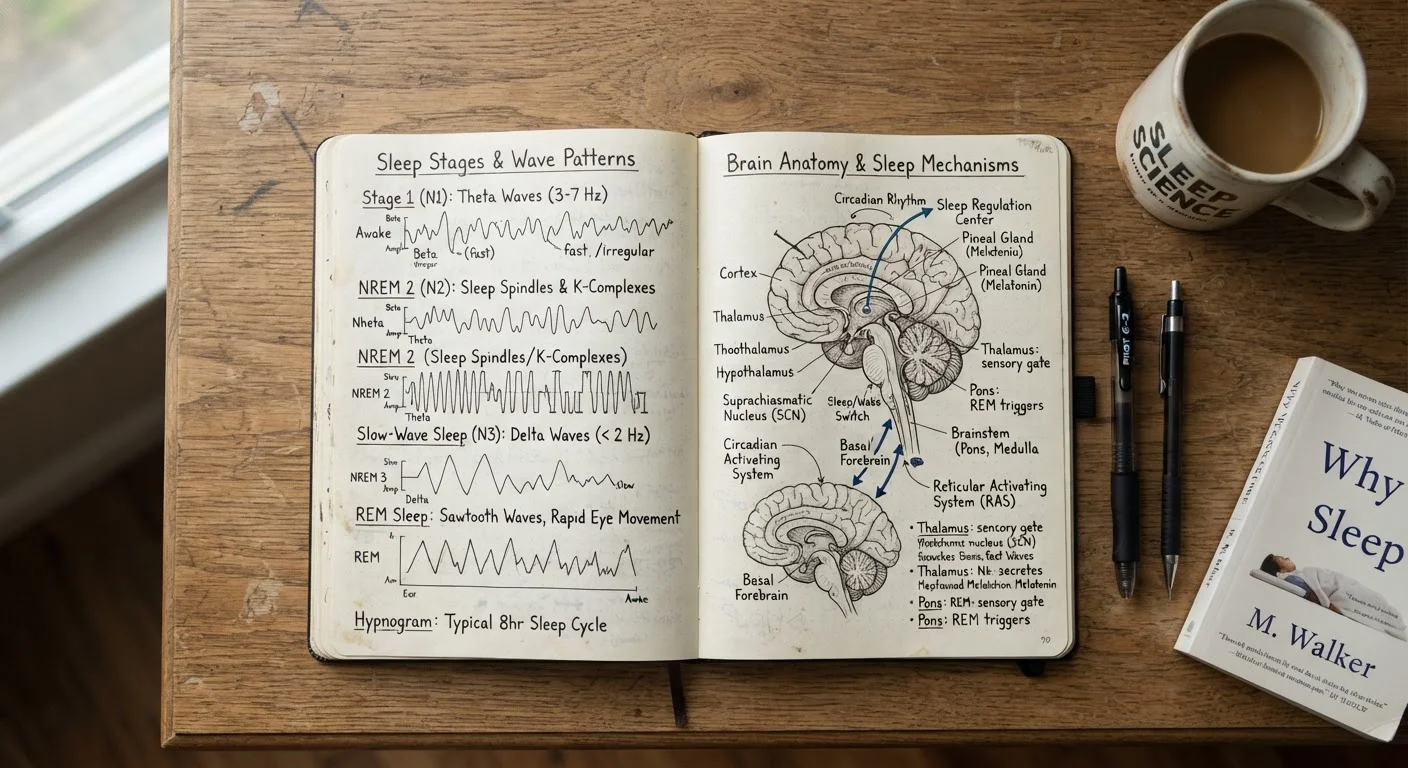
Also called N3 or deep sleep, this is the most physically restorative NREM stage, characterized by high-amplitude, low-frequency delta brain waves. It supports tissue repair, immune function, and memory consolidation.
REM Sleep
Rapid Eye Movement sleep is a stage marked by brain activity resembling wakefulness, muscle paralysis, and vivid dreaming. It is closely linked to emotional memory processing and cognitive flexibility.
Sleep Spindles
Bursts of oscillatory brain activity occurring during N2 sleep, visible on EEG recordings. Research suggests they play a role in memory consolidation and protecting sleep from external disturbances.
Melatonin
A hormone produced by the pineal gland in response to darkness that signals the body to prepare for sleep. It influences sleep timing rather than sleep depth, and its release is suppressed by light, especially blue wavelengths.
Sleep Latency
The amount of time it takes to transition from full wakefulness to sleep onset. Consistently very short or very long latency can indicate underlying sleep or health issues and is a standard metric in clinical sleep studies.
Polysomnography (PSG)
The gold-standard diagnostic recording of multiple physiological signals during sleep, including brain waves (EEG), eye movements, muscle activity, and breathing. It is used to diagnose conditions such as sleep apnea and narcolepsy.
Homeostatic Sleep Drive
The progressive biological pressure to sleep that accumulates during wakefulness, driven largely by adenosine build-up. It dissipates during sleep and works alongside the circadian system to regulate sleep timing and depth.
Sleep Fragmentation
Frequent brief awakenings or arousals that interrupt normal sleep cycling, often without the sleeper's awareness. Fragmented sleep impairs the restorative benefits of deeper stages even when total time in bed is sufficient.
Hypnogram
A graph that visually maps the progression of sleep stages over the course of a night. It allows clinicians and researchers to quickly assess sleep architecture, cycle timing, and the distribution of NREM and REM sleep.
Core Sleep Processes and Mechanisms
Two fundamental biological systems govern when and how deeply you sleep. The circadian system is a roughly 24-hour internal clock, anchored primarily by light exposure, that regulates the timing of alertness and sleepiness. The homeostatic sleep drive — sometimes called Process S — builds pressure to sleep the longer you remain awake. Adenosine, a byproduct of neural activity, accumulates in the brain during wakefulness and is cleared during sleep, serving as a molecular proxy for this pressure. Caffeine works by blocking adenosine receptors rather than eliminating the molecule itself, which is why sleep debt catches up after caffeine wears off.
Together, these two processes — circadian timing and homeostatic pressure — determine your sleep propensity at any given moment. Disruption to either system can fragment or shorten sleep even when total time in bed appears adequate. For a deeper look at how these forces interact with specific sleep stages, see Sleep Stages Decoded.
Sleep Architecture and Staging
A full night of sleep is not uniform. It progresses through a predictable sequence of stages that together form what researchers call sleep architecture — the structural pattern of those stages across the night. The two broad categories are NREM sleep and REM sleep. NREM is further divided into N1 (light, transitional sleep), N2 (consolidated sleep marked by sleep spindles and K-complexes), and N3 (slow-wave or deep sleep, the most physically restorative stage). REM sleep, characterized by rapid eye movements and vivid dreaming, supports memory consolidation and emotional regulation.
A complete sleep cycle — one pass through NREM and REM — lasts roughly 90 minutes, and most adults cycle through four to six of these per night. Early cycles are weighted toward deep NREM; later cycles contain proportionally more REM. This is why cutting sleep short by even an hour or two disproportionately reduces REM. Clinicians analyze this architecture in detail during a polysomnography study — a procedure explained further in our plain-language walk through polysomnography.
This article is for informational purposes only and is not a substitute for professional medical advice, diagnosis, or treatment. If you have concerns about your sleep health, consult a qualified healthcare provider.