What Makes a Vitamin Fat-Soluble or Water-Soluble?
Every vitamin your body needs falls into one of two categories based on a simple chemical property: whether it dissolves in fat or in water. This distinction isn't just chemistry trivia — it determines how vitamins are absorbed from food, where they travel in the body, how long they stay, and whether excess amounts pose any risk.
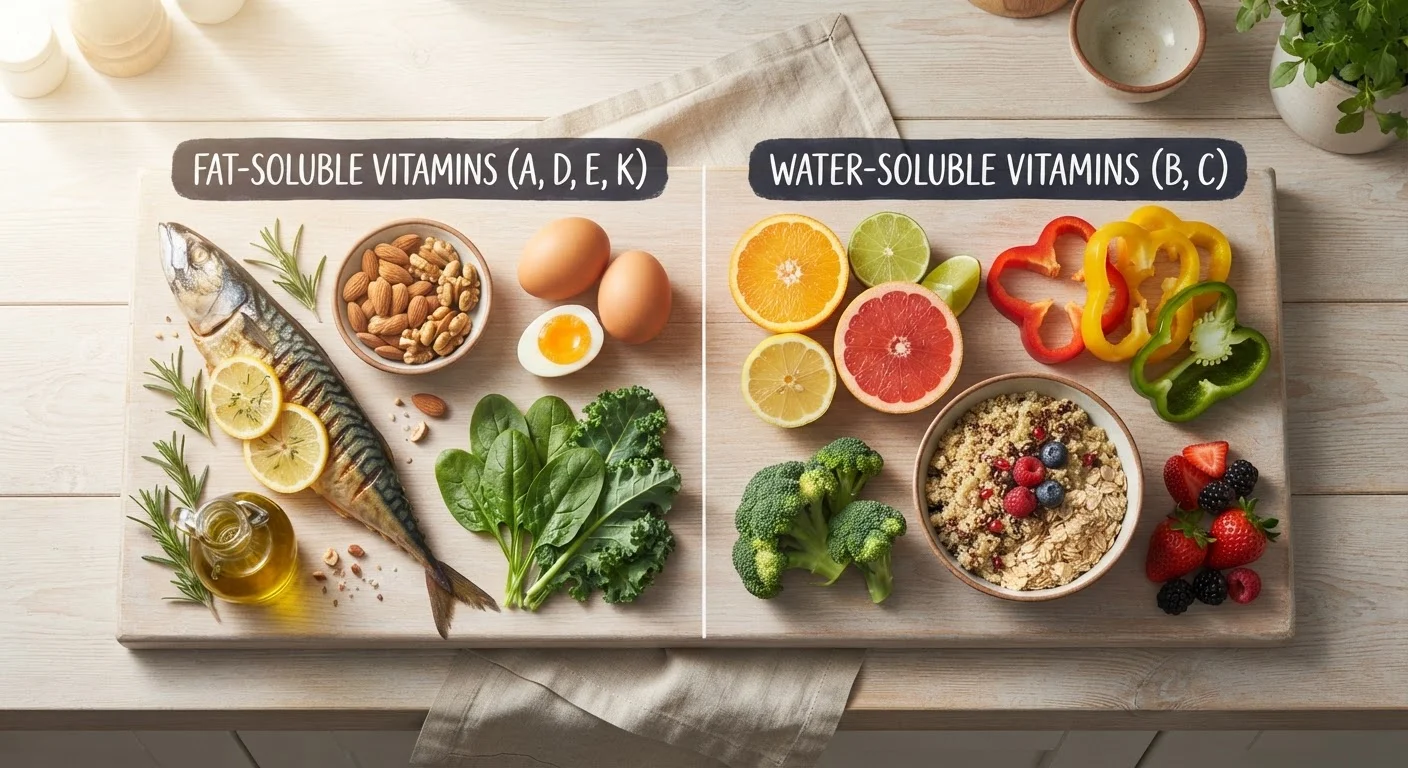
Fat-soluble vitamins — A, D, E, and K — require dietary fat to be absorbed in the small intestine. Once absorbed, they travel through the lymphatic system and are stored in the liver and fatty tissues. This means your body can draw on reserves built up over days or weeks, but it also means surpluses accumulate rather than being flushed out.
Water-soluble vitamins include vitamin C and the eight B vitamins (B1/thiamine, B2/riboflavin, B3/niacin, B5/pantothenic acid, B6, B7/biotin, B9/folate, and B12). These absorb directly into the bloodstream and travel freely in blood plasma. Because the kidneys filter and excrete what the body doesn't immediately need, water-soluble vitamins generally don't accumulate to dangerous levels — but they also don't build significant reserves.
To understand how these vitamins interact with the broader nutrient picture, see our guide to what micronutrients actually do inside your body.
How Absorption and Storage Work in Practice
The fat-solubility of vitamins A, D, E, and K has a direct practical implication: eating these vitamins alongside dietary fat meaningfully improves how much your body absorbs. Research consistently shows, for example, that consuming vitamin-K-rich leafy greens with a source of fat — such as olive oil in a salad dressing — leads to significantly better absorption than eating them plain. Dietary fat plays several underappreciated roles in nutrition, and vitamin absorption is one of them.
Once absorbed, fat-soluble vitamins are packaged into carrier molecules called lipoproteins and transported to the liver for processing or sent to adipose (fat) tissue for storage. Vitamin D, for instance, can be synthesized in the skin through sun exposure and then stored in body fat for later conversion to its active form.
Water-soluble vitamins work quite differently. After absorption through the intestinal wall, they move directly into circulation. Cells pull in what they need, and the kidneys excrete the rest in urine. This is why urine can turn bright yellow after taking a high-dose B vitamin supplement — riboflavin (B2) is water-soluble and the excess is visible in excretion.
| Criterion | Fat-Soluble Vitamins | Water-Soluble Vitamins |
|---|---|---|
| Vitamins included | A, D, E, K | C and all 8 B vitamins |
| Requires fat for absorption | Yes | No |
| Storage in the body | Liver and fatty tissues | Minimal (B12 is an exception) |
| Excess excreted in urine | No — accumulates | Yes — excreted regularly |
| Toxicity risk from excess | Higher, especially A and D | Lower, but not zero |
| Deficiency develops | Slowly over time | Relatively quickly |
| Key food sources | Liver, dairy, eggs, leafy greens, nuts | Citrus, legumes, whole grains, meat, leafy greens |
One important exception worth noting: vitamin B12 is stored in the liver in meaningful quantities — enough to last years in some individuals — making it more resilient to short-term dietary gaps than other water-soluble vitamins.
Deficiency and Toxicity: Where Each Category Carries Risk
Because fat-soluble vitamins accumulate, deficiency tends to develop slowly — but so does toxicity from excessive intake. Vitamin A toxicity (hypervitaminosis A) from supplement overuse can cause liver damage, bone loss, and other serious effects. Excess vitamin D from supplements, rather than sun exposure or food, can raise blood calcium to harmful levels. These risks are real but largely avoidable: food sources rarely deliver enough to cause problems, and most adults don't need high-dose supplementation without a clinically identified deficiency.
Water-soluble vitamins, because they're excreted, carry lower toxicity risk in most cases. However, very high supplemental doses of some — particularly B6 (pyridoxine) — have been associated with nerve-related side effects when taken in excess over extended periods. The general principle that water-soluble vitamins are unconditionally safe in any amount is an oversimplification.
Special Populations and Vitamin Needs
Certain groups face elevated risk for specific vitamin deficiencies based on how their bodies absorb or use nutrients. Older adults often absorb vitamin B12 less efficiently due to changes in stomach acid production. People with fat malabsorption conditions (such as Crohn's disease or cystic fibrosis) may struggle to absorb fat-soluble vitamins regardless of dietary intake. Those following exclusively plant-based diets need to pay particular attention to vitamin B12, D, and K2 status. If you fall into any of these categories, working with a registered dietitian or physician is the most reliable path to understanding your individual needs.
Deficiency in water-soluble vitamins tends to appear more quickly, since reserves are minimal. Vitamin C deficiency (scurvy) can emerge within weeks of very low intake. Folate deficiency is a significant concern during early pregnancy, which is why adequate folate intake is emphasized before and during pregnancy — a topic where consultation with a healthcare provider is especially important.
For context on how vitamin and mineral balance fits into the broader nutritional picture, our article on macronutrients and micronutrients together covers the full framework.
This article is for general informational and educational purposes only and is not a substitute for professional medical advice, diagnosis, or treatment. Always consult a qualified healthcare provider before making changes to your diet, supplementation, or health regimen.