What the Micronutrient Section Actually Shows
Near the bottom of every Nutrition Facts panel you'll find a row of vitamins and minerals — the micronutrients your body needs in relatively small amounts to function properly. Understanding this section is a practical skill that connects directly to everyday food choices. For a broader look at why these nutrients matter at all, see what micronutrients actually do inside your body.
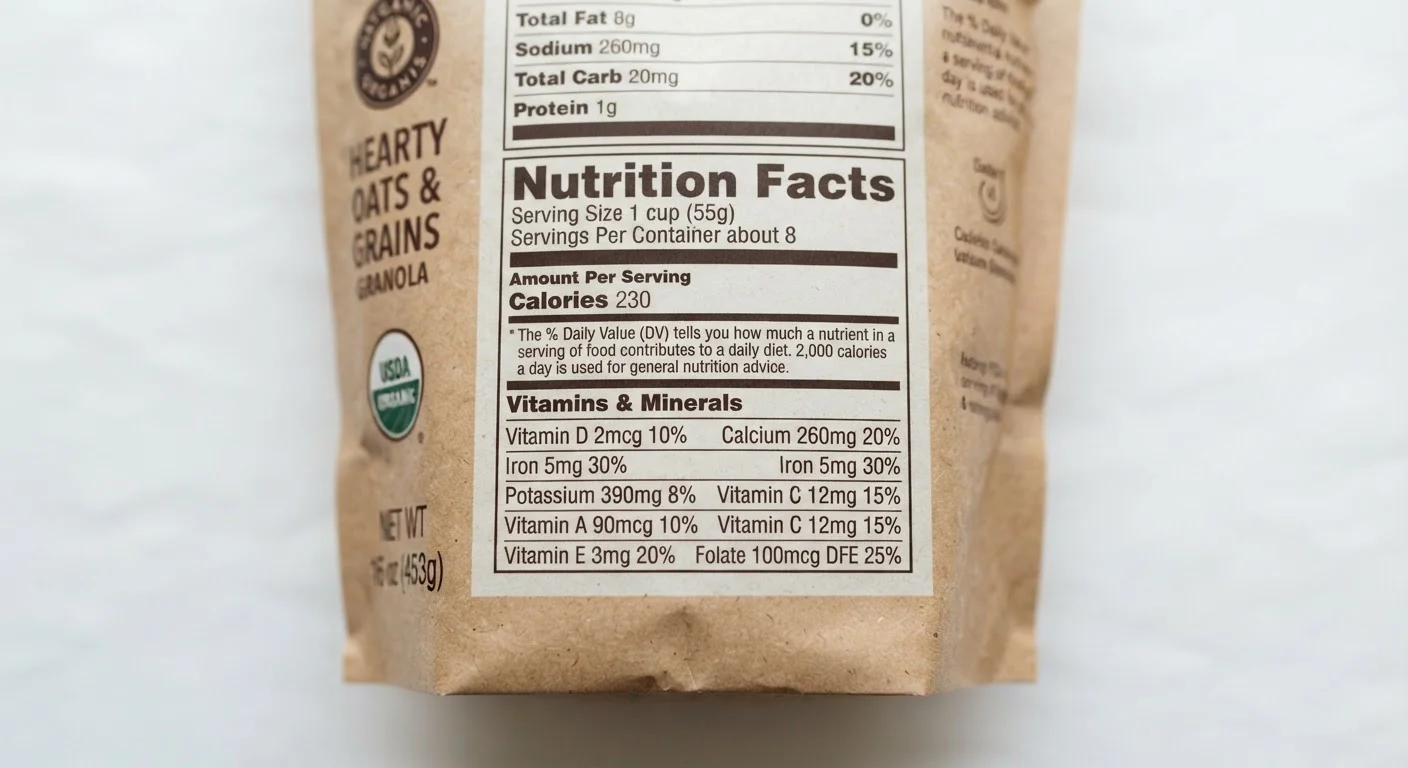
Under FDA regulations updated in 2020, food manufacturers are required to declare four specific nutrients: vitamin D, calcium, iron, and potassium. These were selected because Americans commonly fall short of them. Vitamins A and C, formerly required, are now optional — though many manufacturers still include them voluntarily.
Each listed micronutrient appears with two pieces of data: the absolute amount (in milligrams or micrograms) and the Percent Daily Value (%DV). Both matter, and knowing how to read each one prevents common misreads.
Fortified Foods vs. Naturally Occurring Nutrients
Many packaged foods show high %DV figures for vitamins and minerals because nutrients were added during manufacturing — a process called fortification. Fortified foods can meaningfully contribute to daily intake, but whole food sources (leafy greens, legumes, dairy, eggs, nuts) often provide micronutrients alongside fiber, protein, and other compounds that work together. Neither source is inherently superior; variety across both tends to serve most people well.
Decoding Percent Daily Value (%DV)
The %DV is the most immediately useful number on the label. It answers a simple question: How much does one serving of this food contribute to what I need in a full day? The reference point is a standardized 2,000-calorie daily diet set by the FDA. Your personal needs may differ based on age, sex, health status, or activity level — but the %DV still works as a reliable general benchmark.
The FDA provides two clear thresholds to guide interpretation:
- 5% DV or less — the food is a low source of that nutrient.
- 20% DV or more — the food is a high source of that nutrient.
Everything between 5% and 20% falls in the middle range. A bowl of fortified breakfast cereal listing 25% DV for iron is a meaningfully high source. A slice of white bread at 2% DV for calcium contributes very little toward that goal.
For a deeper look at how macronutrient and micronutrient figures work together on the same panel, food label literacy for macronutrients covers the full picture.
Milligrams, Micrograms, and Why Units Matter
Micronutrients are listed in small units — milligrams (mg) and micrograms (mcg or µg). A milligram is one-thousandth of a gram; a microgram is one-thousandth of a milligram. This 1,000-fold difference is why comparing raw numbers without their units is genuinely misleading.
For example, the Daily Value for calcium is 1,300 mg, while the Daily Value for vitamin B12 is just 2.4 mcg. If a label shows 500 mg of calcium and 1.2 mcg of vitamin B12, those two foods are each providing roughly 38% and 50% DV respectively — very different contributions despite the dramatic difference in the raw numbers.
When scanning labels, always read the unit alongside the number. The %DV column removes this confusion by putting all nutrients on the same percentage scale, which is another reason it's the most practical starting point for comparison.
How to Use This Information While Shopping
Reading the micronutrient section is most useful when you're trying to identify foods that support a specific nutritional gap or compare two similar products. Here's a practical approach:
Locate the micronutrient rows at the bottom of the panel
Scan below the thick dividing line that separates macronutrients from micronutrients. You'll see at minimum vitamin D, calcium, iron, and potassium listed with their amounts and %DV. Additional nutrients like vitamin C or magnesium may appear if the manufacturer chose to include them.
Check the serving size before reading any values
All nutrient values — including %DV for vitamins and minerals — are calculated for one serving as defined on that label. If you eat two servings, every %DV doubles. Confirm the serving size at the top of the panel before interpreting the micronutrient numbers.
Apply the 5%/20% DV rule to each listed nutrient
Run through each micronutrient and categorize it: below 5% DV means low contribution, 20% DV or above means high contribution. This quick scan tells you whether the food is a meaningful source of any given nutrient without requiring you to memorize absolute daily targets.
Note the units and absolute amounts for nutrients you're tracking
If you're monitoring a specific nutrient — say, iron during pregnancy, or potassium for blood pressure support — record the actual milligram or microgram amount, not just the %DV. This lets you add up your intake accurately across multiple foods throughout the day.
Factor in the full day's eating pattern
Use what you learned from each label as one data point in a wider picture. If breakfast provided 25% DV for calcium, lunch 10%, and dinner 15%, you've reached roughly 50% — and dairy snacks, greens, or fortified foods throughout the day can fill the rest. No single meal needs to do the heavy lifting.
Keep in mind that no single food is expected to supply 100% DV of every micronutrient. The goal is a pattern across meals and days — not a perfect score on each label. Be cautious about chasing very high %DV numbers from fortified products alone; some micronutrients carry toxicity risks at excess intakes, particularly fat-soluble vitamins like A, D, E, and K.
Also worth remembering: what's not on the label can matter. Many whole foods — fruits, vegetables, whole grains — contain micronutrients that manufacturers aren't required to list. A label showing few declared nutrients doesn't mean a food is nutritionally empty. For a reality check on common label-reading assumptions, see micronutrient myths that confuse even careful eaters.
This article provides general nutrition education and is not a substitute for personalized advice from a registered dietitian or qualified healthcare professional.