
Why Macronutrients Matter
Every time you eat, you're consuming a mix of nutrients your body uses in different ways. Macronutrients — carbohydrates, protein, and fat — are the category of nutrients needed in the largest quantities. They supply the energy and raw materials your body depends on to breathe, move, repair damage, and regulate itself around the clock.
Understanding what each macronutrient actually does takes the guesswork out of everyday eating. It also helps explain why nutrition guidance consistently emphasizes variety: different foods bring different macronutrient profiles to the table, and your body genuinely needs all three. For a broader look at how macros fit alongside vitamins and minerals, see our guide on how all nutrients fit into a balanced eating pattern.
4 kcal/g
Energy from carbohydrates or protein
Both carbohydrates and protein yield 4 calories per gram, according to established nutritional science used by the USDA and NIH.
9 kcal/g
Energy from dietary fat
Fat is more than twice as calorie-dense per gram as carbohydrates or protein, making portion context important in any eating plan.
9
Essential amino acids humans must get from food
The National Institutes of Health identifies nine amino acids as essential because the human body cannot synthesize them on its own.
~60%
Proportion of the brain that is fat by dry weight
Research in neuroscience consistently notes the high lipid content of brain tissue, underscoring why dietary fat is nutritionally important.
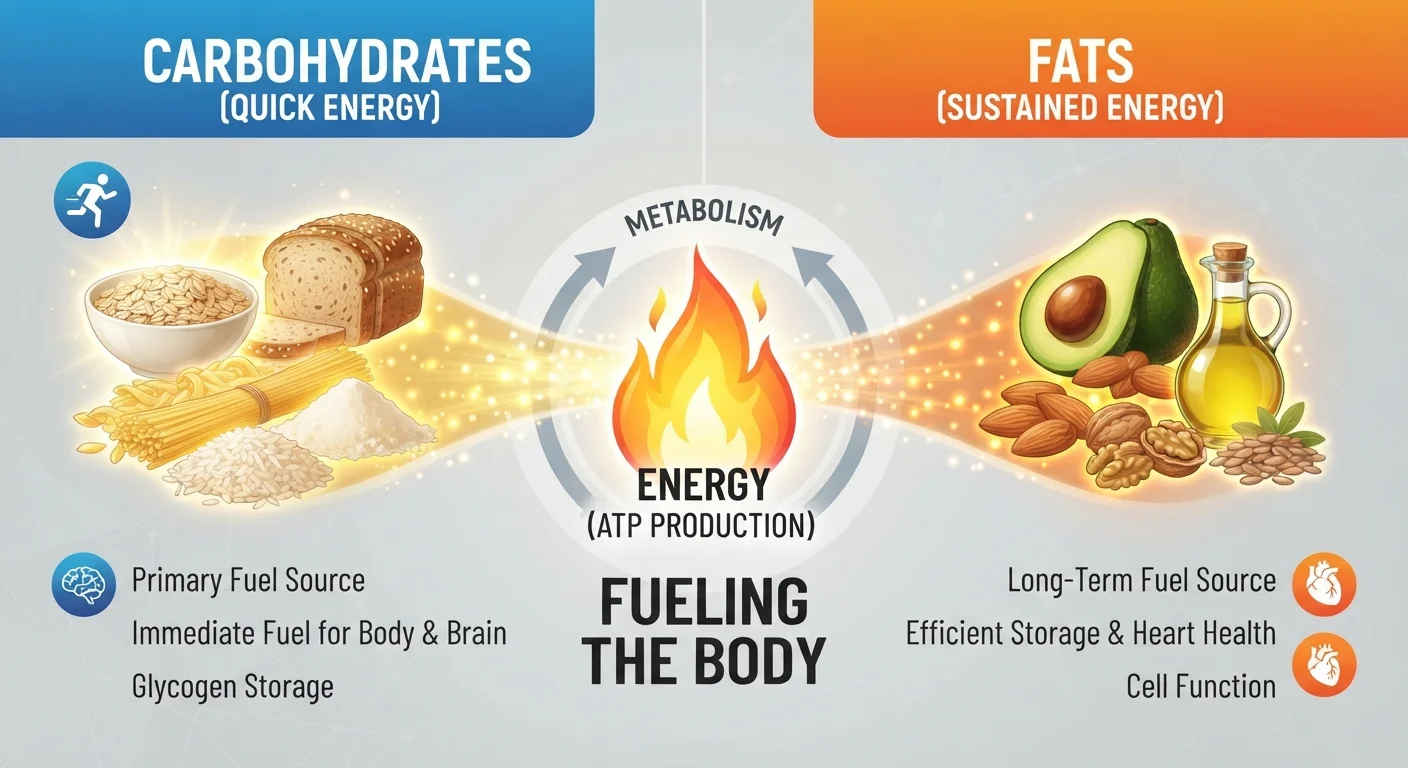
Carbohydrates: Your Body's Go-To Energy Source
Carbohydrates are broken down into glucose, which your cells use as their primary fuel. Your brain, in particular, relies heavily on glucose — it can consume roughly 20% of your body's total energy despite being a small fraction of your overall mass. When you eat carbohydrates, your digestive system converts them into glucose that enters your bloodstream, where insulin helps shuttle it into cells for immediate use or storage.
Not all carbohydrates behave the same way in the body. Simple carbohydrates — found in foods like fruit, milk, and refined sugars — digest quickly. Complex carbohydrates — found in whole grains, legumes, and vegetables — digest more slowly and tend to carry fiber, which supports digestive health and helps moderate blood sugar response.
Fiber, a type of carbohydrate your body cannot fully digest, plays its own important role: it feeds beneficial gut bacteria, supports bowel regularity, and contributes to feelings of fullness after meals.
Protein: The Body's Builder and Repairer
Protein is composed of amino acids — often described as the building blocks of the body. Your body uses amino acids to build and repair muscle tissue, produce enzymes and hormones, support immune function, and maintain the structural integrity of skin, hair, and nails. Of the 20 amino acids your body works with, nine are considered essential, meaning your body cannot produce them on its own and must obtain them through food.
Animal-based proteins — such as meat, poultry, fish, eggs, and dairy — typically contain all nine essential amino acids and are called complete proteins. Many plant-based proteins lack one or more essential amino acids on their own, but eating a variety of plant foods throughout the day provides a complete amino acid profile over time.
Protein also contributes to satiety. Meals with adequate protein tend to keep you feeling full longer, partly because protein digestion is slower and more metabolically demanding than carbohydrate digestion.
Fat: Far More Than Just Stored Energy
Dietary fat often gets an unfair reputation, but it's an essential macronutrient with several critical roles. Fat serves as a long-term energy reserve, insulates and protects organs, and is required for the absorption of fat-soluble vitamins — A, D, E, and K. Without adequate fat in the diet, your body cannot properly absorb these vitamins even if they're present in food.
Fat is also foundational to brain health. The human brain is roughly 60% fat by dry weight, and fatty acids are crucial for building cell membranes and supporting nerve signal transmission. Additionally, certain fats — particularly omega-3 and omega-6 fatty acids — are classified as essential fatty acids because the body cannot synthesize them independently.
The type of fat consumed matters. Unsaturated fats, found in foods like avocados, nuts, seeds, and olive oil, are generally associated with cardiovascular health. Saturated and trans fats, found in some processed foods and certain animal products, are the subject of ongoing dietary research. Major health organizations generally recommend limiting saturated fat and avoiding industrially produced trans fats.
Choose Fat Sources Wisely
Instead of focusing on reducing total fat, consider swapping sources when possible. Replacing some saturated fat with unsaturated fat — for example, using olive oil rather than butter, or snacking on a handful of walnuts instead of processed snack food — aligns with guidance from major health organizations. Small, consistent shifts tend to be more sustainable than sweeping eliminations.
Putting It All Together in Your Diet
In real meals, macronutrients rarely appear in isolation. A serving of peanut butter on whole-grain bread delivers carbohydrates, protein, and fat simultaneously. A chicken and vegetable stir-fry over brown rice hits all three in different proportions. This natural overlap is exactly why rigid elimination of any single macronutrient can create nutritional imbalances.
Different dietary patterns distribute macronutrients in different proportions — and several approaches can support good health depending on individual needs and preferences. For a practical look at how major eating styles compare, explore what different eating patterns actually look like on a plate. If you want to apply these principles to everyday meals without a tracking app, our article on balancing all three macros in a meal offers practical, intuitive guidance.
For a quick-reference summary of calorie values per gram and common food sources, see the macronutrient quick-reference guide. And to understand how macronutrients relate to vitamins and minerals, the article on what micronutrients actually do inside your body rounds out the full nutritional picture.
This article is for general informational and educational purposes only and is not a substitute for professional medical or nutritional advice. Consult a qualified healthcare provider or registered dietitian for guidance tailored to your individual health needs.