
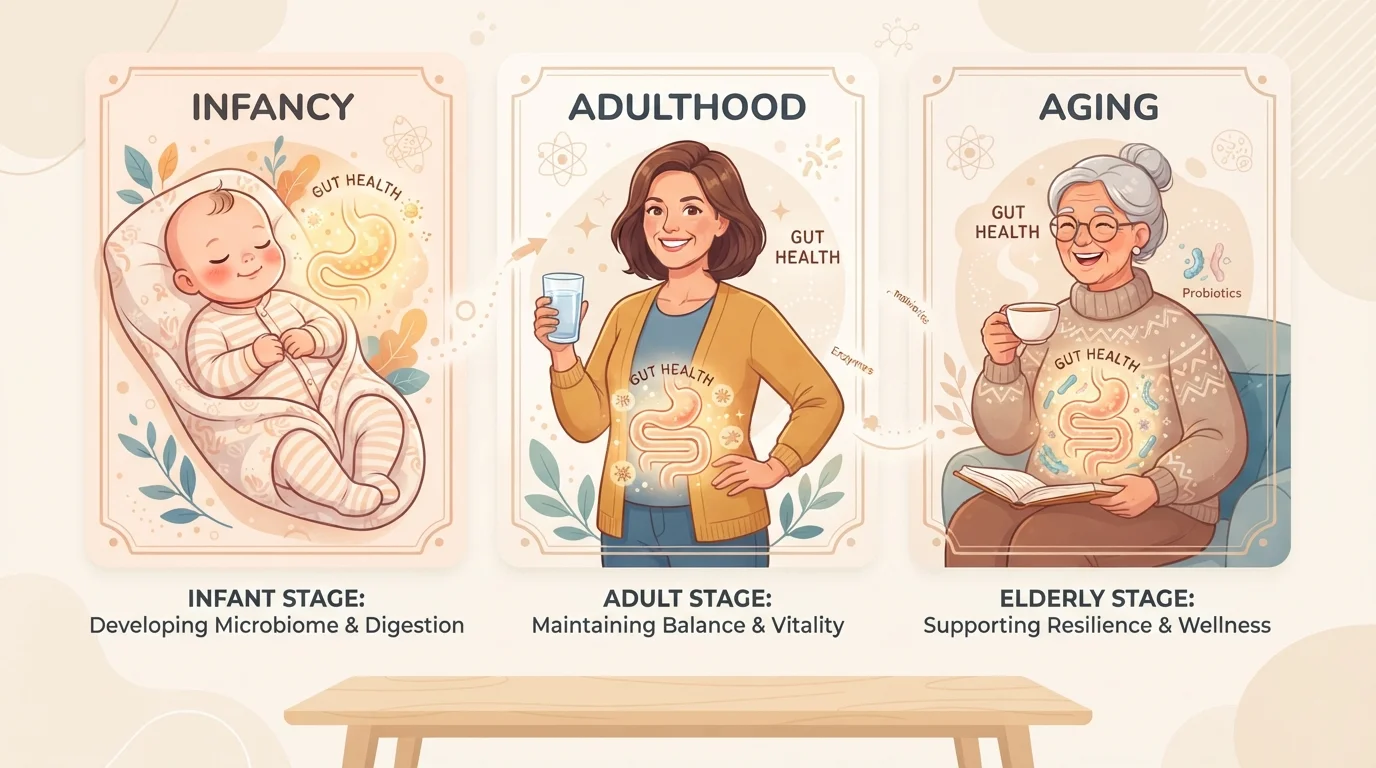
Why the Gut Microbiome Isn't Static
The human gut microbiome — the vast community of bacteria, fungi, viruses, and other microorganisms living in the digestive tract — is not fixed at birth and forgotten. It is a dynamic ecosystem that responds to feeding patterns, environmental exposures, medications, stress, and age itself. Understanding how it shifts across life stages offers important context for everyday health decisions, from infant feeding choices to dietary patterns in older adulthood.
This article provides a stage-by-stage reference overview. For a deeper look at the foundational science, see our overview of how everyday eating patterns influence the gut. And for a glossary of terms like dysbiosis, probiotics, and mucosal immunity, the gut and immune health reference glossary is a useful companion.
| Microbial cells in the gut | Approximately 38 trillion (Sender et al., Cell, 2016) |
| Immune cells housed in the gut | ~70% of the body's total (Established immunological reference range) |
| Age by which microbiome resembles adult profile | 2–3 years (General consensus in microbiome developmental research) |
| Key early influencers of infant microbiome | Delivery mode, feeding method, antibiotic exposure (Multiple peer-reviewed cohort studies) |
| Trend in microbial diversity with aging | General decline observed in older adulthood (Multiple longitudinal aging-microbiome studies) |
| Primary anti-inflammatory genera in gut | Bifidobacterium, Lactobacillus (among others) (Established in gut microbiome research literature) |
Infancy: Colonization and Immune Programming
A newborn's gut is rapidly colonized in the hours and days after birth. Mode of delivery, feeding method, and early antibiotic exposure are among the strongest documented influences on which microbial communities establish first. Vaginal birth exposes infants to maternal microbiota; Cesarean birth introduces a different microbial profile. Neither outcome is inherently harmful, but researchers recognize these early differences as meaningful in shaping later immune function.
Breast milk contributes not only nutrition but also human milk oligosaccharides (HMOs) — complex sugars that selectively feed beneficial bacteria, particularly Bifidobacterium species. Formula feeding produces a different microbial profile, though modern formulas have evolved. By age two to three, the microbiome resembles an adult profile in its general diversity. This window of early colonization is considered critical for immune system calibration — the gut houses roughly 70% of immune cells, and early microbial signals help train immune tolerance.
Parents and caregivers should discuss feeding choices, antibiotic use, and early exposures with a pediatrician rather than drawing conclusions from general information alone. Decisions for infants, especially those with health complications, require individualized clinical guidance.
Adulthood: Stability, Disruption, and Resilience
In healthy adults, the gut microbiome reaches its most stable — though never truly static — state. Diversity tends to be higher in this phase than in early childhood or old age, and a diverse microbiome is generally associated with better resilience against disruption. Research consistently links higher microbial diversity with markers of metabolic and immune health, though causation is difficult to establish with certainty.
Several patterns emerge in adult gut health research:
- Diet quality matters consistently. Diets rich in plant fiber, fermented foods, and dietary variety are associated with greater microbial diversity. Heavily processed, low-fiber diets are linked with reduced diversity.
- Antibiotics cause measurable disruption. A single antibiotic course can significantly alter the microbiome; recovery time varies by individual and antibiotic class.
- Chronic stress and poor sleep affect gut function. The gut-brain axis — the bidirectional signaling pathway between the central nervous system and the enteric nervous system — means psychological stress can manifest in gut symptoms and vice versa. See how sleep architecture shifts across life for related context.
- Physical activity is associated with greater microbial diversity, though research is ongoing on the mechanisms involved.
Preventive strategies during adulthood — maintaining dietary diversity, minimizing unnecessary antibiotic use, managing chronic stress — build the microbial foundation that carries into later life. See our longevity habits guide by decade for broader preventive context.
Aging: Diversity Decline and Inflammatory Shifts
The microbiome undergoes notable changes in older adulthood, and research has identified several consistent patterns — though significant individual variation exists. Overall microbial diversity tends to decline with age. Species associated with anti-inflammatory functions (including certain Bifidobacterium and Lactobacillus strains) often decrease, while species associated with inflammation-promoting activity may increase in some individuals.
This shift contributes to what researchers call inflammaging — a state of low-grade chronic inflammation associated with aging — which has been linked to elevated risk for cardiovascular disease, metabolic conditions, and cognitive decline. The gut microbiome is considered one contributing factor among many. Diet, physical activity, medication burden (older adults often take multiple medications that can affect gut flora), and reduced gastric acid production with age all intersect in complex ways.
Protein intake patterns also intersect with gut health in older adults — see how protein needs shift across life stages for relevant context. For a focused review of the microbiome-longevity connection, our article on gut health and aging provides greater depth.
This article is for general informational purposes only and does not constitute medical advice. Speak with a qualified healthcare provider for guidance specific to your health situation or that of someone in your care.