Why Daytime Decisions Shape Nighttime Sleep
Most sleep advice focuses on what happens in the hour before bed — dimming lights, putting down your phone, winding down with a book. That guidance has merit, but it misses a more fundamental truth: the biological systems that govern sleep quality are being calibrated from the moment you wake up. Your circadian clock, your cortisol curve, your core body temperature — all of these respond to light, food, movement, and stress cues accumulated throughout the day.
This article identifies the everyday habits — many of them invisible or even well-intentioned — that quietly undermine sleep architecture before you've turned off a single lamp. Understanding the mechanism behind each one makes the fix feel less arbitrary and far easier to sustain. For a deeper look at what to build instead, see our nightly routine guide.
Caffeine later than you think
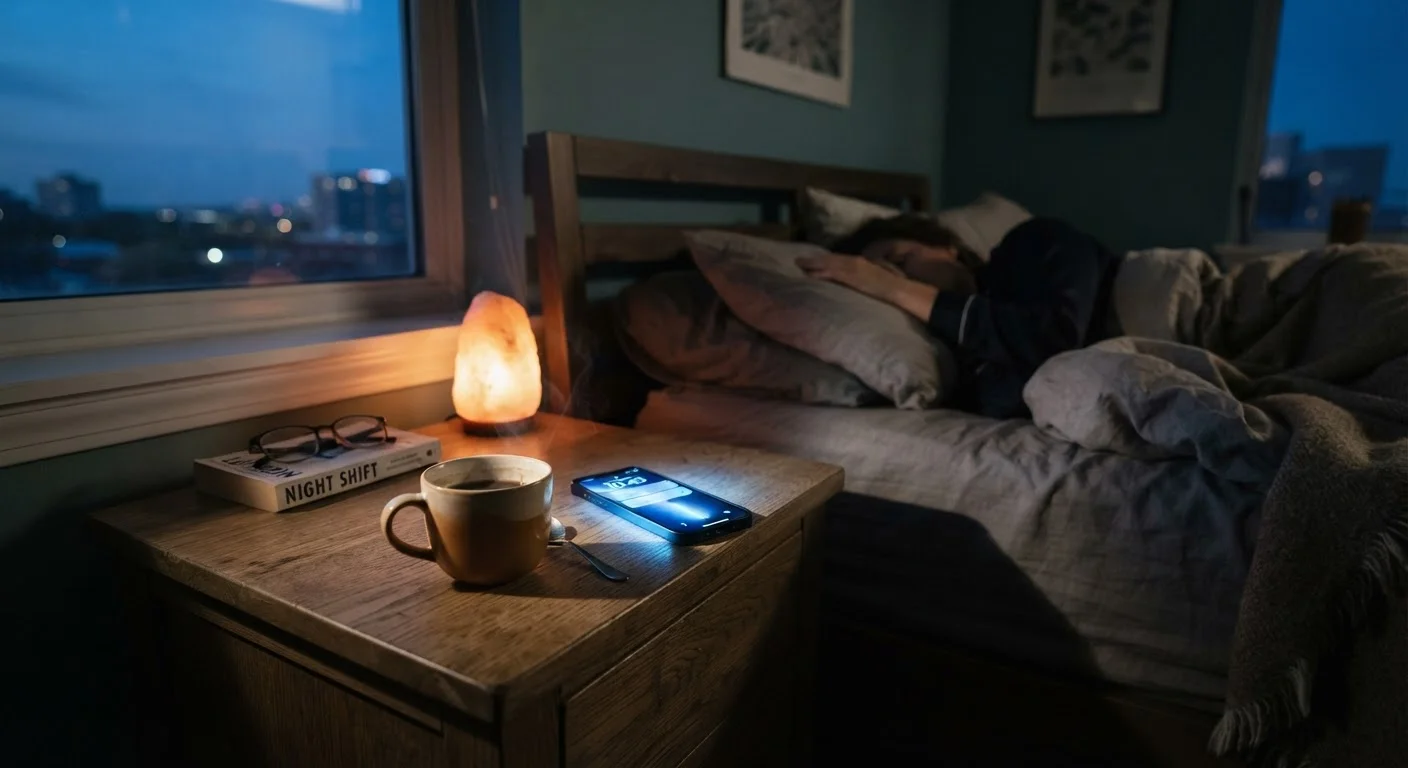
Caffeine's half-life in the body averages five to six hours, meaning half of a 3 p.m. coffee is still circulating when you try to fall asleep at 11 p.m. Research published in the Journal of Clinical Sleep Medicine found that caffeine consumed six hours before bedtime reduced total sleep time by more than one hour in adults — and participants often didn't perceive the quality difference, even as polysomnography confirmed it.
Caffeine works by binding to adenosine receptors. Adenosine is the chemical that builds sleep pressure throughout the day; blocking it delays the subjective sense of tiredness even as sleep debt accumulates. Genetic variation in the CYP1A2 enzyme means some people metabolize caffeine much more slowly than average — what feels like a mild afternoon pick-me-up can act more like an evening stimulant for slow metabolizers.
Practical note: For most people, cutting off caffeine by early-to-mid afternoon is a reasonable starting point. Those who are particularly sensitive may need to move that cutoff earlier.
Half of a 3 p.m. coffee is still active in your system at 11 p.m.
Skipping or delaying meals
Your body operates multiple circadian clocks — one in the brain's suprachiasmatic nucleus (SCN) and peripheral clocks in organs like the liver, gut, and pancreas. While light primarily entrains the SCN, meal timing is one of the strongest zeitgebers (time-givers) for peripheral clocks. Eating very late or skipping meals entirely can desynchronize these peripheral clocks from the central clock, a state researchers associate with poorer sleep quality and disrupted metabolic rhythms.
Irregular eating also affects blood glucose regulation. Going to bed after a large, late meal can cause glucose fluctuations overnight that fragment sleep — while going to bed hungry can do the same by triggering cortisol and adrenaline releases that promote wakefulness. Neither extreme is conducive to consolidated, restorative sleep.
Meal timing is one of the body's most powerful circadian signals — skipping meals sends the wrong message.
Vigorous evening exercise
Exercise is genuinely one of the best long-term supports for sleep quality. The timing, however, matters for a meaningful subset of people. Vigorous aerobic or resistance exercise raises core body temperature, heart rate, and sympathetic nervous system activity. Because the body needs to lower its core temperature to initiate and maintain sleep, high-intensity workouts within two to three hours of bedtime can delay sleep onset.
A 2019 meta-analysis in Sports Medicine found that late-night high-intensity exercise delayed sleep onset and reduced slow-wave (deep) sleep, while moderate-intensity exercise closer to bed had minimal negative effect for most participants. Individual responses vary considerably — some people report sleeping better after evening workouts — so self-monitoring is more useful than rigid rules. If evening is your only available window, lower-intensity options like yoga, walking, or mobility work are less likely to interfere.
High-intensity exercise within two hours of bed can delay sleep onset by raising core body temperature.
Chronic, unresolved stress
The hypothalamic-pituitary-adrenal (HPA) axis — the body's primary stress response system — releases cortisol in a daily pattern that peaks in the morning and drops toward evening, facilitating the rise of melatonin. When psychological stress keeps the HPA axis activated through the afternoon and evening, cortisol remains elevated at night, suppressing melatonin production and increasing arousal. This is a well-established pathway linking anxiety and chronic stress to difficulty falling and staying asleep.
Fragmented sleep then feeds back into heightened stress reactivity the next day, creating a cycle that's hard to interrupt through willpower alone. Brief mindfulness practice, expressive writing, or structured worry time earlier in the evening can help discharge some of the cognitive load before it compounds at bedtime. See how certain evening habits — including unresolved rumination — erode sleep quality further.
Chronic stress keeps cortisol elevated at night, directly suppressing the melatonin needed for sleep.
Extended social media use in the evening
Evening screen use presents two simultaneous problems: photic and psychological. The short-wavelength (blue) light emitted by phone and tablet screens suppresses melatonin secretion by signaling to the SCN that it's still daytime. Research from Harvard's Division of Sleep Medicine has demonstrated that even two hours of tablet use at night can delay melatonin onset and shift the circadian phase later.
Social media adds a second, often overlooked layer: emotional arousal. Scrolling through news, arguments, social comparison, or even exciting content activates the limbic system and elevates sympathetic tone — the opposite of the calm, parasympathetic state needed for sleep. Night mode settings reduce (but do not eliminate) the photic problem; they do nothing to counteract the emotional engagement that keeps the mind alert. Consider designating phone-free time at least 30–60 minutes before your intended sleep time.
Social media combines blue-light suppression of melatonin with emotional arousal — a compounded sleep disruptor.
Variable wake times across the week
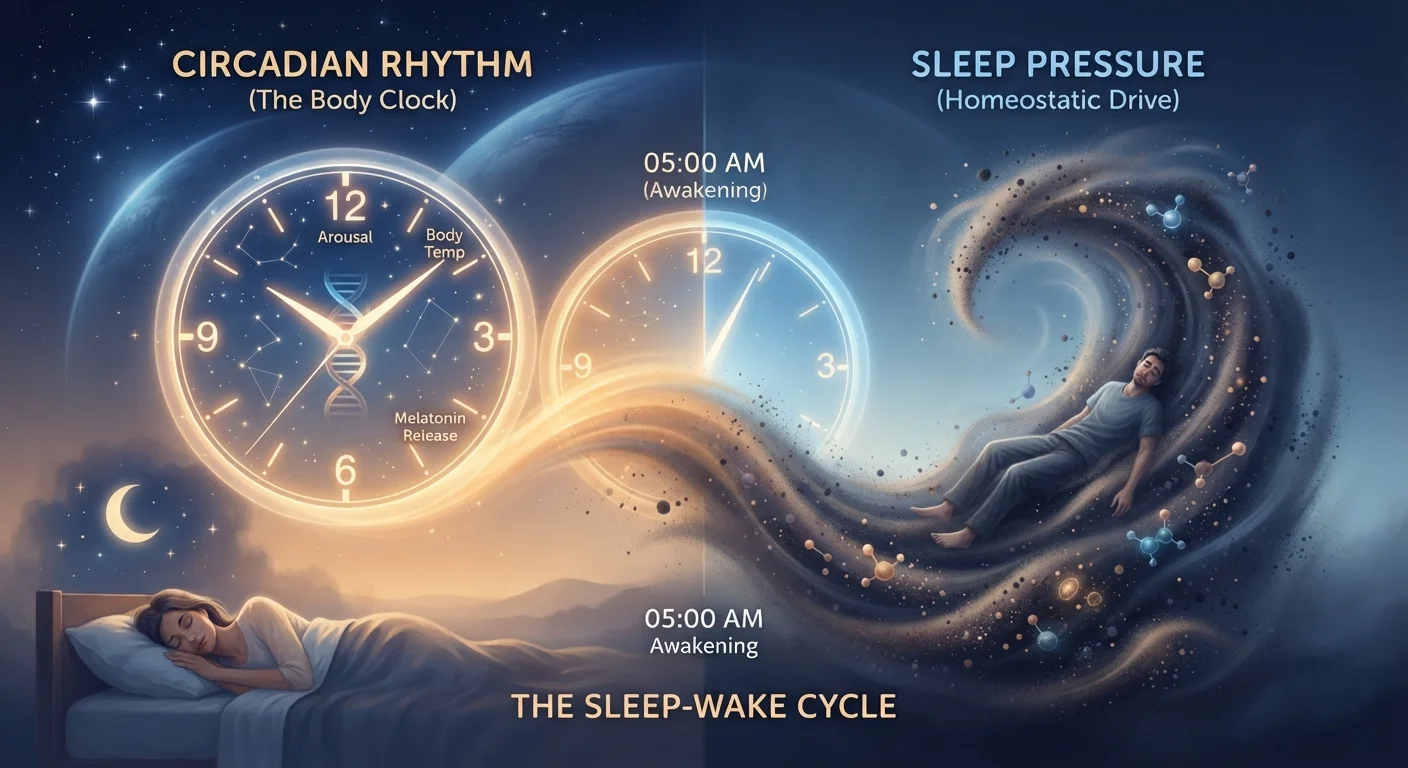
Most people focus on their bedtime when troubleshooting sleep, but sleep researchers consistently identify wake time as the more powerful anchor for circadian rhythm stability. The phenomenon known as social jet lag — sleeping later on weekends than weekdays — creates a circadian misalignment equivalent to crossing one to two time zones every Friday and Monday. Even a 90-minute difference in weekend wake time is associated with poorer sleep quality, daytime fatigue, and — in longer-term studies — greater cardiometabolic risk.
A consistent wake time strengthens adenosine pressure across the day and anchors the timing of cortisol, melatonin, and core body temperature rhythms. This is one of the simplest, zero-cost behavioral changes with the most consistent evidence behind it. Poor sleep rooted in these patterns can also quietly compromise broader health; poor sleep's relationship to immune function is explored in habits that weaken immune function.
Inconsistent wake times cause weekly circadian disruption comparable to crossing time zones every weekend.
Insufficient natural light exposure in the morning
Light is the primary signal that sets the central circadian clock. Getting bright natural light — ideally outdoor light — within the first hour of waking suppresses residual melatonin, advances the cortisol peak appropriately, and anchors the timing of melatonin secretion that evening. Without this morning light anchor, the circadian system drifts, making it harder to feel alert in the morning and sleepy at an appropriate evening hour.
Indoor lighting, even when bright by room standards, typically delivers only 100–500 lux — far below the 1,000–10,000 lux available outside on a cloudy day. Even a 10-to-20 minute walk outside in the morning, without sunglasses, provides a meaningful photic signal. This is one of the most evidence-backed, cost-free levers available for circadian entrainment and sets the trajectory of your entire sleep-wake cycle for the day ahead.
Ten to twenty minutes of outdoor morning light is one of the most evidence-backed free tools for better sleep.
Putting It All Together
Sleep disruption rarely has a single cause. More often, it's a constellation of small, seemingly unrelated habits — a mid-afternoon latte, a skipped lunch, a tense work call at 9 p.m. — that collectively push the nervous system away from the parasympathetic state needed for restorative sleep. If you're unsure where your own routine is falling short, the Pre-Sleep Wind-Down Audit offers a structured way to map your specific vulnerabilities.
It's also worth recognizing that not every strategy works equally for everyone. Your chronotype — the biological timing of your sleep drive — influences when these habits hit hardest. A night owl who experiments with an earlier wake time may actually worsen sleep pressure before it improves. Be patient and systematic: adjust one variable at a time, track results honestly, and consult a healthcare provider if sleep problems persist or significantly affect your daily functioning.
This article is for general informational and educational purposes only and is not a substitute for professional medical advice, diagnosis, or treatment. Always consult a qualified healthcare provider with any questions you may have regarding a medical condition or sleep disorder.
Start with one change at a time
Attempting to overhaul caffeine, meal timing, exercise, and screen habits simultaneously makes it difficult to identify what's actually helping. Choose the habit on this list that resonates most strongly with your current routine and work on it consistently for one to two weeks before layering in another adjustment. Small, measured changes tend to produce more durable improvements than wholesale overnight overhauls.