How Your Brain Reads Light as a Time Signal
Your circadian rhythm — the roughly 24-hour internal clock governing sleep, wakefulness, hormone release, and dozens of other functions — does not run on time alone. It relies on environmental cues called zeitgebers (German for "time-givers") to stay synchronized with the outside world. Light is by far the most powerful of these cues.
The mechanism centers on a cluster of neurons in the hypothalamus called the suprachiasmatic nucleus (SCN). Specialized photoreceptor cells in your retina — called intrinsically photosensitive retinal ganglion cells (ipRGCs) — send light signals directly to the SCN. These cells are especially sensitive to short-wavelength (blue-spectrum) light, roughly 460–490 nanometers, though they respond to broad-spectrum light as well.
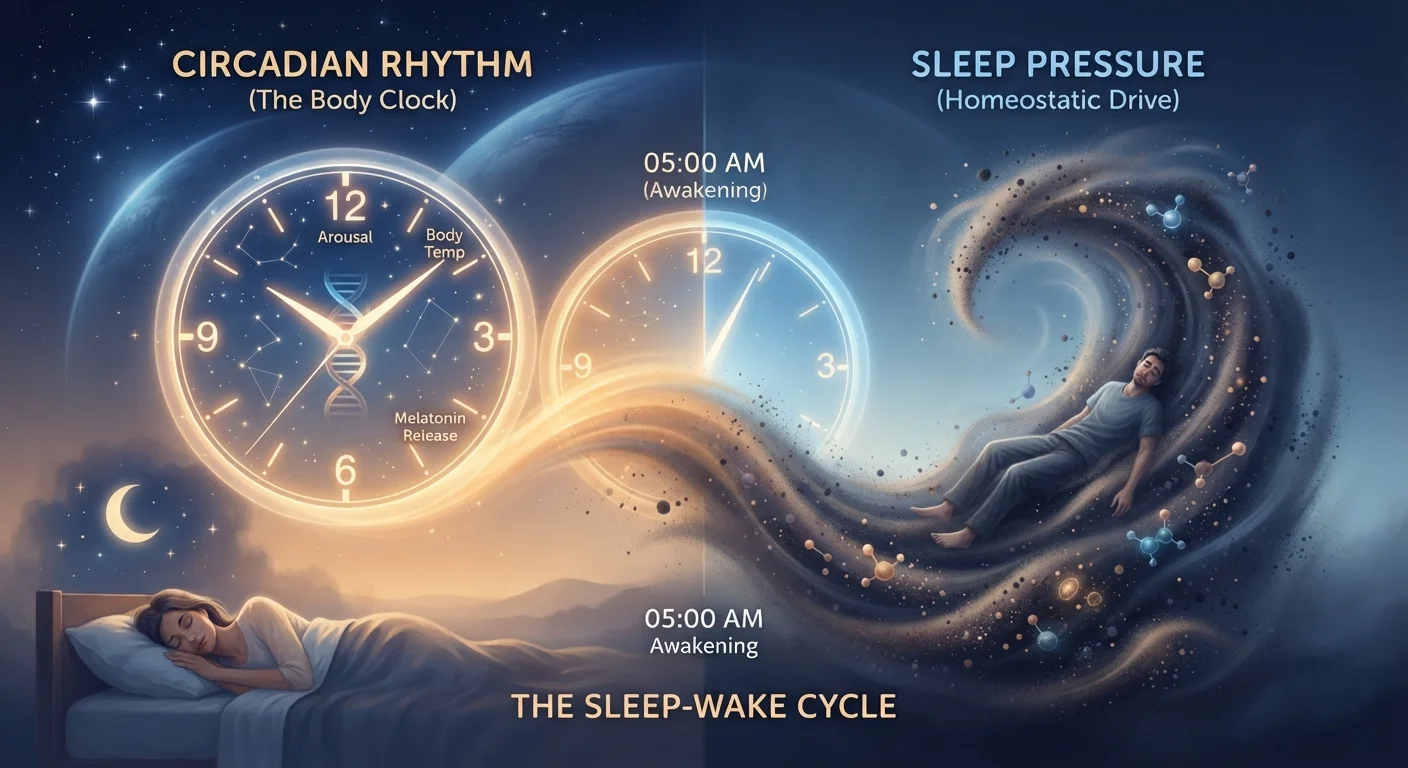
The SCN uses this input to do two things: suppress the production of melatonin (the hormone associated with sleep onset) and calibrate the timing of its own rhythms. Critically, the effect of light on your clock is not uniform across the day — it depends heavily on when the light arrives relative to your current circadian phase. This is what makes morning and evening light functionally opposite in their effects. To understand how these two clocks interact, see how circadian rhythm and sleep pressure work together.
Morning Light: Advancing Your Clock and Sharpening Your Wake Signal
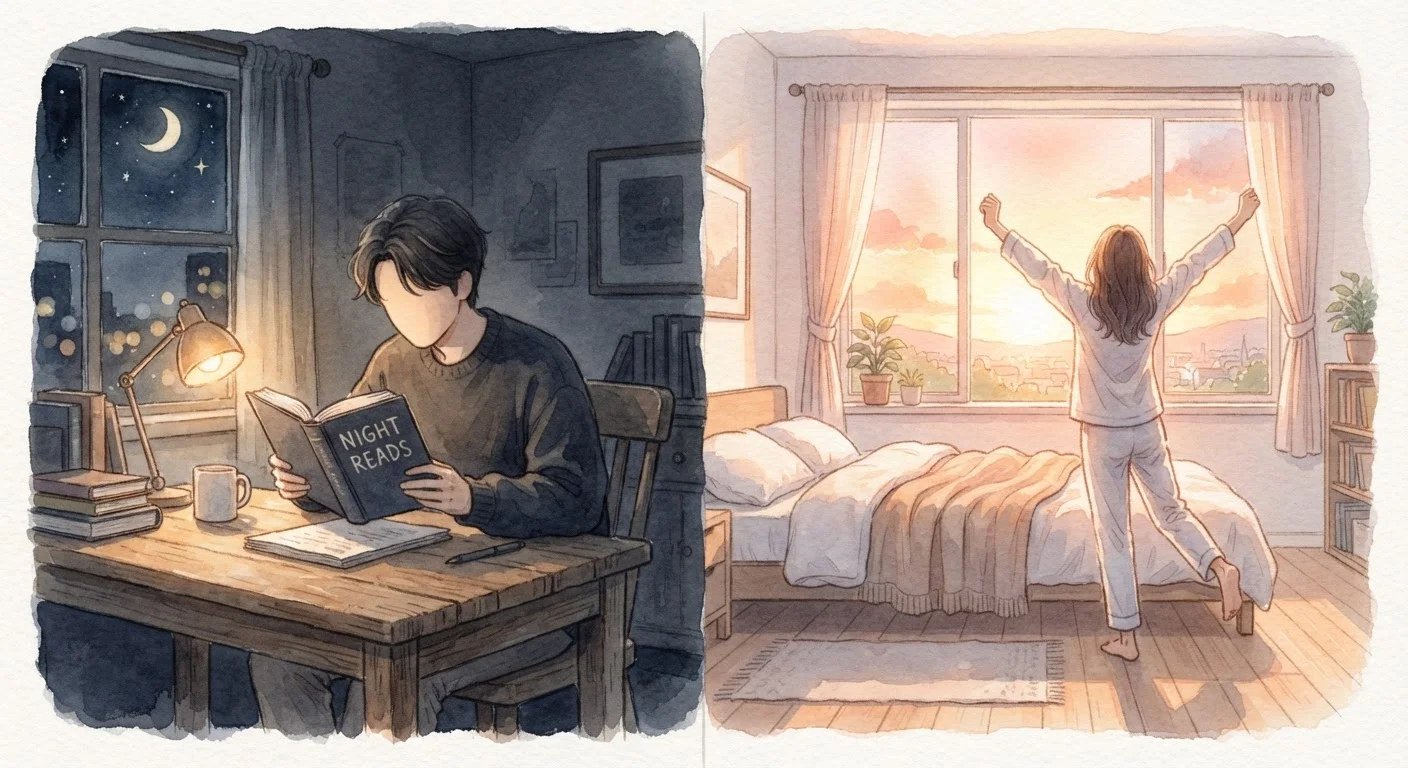
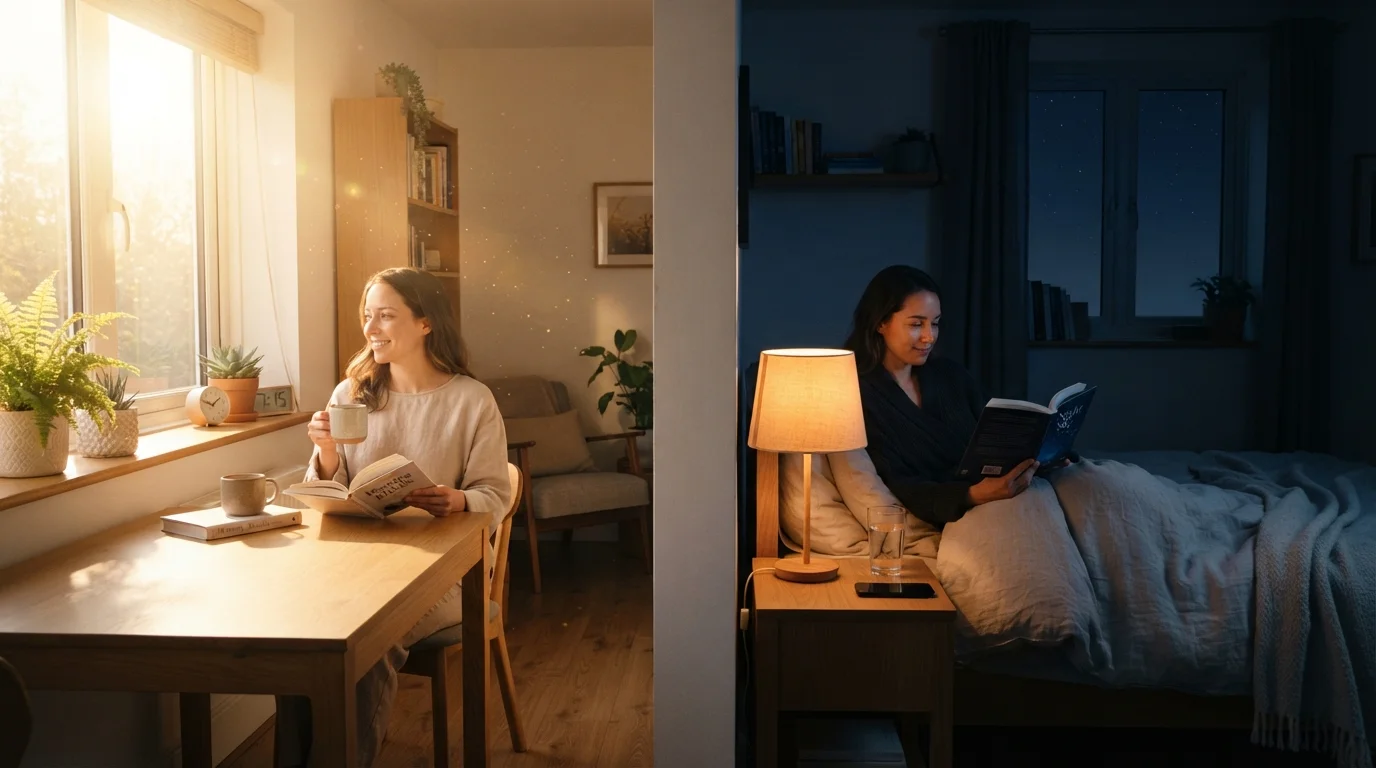
Light exposure in the morning — roughly within the first 1–2 hours after waking — falls on what chronobiologists call the advancing portion of the circadian phase-response curve. In practical terms, this means morning light shifts your internal clock earlier: it signals to your SCN that the day has begun, which in turn triggers a cascade that makes you feel alert sooner and sleepy earlier that night.
Research consistently shows that morning bright-light exposure elevates cortisol (supporting alertness), rapidly suppresses any residual melatonin from overnight, and helps consolidate the timing of subsequent melatonin release in the evening. A 2019 study published in Current Biology found that outdoor light exposure — even on overcast days — was significantly more effective at anchoring circadian timing than indoor light, because outdoor illuminance routinely exceeds 10,000 lux while typical indoor environments rarely exceed 500 lux.
The practical implication is straightforward: spending 10–30 minutes outdoors within an hour of waking, without sunglasses if safe to do so, is one of the highest-leverage behaviors for sleep timing. This matters especially if you feel your sleep schedule is drifting or you have difficulty waking. For a deeper look at why clock consistency matters beyond just hours slept, see why your body clock matters more than your bedtime.
| Criterion | Morning Light | Evening Light |
|---|---|---|
| Effect on circadian clock | Advances timing (earlier sleep, earlier wake) | Delays timing (later sleep, later wake) |
| Melatonin impact | Suppresses residual melatonin; aids alertness | Suppresses evening melatonin; delays onset |
| Cortisol response | Amplifies morning cortisol peak | Minimal direct cortisol effect |
| Most sensitive window | First 1–2 hours after waking | 1–2 hours before habitual sleep time |
| Ideal intensity | Outdoor light (>1,000 lux preferred) | Minimize; dim warm light (<10 lux ideal) |
| Practical action | Go outside shortly after waking | Dim lights; switch to warm-toned sources |
| Effect on sleep onset | Promotes earlier, more consistent onset | Delays and can fragment sleep onset |
Evening Light: Delaying Your Clock and Blunting Melatonin
Light arriving in the hours before your habitual sleep time falls on the delaying portion of the phase-response curve — it shifts your clock later, making it physiologically harder to feel sleepy at your intended bedtime. This is not a minor effect. Research published in the Journal of Clinical Endocrinology & Metabolism demonstrated that room-level indoor light before bed suppressed melatonin by approximately 50% and shortened melatonin duration by roughly 90 minutes compared to dim light conditions.
Screens are a common source of evening light exposure, and while blue light has been heavily emphasized in popular coverage, the evidence suggests that overall light intensity and duration matter at least as much as wavelength alone. Bright overhead lighting, televisions, and tablets all contribute. The actual research on screen time before bed paints a more nuanced picture than "blue light is the enemy," but the core finding holds: bright evening light of any spectrum delays sleep onset.
Practical strategies with solid evidence behind them include switching to dim, warm-toned lighting (amber or red spectrum) in the 1–2 hours before bed, using blackout curtains to block streetlight, and reducing overhead light in favor of lower, indirect sources. These changes can meaningfully preserve your natural melatonin window without requiring dramatic lifestyle overhaul. For a broader look at the sleep environment, see designing your bedroom for better sleep.
Putting It Into Practice: Timing Is Everything
The single most important shift most people can make is treating light as a scheduled input rather than a passive backdrop. Morning light is a tool; evening light is a variable to manage. Neither requires expensive equipment — the sun and a dimmer switch are sufficient for most people.
Individual responses vary based on your chronotype — your genetically influenced preference for earlier or later sleep and wake times. Night owls may need more consistent morning light exposure to counteract a naturally delayed circadian phase, while early risers may be more sensitive to evening light delays. Chronotypes are rooted in biology, not just habit, and understanding yours can help you calibrate these strategies more effectively.
A few evidence-informed principles to guide your approach:
- Seek outdoor light within 60 minutes of waking — even brief exposure on a cloudy day outperforms indoor lighting.
- Dim your environment 60–90 minutes before bed — transition from overhead to low, warm-toned lighting.
- Consistency amplifies the effect — your circadian system responds to patterns, not single exposures.
- Darkness matters at night too — a dark sleeping environment reinforces the light-dark contrast your clock depends on.
This article provides general health information for educational purposes only and is not a substitute for personalized medical advice. If you have concerns about sleep disorders, shift work, or circadian disruption, consult a qualified healthcare professional.