Why Sleep Exists: The Biological Imperative
Sleep is not simply the absence of wakefulness. It is a distinct, highly regulated biological state that evolution has conserved across virtually every animal species studied — a sign of how fundamental it is to survival. Researchers have proposed several overlapping theories to explain why organisms sleep, and the current scientific consensus is that sleep serves multiple critical functions simultaneously.
Among the most compelling discoveries of recent decades is the glymphatic system: a network of channels around brain blood vessels that, during sleep, flushes out metabolic waste products including amyloid-beta, a protein associated with Alzheimer's disease. This clearance process is dramatically more active during sleep than during wakefulness, suggesting the brain uses rest as a maintenance window it cannot replicate while running.
Sleep is also when the body secretes the majority of its daily growth hormone, repairs damaged tissues, consolidates immunological memory after vaccination or infection, and regulates hunger hormones such as leptin and ghrelin. In short, the question isn't why you need sleep — it's hard to name a major biological system that doesn't depend on it. For a broader plain-language overview, see Sleep Science for Beginners.
Circadian rhythm
An internal biological clock that runs on roughly a 24-hour cycle, regulating when you feel sleepy or alert based on environmental cues like light and darkness.
Adenosine
A chemical byproduct of brain activity that accumulates while you're awake, creating increasing pressure to sleep. Caffeine works by temporarily blocking adenosine receptors.
REM sleep
A stage of sleep characterized by rapid eye movements, high brain activity, vivid dreaming, and muscle paralysis. It is strongly linked to emotional processing and memory.
Slow-wave sleep
The deepest stage of non-REM sleep, defined by slow, high-amplitude brain waves. It is the most physically restorative phase and is when growth hormone is primarily released.
Glymphatic system
A recently discovered waste-clearance network in the brain that is most active during sleep, flushing out harmful proteins and metabolic byproducts.
Melatonin
A hormone produced by the pineal gland in response to darkness that signals to the body it is time to prepare for sleep. It does not directly cause sleep but helps time it.
Sleep pressure (homeostatic drive)
The biological urge to sleep that builds the longer you stay awake, driven by adenosine accumulation. It is cleared rapidly during the early cycles of deep sleep.
Suprachiasmatic nucleus (SCN)
A tiny cluster of cells in the brain's hypothalamus that acts as the master circadian clock, coordinating the timing of sleep, hormone release, and body temperature.
The Architecture of a Night's Sleep
A single night of sleep is not uniform. It progresses through a repeating cycle of four stages, classified by researchers using electroencephalography (EEG) — a technology that measures electrical patterns in the brain.
- N1 (light sleep): The brief transition from wakefulness, lasting just one to seven minutes. Muscle tone relaxes and brain waves slow from the alert beta pattern to slower alpha and theta waves.
- N2 (consolidated sleep): The most time-abundant stage across a full night. It features sleep spindles — bursts of synchronized neural activity thought to be important for motor learning and memory consolidation.
- N3 (slow-wave or deep sleep): Characterized by high-amplitude delta waves. This is the most physically restorative stage, when tissue repair and immune function peak. It is hardest to wake from and dominates early cycles of the night.
- REM (rapid eye movement sleep): The brain becomes nearly as active as during wakefulness, but voluntary muscles are temporarily paralyzed. This stage supports emotional regulation and declarative memory. It grows longer in later cycles, peaking in the final hours before waking.
Most adults complete four to six of these 90-minute cycles per night. Disrupting the cycle — through alcohol, fragmented sleep, or early alarms — disproportionately cuts REM sleep, since it clusters toward morning.
The Two Systems That Regulate Sleep
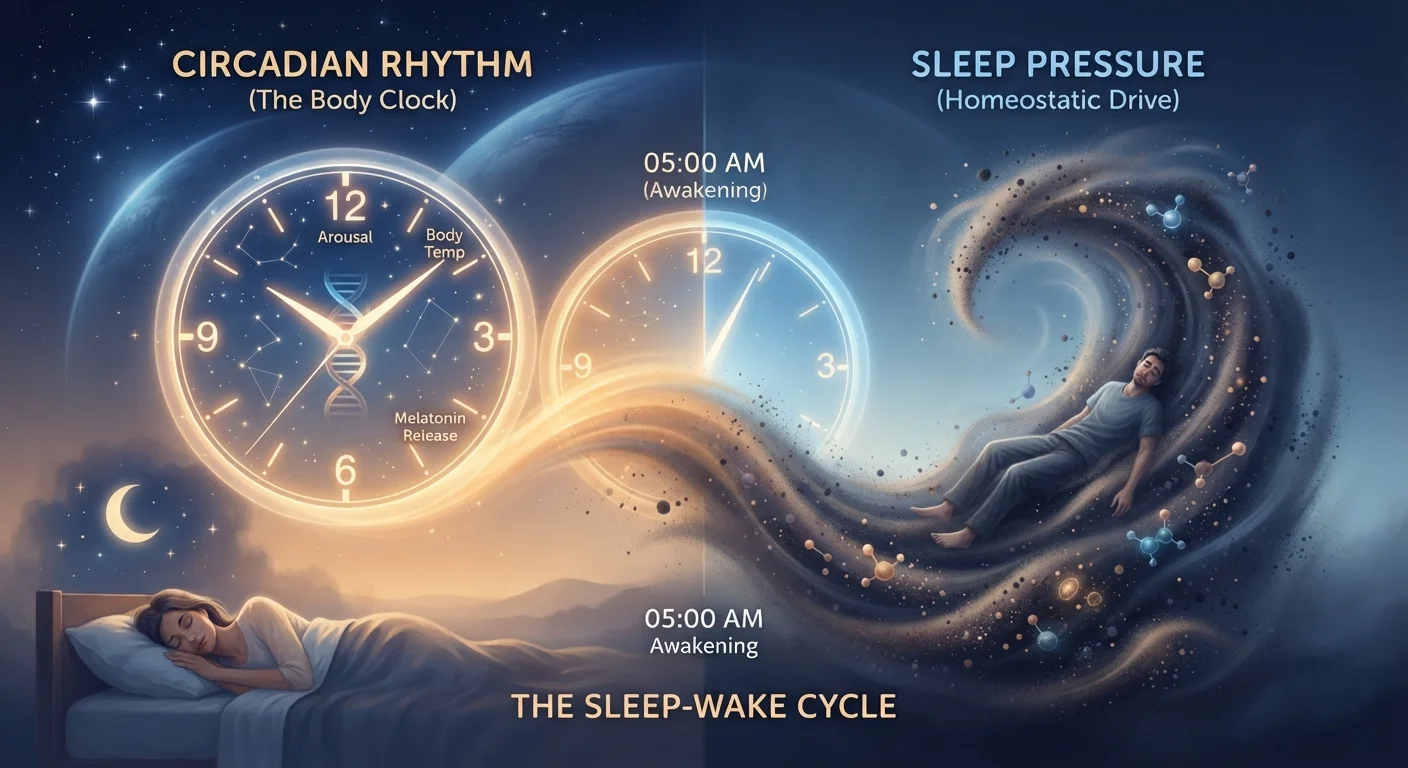
Sleep timing and depth are governed by two interacting biological systems, often called Process C and Process S.
Process C — The Circadian Clock: Located in the suprachiasmatic nucleus (SCN) of the hypothalamus, this internal clock runs on an approximate 24-hour cycle. It responds primarily to light: bright light in the morning suppresses melatonin and promotes alertness; fading light in the evening triggers melatonin release from the pineal gland, signaling the body to prepare for sleep. Core body temperature also follows a circadian curve — dropping in the evening and reaching its nadir around 4 a.m., which corresponds to peak sleepiness.
Process S — Sleep Pressure: From the moment you wake, adenosine — a byproduct of cellular energy use — accumulates in the brain. This builds what researchers call homeostatic sleep pressure. The longer you stay awake, the stronger the drive to sleep. Caffeine blocks adenosine receptors temporarily, which explains why it can delay but not eliminate this pressure. When you finally sleep, adenosine clears rapidly during the first deep sleep cycles.
Sync Morning Light With Your Clock
Getting bright natural light — ideally sunlight — within an hour of waking is one of the most evidence-supported ways to anchor your circadian rhythm. This helps set the timing of your evening melatonin release, making it easier to feel sleepy at an appropriate hour. Even on overcast days, outdoor light is far brighter than typical indoor lighting.
These two systems normally reinforce each other: circadian alertness peaks in the early evening just as sleep pressure is building, then both systems swing toward sleep at night. Disrupting either — through shift work, irregular schedules, or excessive artificial light — can degrade sleep quality independent of total hours. For more on the vocabulary behind these concepts, explore our Sleep Science Glossary.
What Happens to Your Body While You Sleep
The downstream effects of adequate — and inadequate — sleep touch nearly every organ system in the body.
- Brain and cognition
- Sleep stages work together to consolidate memories: N2 spindles transfer short-term learning; slow-wave sleep encodes declarative facts; REM sleep integrates emotional memories and supports creative problem-solving. Even a single night of significant sleep restriction measurably impairs working memory, reaction time, and executive function.
- Immune system
- During sleep, the body produces cytokines — proteins that coordinate immune responses. Studies have shown that people who sleep fewer than six hours before receiving a flu vaccine produce significantly fewer protective antibodies than those who sleep seven or more hours.
- Metabolism and hormones
- Insufficient sleep reduces insulin sensitivity and disrupts the balance of leptin (fullness hormone) and ghrelin (hunger hormone), increasing appetite — particularly for calorie-dense foods. Growth hormone, released primarily in deep slow-wave sleep, supports muscle repair and fat metabolism.
- Cardiovascular health
- Blood pressure naturally dips during sleep — a phenomenon called nocturnal dipping. Chronic short or disrupted sleep is associated with higher baseline blood pressure and elevated cardiovascular risk in large epidemiological studies, though establishing direct causation in humans remains complex.
It is worth noting that most of this evidence comes from population studies and short-term experimental restriction studies. Individual responses vary, and these associations do not mean that anyone who sleeps poorly will inevitably develop these conditions. Always consult a qualified healthcare professional about personal health concerns.
From Theory to Practice: Next Steps
Understanding the mechanics of sleep gives you a more reliable foundation than any single piece of habit advice. When you know that adenosine drives sleep pressure, you can evaluate caffeine timing more thoughtfully. When you understand circadian rhythm, morning light exposure stops being a vague tip and becomes a purposeful biological intervention.
That said, translating science into lasting behavior change is its own discipline. For a practical roadmap, The Complete Guide to Building Lasting Sleep Habits walks through evidence-supported routines from evening wind-down to wake-time consistency. And if you want to evaluate which popular sleep advice is firmly backed by research versus which is softer habit guidance, Sleep Hygiene vs. Sleep Science offers that critical comparison.
Sleep science is a rapidly evolving field — some mechanisms described here represent established consensus, while others, such as the precise role of the glymphatic system in humans, are still being actively investigated. Maintaining that distinction between what is known and what is still emerging is part of what it means to be a well-informed reader on this topic.
Sleep Science Glossary
A plain-language reference covering the most commonly used terms in sleep science, from adenosine to slow-wave sleep. Useful for building a stronger vocabulary as you read further.
American Academy of Sleep Medicine (AASM)
The professional organization for sleep medicine clinicians and researchers publishes patient-facing educational resources grounded in clinical evidence, including guidance on common sleep disorders.
National Sleep Foundation
A nonprofit organization that publishes research-based sleep duration recommendations and educational content for general audiences on sleep health across the lifespan.
This article is for general informational and educational purposes only and does not constitute medical advice. If you have concerns about your sleep or health, consult a qualified healthcare professional.